You Have Decided to Divorce. The Court Gave You Blank Forms. Nobody Told You What Happens Next.
The Regional Court hands you a Combined Summons and a Particulars of Claim. Two blank forms. No instructions. The clerk behind the counter is not allowed to tell you how to fill them in, which court has jurisdiction, or what to do after the forms are done. You walk out of the courthouse holding paperwork that means nothing until a sheriff physically serves it on your spouse — and nobody explained that part either.
Meanwhile, family law attorneys charge R1,500 to R3,000 per hour. An uncontested divorce with a lawyer costs R5,000 to R25,000. Automated document platforms like DiyLaw charge R1,250 just to generate the papers — and still do not tell you how to file them, how to get the sheriff to serve them, or how to draft a settlement agreement the court will actually accept.
You do not need someone to fill in the forms for you. You need someone to walk you through the process — step by step, from jurisdiction check to Home Affairs registration — so you know what to do, in what order, and what to watch for.
The Filing Process Navigator
This is not a forms packet. It is a step-by-step process manual that walks you through every administrative action your South African divorce requires — from verifying which court has jurisdiction to updating your marital status at Home Affairs after the decree is granted.
You start by confirming your eligibility and gathering documents. Then you work through drafting the combined summons, arranging sheriff service, navigating the three possible paths after service (uncontested, default, or contested), drafting a settlement agreement that the court will accept, and completing the Statistics South Africa form. By the end, you have a clear, sequenced workflow — not a pile of papers and a prayer.
Whether you are filing without a lawyer, preparing for mediation, or trying to understand what your attorney should be doing, this guide turns the South African divorce process into a checklist you can follow.
What Is Inside — 15 Chapters Plus 10 Standalone Worksheets
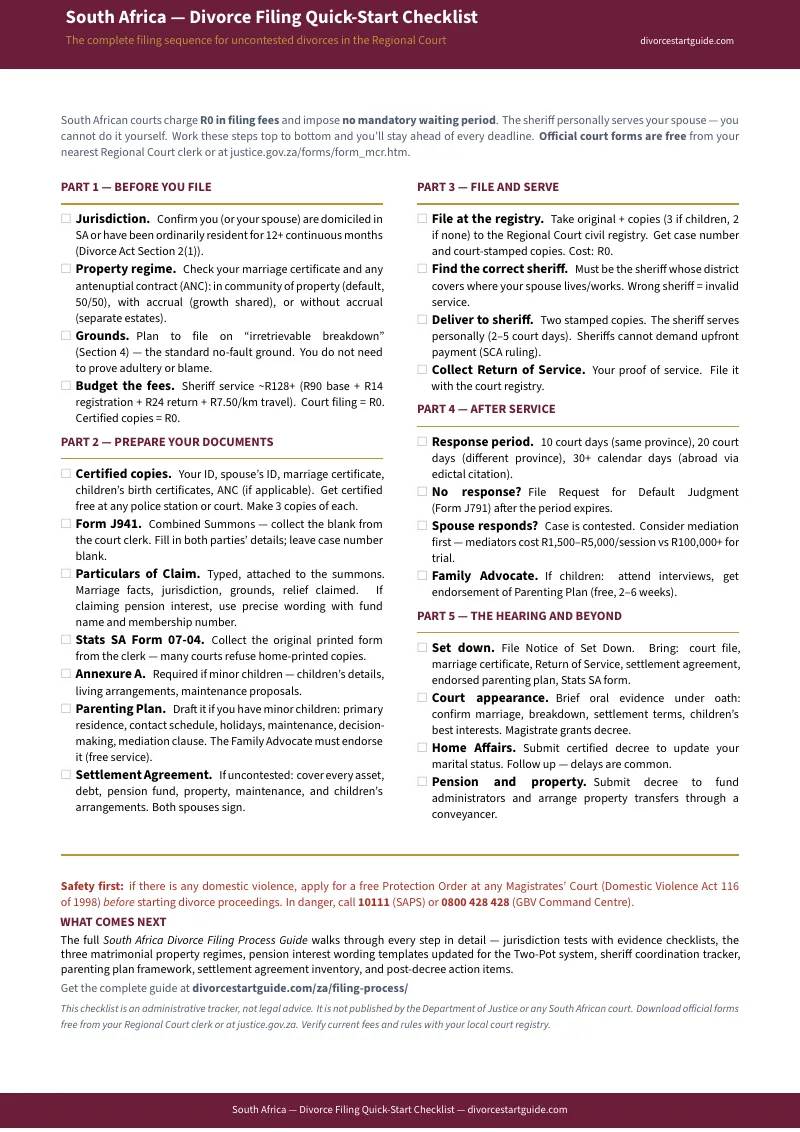
The complete guide plus 10 printable standalone worksheets you can bring to the courthouse, the sheriff's office, or the Family Advocate's enquiry:
- Jurisdiction Self-Assessment — work through the residency requirements, determine whether to file in Regional Court or High Court, and confirm which courthouse serves your area. Includes the domicile vs. ordinary residence distinction that trips up cross-border couples.
- Matrimonial Property Regime Identifier — determine whether you are married in community of property, out of community with accrual, or without accrual — the answer shapes everything about how assets get divided.
- Document Readiness Tracker — every form, certificate, and supporting document listed in filing order. Covers your ID, unabridged marriage certificate, antenuptial contract (if applicable), children's birth certificates, and the Statistics South Africa GPF form that many filers do not know exists.
- Combined Summons Drafting Guide — a section-by-section walkthrough of the Particulars of Claim. Shows you what the court needs to see in each paragraph — grounds for divorce, relief sought, property regime, and children's arrangements — with plain-language explanations of the legal formulas.
- Sheriff Service Coordination Tracker — how to find the correct sheriff for your spouse's address, what to deliver, the gazetted fee tariff (R90 flat fee plus R7.50 per kilometre), and what to do if service fails on the first attempt. Includes the SCA ruling that sheriffs cannot demand upfront deposits.
- Three-Path Decision Framework — after the sheriff serves the papers, your case takes one of three directions. This worksheet helps you identify which path you are on (uncontested, default, or contested) and maps the next steps for each route.
- Settlement Agreement Inventory — catalogue every asset and debt before drafting your settlement agreement. The structure your agreement needs to follow so the court endorses it as a court order.
- Pension Interest Clause Templates — exact wording for Section 7(7) and Section 7(8) pension claims under the Divorce Act, updated for the Two-Pot retirement system. Includes the fund name, membership number, and Section 37D(4) transfer directive that fund administrators demand — vague wording gets your claim rejected.
- Parenting Plan Framework — the structure the Family Advocate reviews during the enquiry. Covers living arrangements, contact schedules, education and healthcare decisions, and maintenance contributions, aligned with the Children's Act requirements.
- Post-Decree Administration Checklist — every step after the court grants your decree: updating Home Affairs, banking records, insurance policies, medical aid membership, and school enrolment. Includes the DHA database delay workaround that prevents your marital status from blocking remarriage or emigration.
Who This Guide Is For
- Self-represented filers navigating the South African divorce process without a lawyer — you need the process sequence, not just blank forms
- Couples filing by consent who agree on everything but need help translating their agreement into documents the court will accept
- People earning above the Legal Aid means test (R9,400/month individual threshold) who cannot afford private attorney fees but do not qualify for free legal representation
- Expats and cross-border couples who need to confirm South African court jurisdiction and understand how foreign property laws interact with the Divorce Act
Why Not Just Use the Free Court Forms?
The blank Combined Summons from your nearest courthouse is free. It should be. But a blank form does not tell you which court has jurisdiction over your marriage. It does not explain the difference between community of property and out of community with accrual — or why that distinction determines everything about how your assets get divided. It does not warn you that a vague pension interest clause will be rejected by the fund administrator, costing you months.
The Department of Justice FAQ page covers the basics in two paragraphs. It does not explain how to arrange sheriff service, how to draft a parenting plan the Family Advocate will endorse, or how the Two-Pot retirement system changes what your spouse can claim from your pension fund.
DiyLaw generates documents for R1,250. iDivorce starts at R1,000 and goes up to R8,500. Neither explains the filing sequence, the sheriff service process, or what happens after you file. You get papers — not a process.
This guide covers the entire workflow from first decision to final registration, in plain language, with fillable worksheets for every step that requires one.
Satisfaction Guarantee
If the guide does not help you navigate your South African divorce filing process, email us and we will make it right. No fine print.
— Less Than One Hour of a Family Law Attorney's Time
South African family lawyers charge R1,500 to R3,000 per hour. Most self-represented filers spend weeks piecing together the process from government FAQ pages, legal blogs, and courthouse visits. This guide compresses the entire workflow into a structured, sequential process with fillable worksheets and the exact wording your documents need.
Download the free checklist to see the filing steps at a glance. When you are ready for the full process navigator — with drafting guides, pension clause templates, and the complete post-decree administration sequence — the guide is here.