You Agreed to Divorce. Nobody Told You What to File Next.
You and your spouse agree: the marriage is over. Maybe the conversation was painful, maybe it was a relief — but the decision is made. Now you need to actually do it.
So you search online. You find your court's self-help page. You download a petition form, a summons, a financial affidavit, and something called a "case information sheet." And then you stare at them. Which one goes first? What financial data do you need before you start filling anything in? How do you "serve" your spouse if they're already sitting across the kitchen table?
The court clerk can hand you forms but is legally prohibited from telling you how to complete them. Free legal aid has a six-month waitlist and a domestic-violence priority filter most applicants don't pass. An attorney wants $2,500 to $5,000 just to start — for paperwork you could file yourself if someone showed you the operating sequence.
The Process-Navigation System: What Goes Where, and When
The DIY Divorce Without a Lawyer Guide is not a stack of blank court forms (your court provides those free) and it's not legal advice (we'll tell you clearly when you need a lawyer). It's the Process-Navigation System — a 38-page workbook that gives self-represented filers what the court system doesn't: the step-by-step operating sequence from pre-filing assessment through final decree.
Every chapter follows the actual chronology of an uncontested divorce case. You organize your data in the worksheets before opening a single court form — so when you do sit down to file, your numbers are clean, your documents are gathered, and the clerk has no reason to send you back.
What's Inside: 13 Printable PDFs
- 38-Page Process-Navigation Workbook — the full guide covering every phase from pre-filing assessment through final decree, with worksheets, flowcharts, and local rules diagnostics
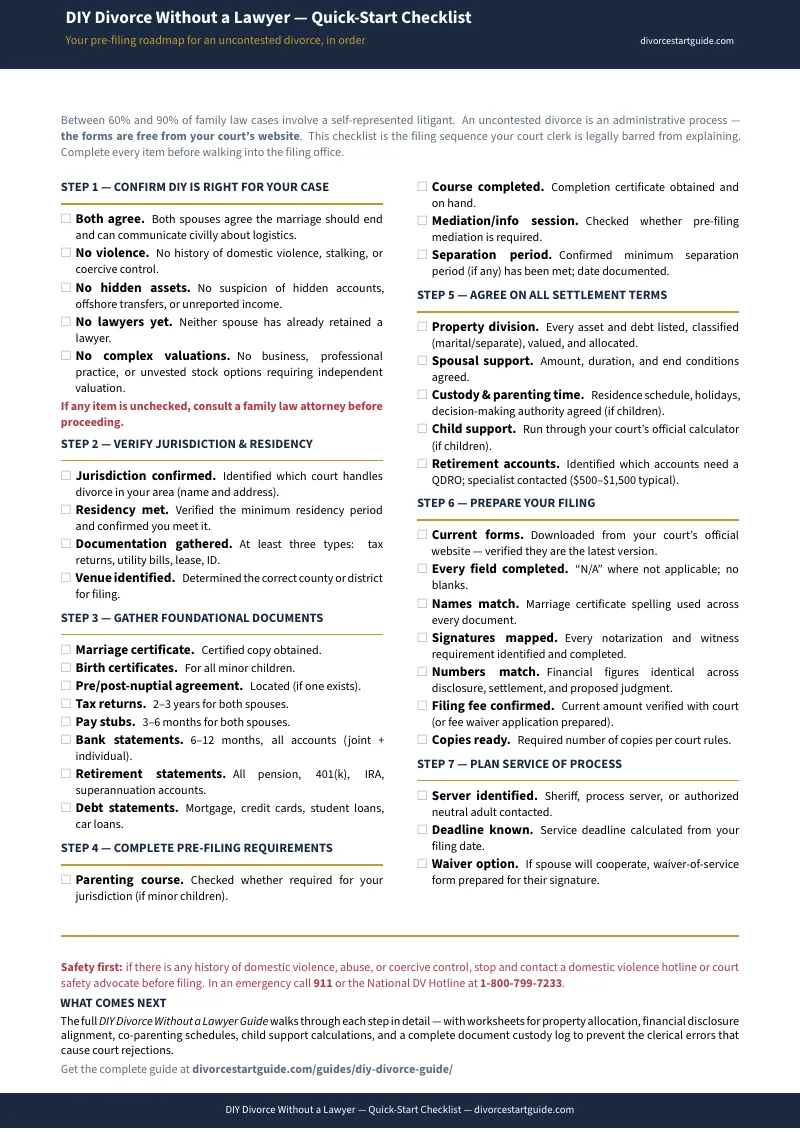
- Quick-Start Checklist — 20 action items across 7 steps, designed to get your case organized in a single focused weekend
- DIY Qualification Checklist — a green-light/red-flag assessment so you know within 10 minutes whether your case is safe to self-file or needs professional help
- Residency Documentation Worksheet — confirm your court has authority to hear your case before you spend a dollar on filing fees, plus local rules diagnostic questions
- Document Gathering Worksheet — organized by category (financial accounts, real estate, vehicles, insurance, debts) with exact items to collect, plus separation date documentation
- Pre-Filing Requirements Checklist — mandatory steps to complete before your court will accept a filing, plus signature and notary requirements for every document
- Settlement Agreement Worksheets — property allocation, co-parenting schedule, and child support calculation worksheets to organize your proposed terms before transferring them to court templates
- Filing Verification Worksheet — a pre-filing checklist that catches the errors that get self-filers sent back from the clerk's window
- Service of Process Tracker — track every step of serving your spouse, with deadline calculation and common mistakes to avoid
- Financial Alignment Matrix — verify that every figure matches across your disclosure, settlement agreement, and proposed judgment before filing
- Retirement Account Division Worksheet — QDRO requirements, account division tracker, and when to get professional help
- Submission Checklist — final check before the judge reviews your file, plus what to bring if a hearing is required
- Post-Divorce Action Tracker — administrative tasks after your decree is final (tax, insurance, beneficiaries, property titles, name change)
Who This Is For
- The budget-conscious filer — you don't qualify for legal aid, you can't afford $300/hour attorney billing, but you're capable of managing your own paperwork with the right structure
- The amicable couple — you and your spouse agree on the basics and want to finalize without lawyers escalating a cooperative split into an adversarial proceeding
- The organized self-helper — you approach this as a project with steps, deadlines, and deliverables, and you want the checklist, not the lecture
- The respondent — you were served papers and need to understand your timeline, response options, and how to participate in the settlement process
Why Not Just Use Free Online Resources?
You absolutely can. Court websites provide blank forms. DivorceNet and Nolo publish excellent articles on specific topics. But here's what free resources don't give you:
A unified operating sequence. Free information is scattered across hundreds of pages, organized by topic rather than by the order you actually need it. You'll read about service of process before you understand what financial data to gather — or you'll start filling out forms before organizing your asset inventory, then discover you need to redo everything because your numbers don't reconcile.
Worksheets that feed into court forms. The guide's worksheets are designed so that when you open your court's official financial affidavit or settlement agreement template, you can transfer your organized data directly — cell by cell — instead of assembling it from bank statements, tax returns, and sticky notes in real time.
A clear "stop and get help" signal. Free resources rarely tell you when your case has crossed the line from "administrative filing" to "you need a lawyer." This guide marks those thresholds explicitly — hidden assets, contested custody, pension divisions, business valuations — so you don't discover you needed professional help after making an irreversible filing error.
What This Guide Is Not
It is not a form generator, a document-preparation service, or a legal advice platform. It does not replace an attorney for contested divorces, complex estates, or cases involving domestic violence. It is a process-navigation workbook — an educational tool that helps you organize your case so you can file your own paperwork correctly, or hand an attorney a clean file that saves you thousands in billable hours.
Your Purchase
For , you get the complete workbook and checklist — a one-time purchase with lifetime access. No subscription, no monthly fees, no recurring charges to keep your documents accessible.
Not ready to commit? Download the free Quick-Start Checklist first — 20 action items to get your case organized this weekend. If the checklist shows you the process makes sense, the full guide gives you every worksheet and framework to complete it.