Your State's Calculator Is Free. Knowing What Numbers to Enter Is the Hard Part.
Every state has a child support calculator. It's free, it's online, and it will spit out a number in seconds.
But here's what the calculator page doesn't tell you: the result is only as accurate as the numbers you type in.
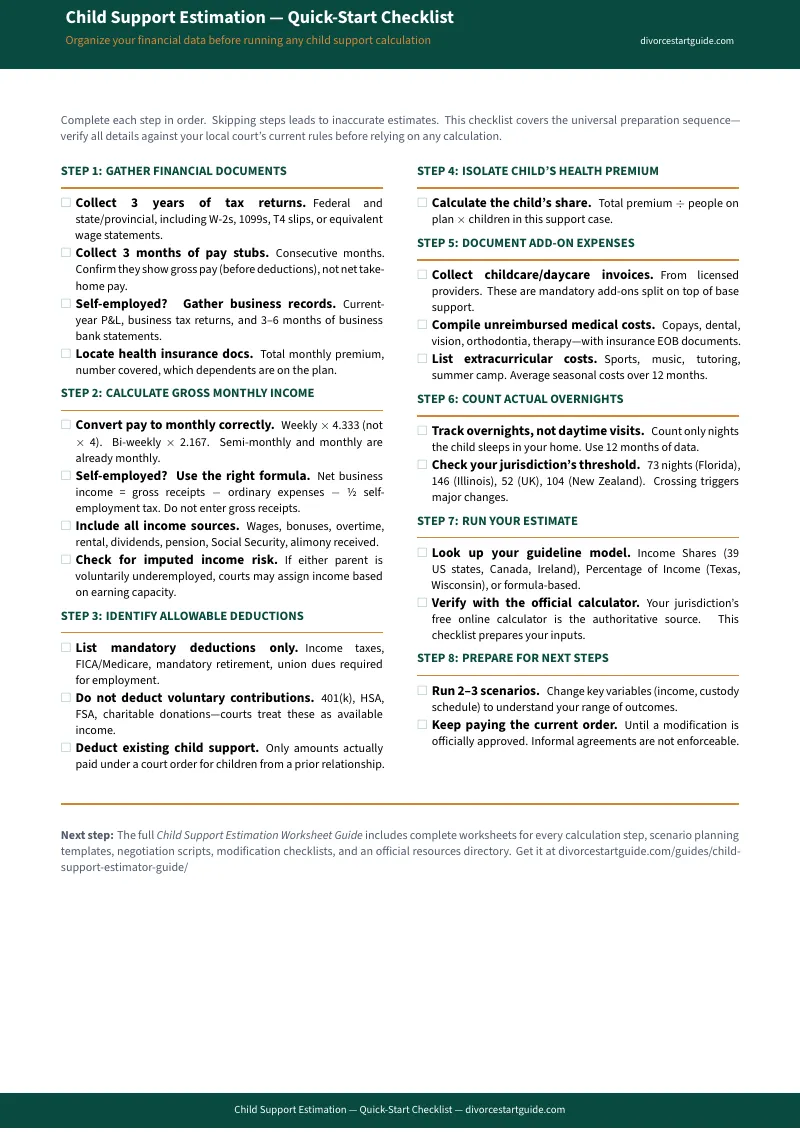
Enter your raw paycheck amount instead of your court-adjusted gross income, and the estimate is wrong. Miss a mandatory deduction, and it's wrong. Use the wrong weekly-to-monthly multiplier (hint: it's 4.33, not 4), and it's wrong. Forget to account for your child's share of the health insurance premium — wrong again.
And "wrong" isn't an abstraction. A miscalculated child support number can follow you for years — built into a court order that costs hundreds of dollars and months of paperwork to modify.
The Pre-Calculator Preparation System
The Child Support Estimation Worksheet Guide is the step-by-step preparation workbook that sits between your pay stubs and your state's calculator. It walks you through locating every number the calculator needs, cleaning it into the format courts actually use, and running your own estimate before you sit down with a mediator, an attorney, or a judge.
This isn't a replacement for the court's worksheet — it's the user manual the court's worksheet should have come with.
What's Inside
- Income Calculation Worksheets — separate printable tracks for W-2 employees, self-employed parents, and parents with variable income. Each one walks you through the specific adjustments courts make — including the weekly-to-monthly conversion factor that trips up most parents, and the self-employment tax deduction you're probably not accounting for.
- Deduction Auditing Worksheet — a line-by-line review of which payroll deductions courts allow (union dues, mandatory retirement) and which ones they add back to your income (voluntary 401k, HSA contributions). Plus the formula to isolate your child's share of a family health insurance premium — one of the most commonly misreported numbers in support calculations.
- Parenting Time Overnight Tracker — courts don't care about your "general schedule." They count overnights. This printable 12-month tracker helps you document actual overnights and shows you where the threshold cliffs are — the specific overnight counts that trigger major formula changes in states like Florida, Illinois, and Ohio.
- Three Calculation Models Explained — Income Shares (used by 39 states), Percentage of Income (used by 9 states including Texas and Wisconsin), and the Melson Formula (used by Delaware, Hawaii, and Montana). Each model gets a plain-language explanation and a fill-in worksheet so you can run your own estimate regardless of where you live.
- Add-On Expense Organizer — separate categories for mandatory add-ons (childcare, uninsured medical) and discretionary extras (sports, tutoring, summer camps). Shows you how to calculate each parent's pro-rata share and document everything courts expect to see.
- Scenario Comparison Worksheet — run side-by-side estimates for different custody arrangements, income assumptions, or expense scenarios. Useful when you're negotiating and need to see how specific changes affect the bottom line.
- Modification Checklist — if you already have a support order and circumstances have changed, this covers the legal standard for modification, walks you through recalculating with updated numbers, and lists the documents you'll need to file.
- Mediation Preparation Checklist — everything to complete before sitting down with a mediator, including negotiation scripts for proposing guideline-based agreements, splitting add-on expenses, and addressing changed circumstances.
- Document Gathering Tracker — a printable checklist of every financial document you need before starting calculations, so nothing gets missed.
Who This Is For
- Parents preparing for a first child support hearing — you need to know the approximate number before you walk into court so you can budget, negotiate, and spot errors in the other side's figures.
- Parents heading into mediation — a mediator expects both parties to come with financial data. This guide helps you organize yours into the format the process requires.
- Parents checking a proposed support amount — if your ex or their attorney has proposed a number, this guide lets you reverse-engineer whether it's based on accurate inputs.
- Parents considering a modification — job loss, custody changes, a child aging out — any major change could justify a new calculation. This guide helps you run the updated numbers before you pay filing fees.
- Self-employed parents — the standard calculator assumes you already know your court-adjusted gross income. If you're self-employed, you probably don't. The self-employment chapter walks you through it.
Why Not Just Use Free Tools?
You should use the free calculator — it's the official tool. This guide doesn't compete with it. It prepares you for it.
The gap in every free resource — whether it's the state's self-help page, a legal blog, or a generic online template — is the same: they tell you what to calculate but not how to find and prepare the numbers that go into the calculation.
They don't explain that your "take-home pay" includes voluntary deductions a judge will add back. They don't warn you that multiplying your weekly pay by 4 (instead of 4.33) can throw your annual figure off by an entire month of income. They don't show you how to isolate your child's health premium from a family plan, or how to calculate a "theoretical support order" for children from a prior relationship.
That's the gap this guide fills. Not the calculation itself — the preparation that makes the calculation accurate.
Satisfaction Guarantee
If the guide doesn't help you organize your financial data for a child support estimate, email us for a full refund. No hoops, no deadlines.
Get the Estimation Worksheets — or Start With the Free Checklist
The free checklist gives you a quick-start overview of what to gather and how the process works. The full guide gives you the worksheets, calculation walkthroughs, and scenario-planning tools to actually run your numbers.
For , you get a preparation system that would take hours to piece together from scattered free sources — organized into one walkthrough that works regardless of which state or country you're in.