You built this company. Now a forensic accountant is telling the court what it's worth — and nobody asked you.
Your business is about to be valued by someone who has never walked the floor, never met your clients, and never seen the 80-hour weeks that built the thing. Their number goes into a formula. That formula determines how much your spouse gets. And if your attorney doesn't catch the difference between personal goodwill and enterprise goodwill, that number could be inflated by hundreds of thousands of dollars — money the business doesn't actually have.
Meanwhile, your normalized income is being calculated for the property division. The same income is being used again to set spousal support. That's double-dipping — and in many jurisdictions it's avoidable, but only if you catch it before the settlement is signed.
Free court forms tell you what to file. Your lawyer tells you what your rights are. But neither one teaches you how to organize five years of general ledgers before discovery, how to document the difference between your personal reputation and your company's brand value, or how to model a buyout structure that keeps the business alive after the decree.
The Business Owner's Divorce Preparation System
This guide is built on one idea: the business owner who walks into every meeting with organized financials, informed questions, and a clear understanding of valuation concepts will spend less on professional fees and get a better outcome than the one who hands their attorney a box of unsorted bank statements.
It is not a valuation service. It is not legal advice. It is a process-navigation and financial-organization toolkit that turns the chaotic, adversarial experience of divorcing with a business into a structured preparation workflow — so your $400-per-hour professionals spend their time on strategy, not sorting your paperwork.
For — less than a single six-minute increment of your attorney's billable time — you get the organizational frameworks and worksheets that make every subsequent professional interaction more efficient and more informed.
What's inside — 12 PDFs and the mistake each part prevents
- Complete Business Owner's Divorce Guide (guide.pdf) — 16 chapters covering preparation, property classification, valuation methods, goodwill, double-dipping, temporary orders, expert coordination, tax traps, buyout structures, and post-decree implementation across 8 jurisdictions. Prevents: walking into professional meetings unprepared and paying $400-per-hour rates for basic education.
- Financial Disclosure Document Tracker (financial-disclosure-tracker.pdf) — printable 2-page organizer for 22 categories of corporate records your spouse's attorney will subpoena. Prevents: your attorney billing you to sort bank statements you could have organized yourself.
- Normalization Self-Audit Worksheet (normalization-self-audit.pdf) — identify every personal expense a forensic accountant will add back to your earnings before they find it first. Prevents: being blindsided by a valuation that's inflated by discretionary expenses you forgot were on the corporate books.
- Valuation Method Decision Tree (valuation-decision-tree.pdf) — printable flowchart showing which valuation approach is most likely for your business type, with personal vs. enterprise goodwill implications. Prevents: nodding through a $10,000 appraisal without understanding whether the method chosen was the right one.
- Buyout Scenario Comparison (buyout-comparison.pdf) — side-by-side modeling worksheet for asset offset, installment note, and corporate share redemption, with tax and cash flow projections for each. Prevents: agreeing to a buyout structure that keeps the business on paper but drains its operating capital in practice.
- Tax Impact Comparison Worksheet (tax-impact-comparison.pdf) — calculate the after-tax reality of each settlement element so a "50/50" split doesn't become 60/40 after embedded capital gains. Prevents: structuring a "tax-free" transfer that triggers an unexpected capital gains bill.
- Monthly Cash Flow During Divorce (cash-flow-worksheet.pdf) — maps personal income, expenses, and business obligations during the interim period between filing and resolution. Prevents: agreeing to temporary support terms that starve the business of operating capital.
- Evidence Log: Active vs. Passive Growth (evidence-log.pdf) — landscape tracking worksheet for documenting whether business value changes were driven by your labor or external forces. Prevents: losing a separate-property argument because you never documented that growth was passive.
- Stakeholder Communication Scripts (stakeholder-scripts.pdf) — ready-to-use scripts for co-owners, board members, clients, and employees, with a disclosure guide showing what to share and what to withhold. Prevents: operational panic from a poorly timed or poorly worded announcement.
- Mediation Preparation Checklist (mediation-prep.pdf) — documents to bring, advantages of mediation for business owners, and the BATNA framework for evaluating settlement offers. Prevents: walking into mediation without a proposal and reacting instead of negotiating.
- Post-Decree Checklist (post-decree-checklist.pdf) — corporate clean-up, estate planning updates, and settlement execution steps with time-sensitive filing deadlines. Prevents: missing QDRO deadlines or leaving your ex-spouse as beneficiary on retirement accounts.
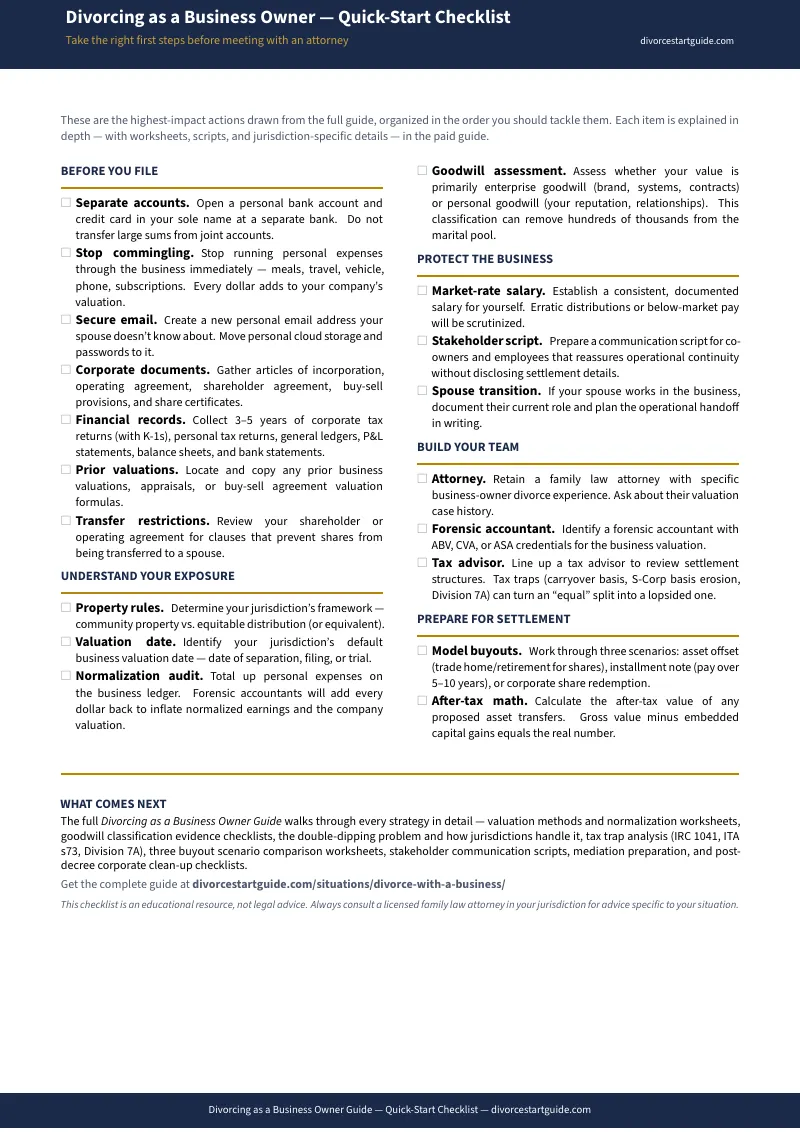
- Quick-Start Checklist (checklist.pdf) — 20-item condensed action list for the financial separation, document preservation, and expert coordination steps to act on immediately. Prevents: missing the pre-filing preparation window when you have the most strategic advantage.
Who this is for
- You own a business — sole proprietorship, LLC, S-Corp, partnership, or professional practice — and a divorce is forcing you to explain its value to a court.
- You want to keep the business but have no idea how to structure a buyout your spouse will accept and your company can survive.
- Your attorney keeps referencing "normalized earnings," "enterprise goodwill," and "add-backs" and you need to understand the concepts before your next meeting — not after.
- You are facing financial discovery and need an organizing framework for five years of corporate records before the deadline hits.
- Your spouse worked in the business and you need to understand how their contribution affects the valuation and the property division.
- You have a forensic accountant, a valuator, and a lawyer on your team — and you want to walk into every meeting prepared, not paying them to explain basic concepts at $400 an hour.
Why not free resources?
Because they stop exactly where the hard part starts.
- Law firm blog posts explain that business valuation exists — then tell you to call for a free consultation. No worksheets, no organizing frameworks, no preparation system.
- Nolo and LegalZoom ($25–$500) cover general divorce financials for W-2 wage earners. Business valuation gets a chapter; goodwill classification gets a paragraph; double-dipping gets a footnote. None of them give you a worksheet for organizing discovery documents or modeling a buyout.
- Certified Divorce Financial Analysts ($2,000–$5,000) provide deep, personalized financial analysis — after you've assembled your records and can explain your business structure. This guide helps you arrive at that engagement organized, so their billable hours go to analysis rather than document collection.
- A family law attorney ($350–$500/hour) handles courtroom strategy and negotiation. But at those rates, using your attorney to organize bank statements, explain what an add-back is, or walk you through basic valuation concepts is the most expensive education you'll ever buy.
This guide is the preparation layer underneath all of those: the organizational system that makes every professional interaction more efficient, more informed, and less expensive.
An honest promise
This is an educational process-navigation and financial-organization tool. It is not legal advice, it does not replace a qualified attorney or forensic accountant, and it will tell you plainly when your situation requires professional representation. Every jurisdiction handles business valuation, goodwill classification, and property division differently — the guide maps the universal preparation work and flags exactly where local rules diverge.
Try it. Work through the financial discovery organizer and the buyout modeling templates. If it doesn't give you more clarity and control over your business divorce than anything else you've found, reply to your receipt and we'll make it right.
Start where you are
Download the free Quick-Start Checklist — 20 actionable items covering the financial separation, document preservation, and expert coordination steps most business owners miss. If the checklist alone saves you one hour of professional fees, it's done its job.
When you're ready for the full system — 12 printable PDFs covering valuation breakdowns, buyout modeling, tax impact analysis, discovery organizers, communication scripts, and expert coordination checklists — get the complete guide for .