You don't have a legal problem yet. You have a filing problem.
Your divorce will eventually require court forms, financial affidavits, disclosure schedules, and probably a settlement agreement. Every court in every jurisdiction hands you those forms for free. What no court, no self-help website, and no free download gives you is a system for collecting the hundreds of documents those forms require you to reference, attach, or summarize.
Three to five years of tax returns with all schedules. Monthly statements from every bank, brokerage, retirement, and credit card account. Mortgage documents, vehicle titles, insurance policies, business records if applicable. Property deeds, appraisals, pension plan summaries. Your children's school enrollment records, medical expenses, daycare invoices, extracurricular costs. Digital assets — loyalty program balances, cryptocurrency holdings, income-producing online accounts.
Right now, that information is scattered across filing cabinets, email inboxes, online portals, shared cloud drives, glove compartments, and your spouse's desk. And every day you spend without a system for gathering it is a day closer to a disclosure deadline, a mediation session, or an attorney meeting where you'll pay hundreds of dollars per hour while someone sorts through what you could have organized yourself.
The Case-Stage Filing System
The Divorce Document Organizer & Checklist is a 14-chapter process-navigation toolkit built around one structural idea that separates it from every generic checklist and Etsy template: your document needs change at each phase of your case, and your organizational system should reflect that.
Generic checklists give you one flat list of documents and leave you to figure out what's urgent, what can wait, and what you didn't know you needed until a court deadline made it critical. The Case-Stage Filing System organizes your document collection into the actual phases of a divorce case — pre-filing, case initiation, mandatory disclosure, negotiation and settlement, and post-decree transition — so you always know which records to prioritize right now and which ones to queue for later.
It is jurisdiction-neutral by design. The documents you need to collect are fundamentally the same whether you file in California, Ontario, England, or New South Wales. Where local rules create variation — community property versus equitable distribution, mandatory disclosure timelines, specific court form requirements — the guide flags those touchpoints with Local Law Checkpoints and tells you exactly what to verify.
What's Inside
Filing System Blueprint — step-by-step setup instructions for both a physical binder with labeled divider sections and a mirrored digital folder structure. Includes a standardized file-naming convention (YYYY-MM-DD_DocumentType_Account.pdf), cloud backup guidance, and protocols for keeping your organizational system out of a shared spouse's access. You build the infrastructure once; every document you collect from that point forward has a home.
Pre-Filing Document Collection Guide — the complete inventory of personal, financial, and legal records to secure before your spouse knows you're preparing. Covers the records people always remember (marriage certificate, tax returns, bank statements) and the ones they consistently miss until it's too late (HSA account balances, stock option grant letters, business formation documents, digital asset accounts, loyalty program balances worth thousands).
Financial Disclosure Worksheets — fillable worksheets that mirror what every jurisdiction's mandatory financial affidavit requires. Income verification, monthly expenses, asset inventories with estimated values, and liability schedules. Fill in the organizer's worksheets once, then transfer the numbers directly to whatever court-mandated disclosure form your jurisdiction uses. No starting from scratch on a blank government form.
Master Asset Ledger — a structured framework for cataloging every asset in the marriage, organized by category: real property, vehicles, bank and investment accounts, retirement plans, household goods, digital assets, and more. Each category has fields for account numbers, current values, date-of-marriage values, and whether the asset is individual or marital property. The companion Debt Apportionment Worksheet mirrors the same structure for credit cards, mortgages, student loans, medical debt, and tax obligations.
Parenting Time & Holiday Planner — a scheduling worksheet for mapping proposed custody arrangements before mediation or settlement conferences. Weekly time-allocation grids, holiday rotation templates, and a transportation logistics section. Walk into negotiations with a concrete, documented proposal backed by actual calendars instead of vague preferences that invite pushback.
QDRO Intake & Pension Mapping — the retirement account division chapter that catches most people off guard. How to locate plan documents, identify the plan administrator, understand the difference between defined-benefit and defined-contribution plans, and prepare the information a QDRO attorney or preparer will need. Includes a tracking worksheet so the QDRO doesn't become the afterthought that delays your final decree by months.
Post-Decree Administration Checklist — the administrative transition nobody warns you about. Title transfers, beneficiary designation updates, name changes across government agencies and financial institutions, health insurance transitions, school and medical provider notifications, and the timeline for executing every court order after the decree is signed.
Who This Is For
People in the early stages who need a system before they need a lawyer. You know your marriage is ending and you've been told to "start gathering documents." This guide tells you exactly which documents, where to find each one, and how to do it discreetly.
Self-represented filers handling their own paperwork. Court self-help websites give you blank forms. Those forms require financial data you haven't compiled, document attachments you haven't gathered, and filing procedures you haven't mapped. This is the preparation layer those websites assume you've already done.
People with attorneys whose legal bills are climbing. Your attorney charges for every administrative hour. Arriving organized — documents labeled, indexed, complete — means your attorney spends billable time on legal strategy, not on sorting your unlabeled bank statements at full rate.
Anyone facing a disclosure deadline or discovery request. Courts enforce strict timelines for financial disclosure exchanges, and sanctions for missing them are real. The financial worksheets and document-tracking system let you respond systematically instead of panic-searching through drawers and old emails.
Why a Checklist Isn't Enough
A checklist tells you to collect "bank statements." It does not tell you how many months of statements the court requires, which accounts count as marital versus separate, how to handle closed accounts, or what to do when your spouse refuses to produce records from accounts only they control.
A checklist tells you to gather "tax returns." It does not explain that courts want all schedules and attachments — not just the 1040 — and that a missing Schedule K-1 from a partnership interest can delay your disclosure and trigger a motion to compel.
A checklist tells you to "organize your documents." It does not give you a folder structure, a naming convention, a digital backup protocol, or a system for tracking which documents you have, which ones are missing, and which ones your attorney has already received.
This organizer gives you all of that. The checklist tells you what. The organizer tells you how, when, where, and what to do when something is missing.
Satisfaction Guarantee
If the organizer doesn't save you time, stress, or money on your case, email [email protected] and we'll make it right. No forms, no hoops.
Start Organizing Today
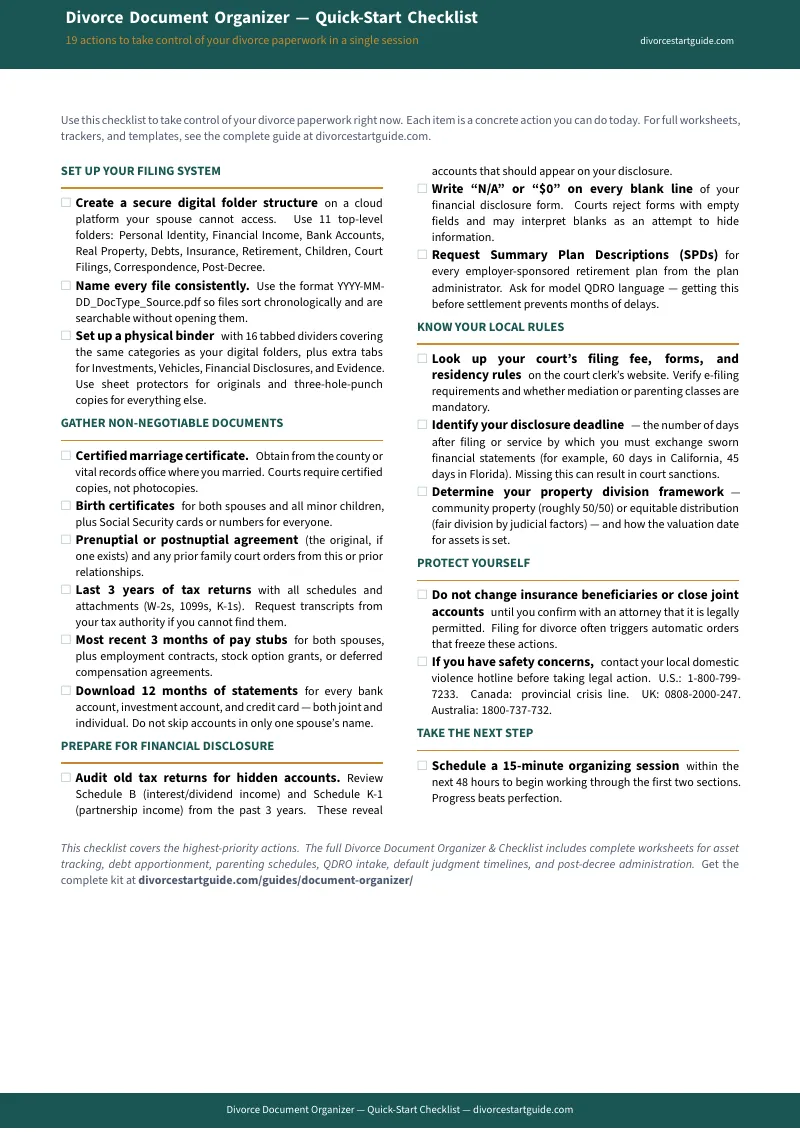
The free quick-start checklist gives you the document categories and a starting framework. The full Divorce Document Organizer & Checklist gives you 14 chapters of step-by-step guidance, fillable worksheets, asset and debt tracking frameworks, parenting schedule planners, and post-decree transition checklists — everything you need to walk into your next meeting, mediation, or court date with every document collected, labeled, and ready.
Download the free checklist to get started. When you're ready for the complete system, the full toolkit is waiting — for less than a single six-minute billing increment at your attorney's rate. The paid download is 12 PDFs: the 14-chapter guide, the quick-start checklist, and 10 print-and-write worksheets (Filing System Blueprint, Pre-Filing Document Collection, Local Court Rules Tracker, Financial Disclosure Worksheets, Master Asset Ledger, Debt Apportionment Worksheet, Parenting Time and Holiday Planner, QDRO Intake and Pension Mapping, Post-Decree Administration Checklist, and Default Sequence Tracker).