Every text to your ex feels like walking through a minefield
You draft a simple message about picking the kids up at 3:00. You rewrite it four times. You delete the part that sounds passive-aggressive. You add it back because you need them to understand. You stare at the screen for ten minutes and then send something you immediately regret.
Meanwhile, your co-parent fires back a paragraph-long attack about last Wednesday's forgotten lunch box — and suddenly a logistical question has become a referendum on your parenting.
This is not a personality flaw. It is a structural problem. Two people who could not sustain a marriage are trying to run a joint operation with no shared playbook, no communication rules, and no system for keeping the conversation focused on the only thing that matters: the children.
The Co-Parenting Dialogue System
The Co-Parenting Communication Toolkit is built around one core principle: co-parenting is a business partnership, and business partnerships run on systems, not goodwill. The Dialogue System replaces emotional improvisation with structured, repeatable communication patterns that keep every exchange child-focused, court-appropriate, and personally sustainable.
At the center of the system is the BIFF framework — Brief, Informative, Friendly, Firm. Every script, template, and worksheet in this toolkit is designed to help you apply BIFF to the real situations that trip parents up: the schedule-change request that turns into a power struggle, the medical decision that becomes a loyalty test, the holiday negotiation that devolves into a history lesson about who ruined Thanksgiving.
What's inside the toolkit
The full toolkit includes the complete guide (11 chapters) plus 10 standalone printable worksheets you can fill in, pin to your fridge, or bring to mediation.
- Ready-to-use message scripts — copy-and-paste templates for the ten most common co-parenting flashpoints, from late pickups and medical emergencies to new-partner introductions and missed child support. Each script shows you the hostile draft, explains exactly what triggers conflict in it, and provides the BIFF-rewritten version you actually send. Includes a standalone BIFF Message Scripts card and a BIFF Filter Checklist for pre-send screening.
- A complete parenting schedule builder — worksheets for building your weekly rotation, handling school breaks, splitting holidays using three different models (alternating years, split days, celebrate-twice), and planning summer custody. Includes standalone printable worksheets for your Weekly Schedule, Holiday Allocation, and Transition Planning.
- A joint decision-making framework — a structured system for categorizing decisions into three tiers (major decisions requiring joint agreement, day-to-day logistics each parent handles independently, and emergency situations) so you stop fighting about whether a haircut requires a committee meeting. Comes with a standalone Decision Tracking Log.
- The behavior documentation log — a formatted, printable system for tracking missed exchanges, late arrivals, hostile communications, and child health concerns. Built specifically for parents who need to present patterns to an attorney, mediator, or judge — organized chronologically, stripped of editorializing, and designed to demonstrate credibility rather than undermine it. Includes a standalone printable Behavior Log with category codes.
- A shared-expense tracker — a structured log for medical co-pays, extracurricular fees, school supplies, and unplanned costs, with a reimbursement-request template that removes the emotional charge from money conversations. Includes a standalone monthly Expense Tracker worksheet.
- The parallel parenting chapter — a complete operational framework for parents in high-conflict situations where cooperative co-parenting has failed or is structurally unsafe. Covers how to shift from direct to structured communication, what boundaries to set, how to manage transitions with minimal contact, and how to protect your children from ongoing conflict exposure.
- Communication channel selection guide — a decision framework for choosing between text, email, co-parenting apps, and court-monitored platforms based on your conflict level, documentation needs, and court requirements. Includes a standalone Communication Channel Agreement worksheet both parents can sign.
- A professional escalation roadmap — clear criteria for when to bring in a mediator, family therapist, parenting coordinator, or attorney, so you stop second-guessing whether the situation has crossed a line.
Who this toolkit is for
This toolkit is built for separated or divorcing parents who are tired of every co-parenting conversation turning into a fight. It works whether your relationship is mostly cooperative but needs better structure, or deeply adversarial and headed toward parallel parenting.
It is especially useful if you are:
- Preparing for mediation and need to organize your communication records and scheduling proposals
- Working with a family law attorney and want to stop paying hundreds of dollars an hour for them to sort through your text screenshots
- Using a court-ordered communication app and want to ensure every message you send demonstrates your reasonableness
- Dealing with a high-conflict co-parent who weaponizes communication — using therapy-speak, late-night message floods, or the children as messengers
- Recently separated and trying to establish communication boundaries before bad patterns calcify
Why the free checklist is not enough
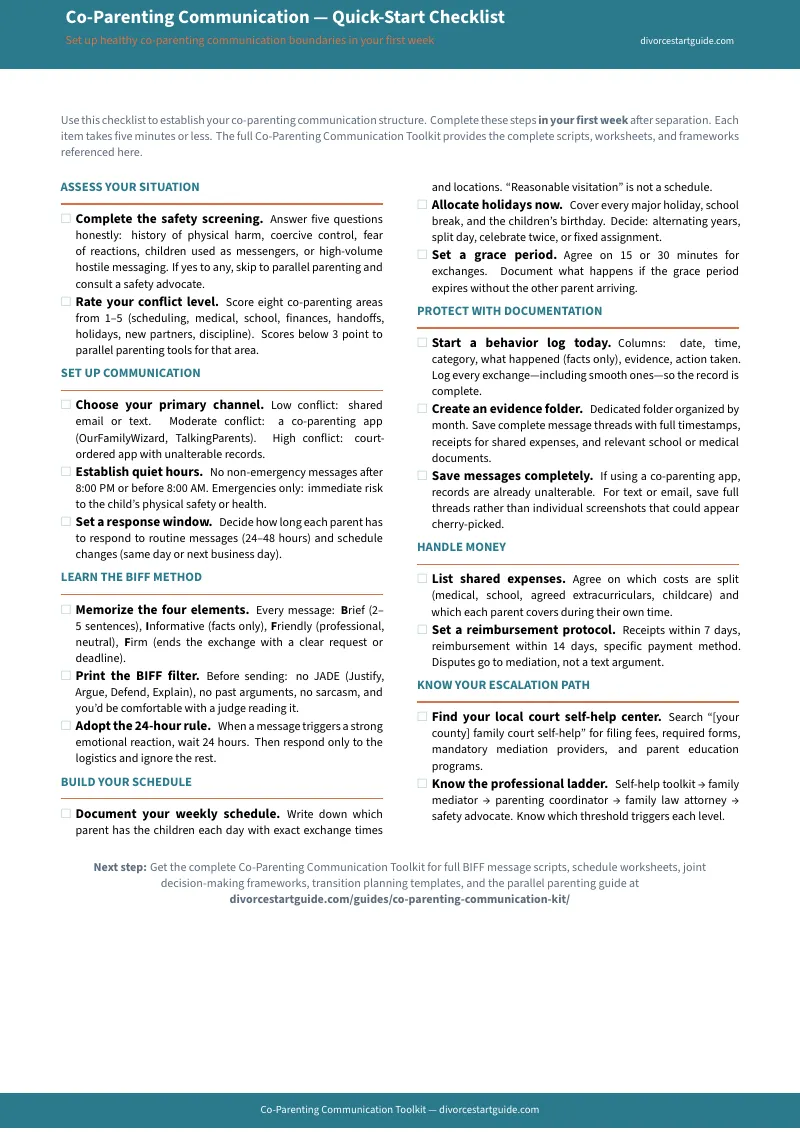
The free Quick-Start Checklist gives you the essential action items — the "what to do" summary that gets you moving. But a checklist cannot teach you how to respond to a hostile message without escalating, how to structure a holiday schedule both parents will actually follow, or how to build documentation that a judge takes seriously.
That is the difference between a checklist and a system. The checklist tells you to "establish communication ground rules." The full toolkit gives you eleven chapters of scripts, worksheets, and frameworks that show you exactly how — with side-by-side examples of conflict-heavy drafts and their BIFF-rewritten alternatives, so you see the mechanics of neutral communication rather than just reading about them.
Free co-parenting resources online give you the same generic advice: "keep it about the kids," "don't badmouth your ex," "be flexible." That advice is not wrong. It is just useless when you are staring at a three-paragraph accusation at 11 PM and your hands are shaking.
Satisfaction guarantee
If the toolkit does not change how you approach co-parenting communication, email us. We want every parent who downloads this to use it — not to have it sit unopened on a laptop.
Start communicating with structure instead of emotion
You cannot control what your co-parent says. You can control what you say back — and a structured system makes that dramatically easier. Download the free checklist to see whether the approach resonates, or get the full toolkit and start using the Dialogue System today.
The full toolkit is a one-time download — no subscription, no recurring fees, no app to install. You own it permanently, and it works in any jurisdiction.