The Disclosure Prep System — Every Dollar, Every Account, Every Answer Ready Before You Sign Anything
Divorce requires you to disclose everything you own and owe — under penalty of perjury. But court forms don't tell you how to calculate unvested stock options, trace premarital equity through a joint account, or convert biweekly pay into the monthly figure the form demands.
That's the gap. You're handed a blank form that assumes you already know what everything is worth, where every account is, and how to separate what's yours from what's shared. Most people guess. They round. They forget the HSA, the frequent flyer miles, the restricted stock units. And every missed asset or inflated number becomes ammunition in negotiations — or grounds for sanctions.
What Makes This Different from Free Court Forms
Court financial affidavits are exams. This workbook is the study guide. It walks you through the entire preparation process — from securing your credit report before anything moves, to modeling different settlement splits so you can see the real after-tax value of each offer before you agree.
Free tools give you empty boxes. Etsy templates give you pretty layouts with no legal context. Attorney billing rates mean every minute they spend sorting your bank statements costs you $270–$450. The Disclosure Prep System sits in the space between: structured enough to replace the expensive admin work, guided enough to catch what you'd miss on your own.
What's Inside — 14 Chapters, Each One Solving a Specific Problem
- Baseline Security Checklist — Pull your credit report, freeze joint cards, open a separate account, and document starting balances before anything changes. This chapter exists because spouses who skip these steps often discover missing money after it's too late to trace.
- Document Gathering Tracker — Category-by-category framework covering tax returns, bank statements, retirement plan summaries, insurance policies, property records, and business documents. Every item has a checkbox and a note on where to find it — because half the stress of disclosure is not knowing what you're looking for.
- Marital vs. Separate Property Classifier — Worksheets for tracing premarital balances, inherited funds, and commingled accounts. If you bought a house before the marriage but your spouse helped pay the mortgage, this chapter shows you how to document the paper trail that proves what portion is yours.
- Asset Ledger — Covers real estate, vehicles, financial accounts, business interests, household property, and the assets people consistently forget: reward points, health savings accounts, unvested stock options, deferred compensation, digital assets, and tax refund receivables.
- Debt & Liability Ledger — Track every obligation with account numbers, balances, minimum payments, and whose name is on the account. Joint debts, individual debts, contingent liabilities, tax liens — all categorized so you can see total exposure at a glance.
- Income Worksheet — Built-in formulas for converting weekly, biweekly, or irregular income into the standard monthly figures court forms require. Separate sections for salary, self-employment, rental income, and irregular sources like bonuses, commissions, and RSU vesting schedules.
- Expense Harmonizer — A month-by-month tracker that reconciles what you actually spend against what you think you spend. Courts care about verified expenses, not estimates — this worksheet builds a defensible number from real bank and credit card data.
- Pre-Tax vs. Post-Tax Comparison — The worksheet that prevents the most expensive mistake in divorce settlements. A $100,000 retirement account is not worth $100,000 in cash — at a 28% marginal rate, it's worth roughly $72,000 after taxes. This side-by-side comparison shows you the real value of each asset class so you don't trade a dollar of home equity for seventy-two cents of retirement savings.
- Settlement Scenario Modeler — Test different division splits and see the actual after-tax distribution before you agree. Compare keeping the house versus keeping the retirement accounts. Model the impact of taking on the mortgage versus splitting liquid assets. Walk into negotiations with numbers, not guesses.
- Document Request Letter Templates — Copy-and-paste letters for requesting bank statements, pension plan details, employment records, property valuations, and insurance policy summaries. Each template is addressed to the right department and asks for the right documents.
- Disclosure Amendment Log — A tracking system for updates and corrections to your financial disclosures. Because missing an amendment deadline can trigger sanctions, and forgetting what you updated makes your entire filing look unreliable.
- Court Form Reference — Guidance on transferring your organized numbers directly into standard financial disclosure forms, with links to official state court portals. Your state's form is the final destination — this workbook is the preparation that makes filling it out straightforward.
8 Standalone Printable Worksheets Included
Every major section of the workbook is also available as a standalone printable PDF — print only what you need, bring it to a meeting, fill it in by hand, or hand it to your attorney:
- Baseline Security Checklist — immediate steps to freeze credit and document starting balances
- Document Gathering Tracker — category-by-category checklist for every document your disclosure requires
- Asset Ledger — fillable tables covering real estate, accounts, investments, retirement, vehicles, and commonly overlooked assets
- Debt & Liability Ledger — secured, unsecured, and contingent liabilities with balances, rates, and ownership
- Income & Expense Worksheets — income conversion formulas plus a full monthly expense tracker
- Pre-Tax vs. Post-Tax Comparison — side-by-side worksheet for comparing the real after-tax value of each asset class
- Settlement Scenario Modeler — test different division splits and see the after-tax distribution
- Document Request Letter Templates — copy-and-paste letters for pension administrators, mortgage lenders, and banks
Who This Workbook Is For
- You're preparing to file and want a secure, private way to inventory joint finances before taking any legal action
- You've been served and face a mandatory disclosure deadline in 30–60 days
- You're heading into mediation and need clear, organized financial data on the table
- You have an attorney and want to reduce the hundreds of dollars they'd bill to sort your bank statements
- You suspect forgotten or overlooked assets and want a systematic checklist that catches what you'd miss
- You're self-represented and need a structured process to replace what a paralegal would normally organize
Why Free Tools Fall Short
State court self-help portals give you free forms — but those forms ask for "current gross fair market value" of your possessions without explaining how to calculate it. They ask for monthly income without showing you how to convert a biweekly paycheck. They ask you to classify property as separate or community without explaining what commingling does to that classification.
Etsy worksheets give you clean spreadsheet layouts for $4–$15, but they carry no legal context. They don't flag that a 401(k) and a savings account with the same balance are not worth the same amount. They don't include letter templates for requesting records. They don't help you model settlement scenarios.
This workbook does both: the structure of a professional financial organizer with the guidance of a process navigator. It sits between free court forms and a $300/hour attorney session — organized enough to do the preparation work yourself, guided enough to catch the gaps that cost people thousands in bad settlement trades.
Satisfaction Guarantee
This is a preparation tool — it helps you organize, calculate, and model before you sign anything. If you open the workbook and feel it won't help your situation, email [email protected] and we'll make it right.
Start With the Free Checklist
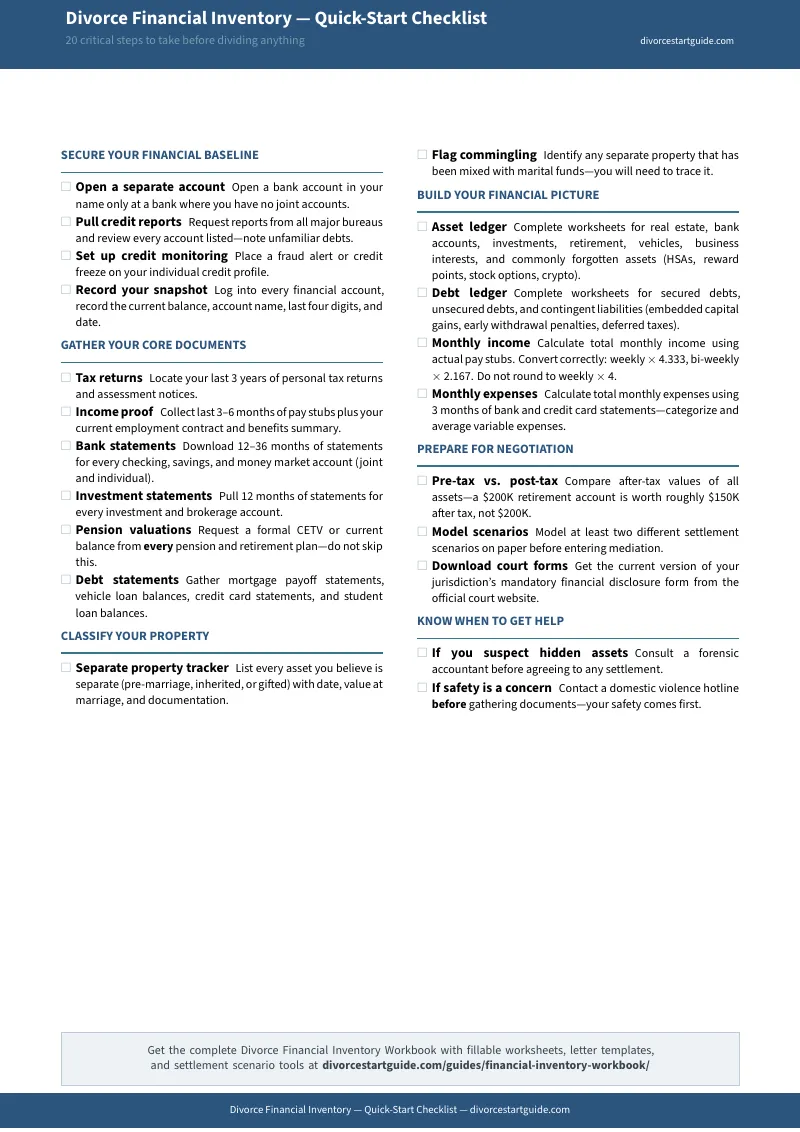
Download the free Quick-Start Checklist — a 20-item action list covering the first steps every divorcing spouse should take to secure their financial position. If the checklist is useful, the full workbook goes fourteen chapters deeper: asset ledgers, debt trackers, income normalization, settlement modeling, and document request templates.
Get the Full Workbook — , instant download. Less than twenty minutes of attorney billing time, and it replaces hours of the administrative work they'd charge you for.