
Your Child Deserves a Plan That Actually Works — Not a Blank Form and a Prayer
You know that "custody" and "access" aren't even the legal terms anymore. You've heard about "care" and "contact" and "parental responsibilities and rights" under the Children's Act. You might have Googled the Family Advocate's office hours. But knowing the vocabulary and knowing what to do next are two completely different things.
The free government forms — Form 8, Form 9, Form 10 — give you blank boxes and no instructions. Attorney templates hand you legal clauses for R600 to R800 but leave you alone to negotiate a schedule you've never built before. And family lawyers charge R1,500 to R3,500 an hour to walk you through decisions you could have mapped out at your kitchen table — if anyone had shown you how.
The Parenting Plan Navigation System
This guide is not a legal template. It is a step-by-step decision-making workbook that sits between the free forms and the expensive professionals. It walks you through every choice a parenting plan requires — from daily care schedules to holiday rotations to medical decision-making authority — so you arrive at your mediation session, Family Advocate inquiry, or attorney meeting with a clear, structured proposal already drafted.
The result: fewer billable hours, less conflict at the negotiating table, and a plan that a court will actually approve because it is built around your child's developmental needs, not parental convenience.
What's Inside — 9 PDFs
- Children's Act Decoder — a plain-language walkthrough of Sections 7, 18, 21, 33, and 34 so you understand exactly what "parental responsibilities and rights" means in practice, not just on paper.
- Age-Appropriate Schedule Builder — concrete daily and weekly templates for infants through teenagers, including step-up plans that evolve as your child grows. Covers 5-2-2-5 rotations, alternating weeks, midweek overnights, and graduated toddler plans.
- Holiday Rotation Worksheet — a standalone printable for drafting your alternating school holiday, public holiday, and special day schedule. Fill it in and bring it to your mediation session.
- Family Advocate Preparation Sheet — standalone printable covering what the inquiry looks like, what the Family Counsellor asks, and space to draft your answers before your appointment.
- Mediation Prep Worksheet — structure your proposed care arrangement, decision-making authority, and negotiation strategy before your mandatory mediation session.
- Self-Audit Worksheet — honestly assess yourself against the Section 7 best-interests factors before your Family Advocate inquiry or court hearing.
- Maintenance Evidence Worksheet — build your child's monthly expense budget using the 2:1 apportionment formula, with a proportional contribution calculator.
- Shared Expense Agreement — define how irregular and extraordinary expenses are split between co-parents, with consent thresholds and a claim tracking log.
- Communication Templates — three ready-to-adapt templates for requesting schedule changes, documenting breaches, and proposing mediation in neutral, child-focused language.
Who This Is For
- Divorcing parents who need to build a parenting plan from scratch — whether filing at a Regional Court or the High Court
- Unmarried fathers establishing parental responsibilities and rights under Section 21
- Parents already in litigation who need to prepare for a Family Advocate inquiry or a Rule 43/Rule 58 interim application
- Co-parents with an existing order that no longer fits — the child has outgrown the schedule or one parent has relocated
- Anyone heading into private mediation who wants to arrive with proposals, not arguments
Why Free Tools Don't Get You There
The Department of Justice's Forms 8, 9, and 10 are administrative cover sheets. Form 8 registers a plan with the Family Advocate. Forms 9 and 10 confirm that mediation happened and the child's voice was heard. None of them tell you how to structure a holiday rotation that a judge will approve, or how to handle the moment your co-parent rejects your proposed schedule.
Attorney templates from Anel Krog or Agreements Online give you the legal clauses — but if you and your co-parent disagree on a single handover time, a static Word document cannot help you resolve it. You are left paying a mediator R4,400 to R5,900 per session to work through decisions you could have structured in advance.
This guide fills the gap between the free blank forms and the expensive professionals. It gives you the decision-making framework, the developmental context, and the negotiation structure so that when you do use a professional — mediator, Family Advocate, or attorney — you use them efficiently.
Satisfaction Guarantee
Read the guide. Work through the worksheets. If it does not help you build a clearer, more structured parenting plan, email us at any time and we will refund your purchase — no conditions.
Start With the Free Checklist or Get the Full Guide
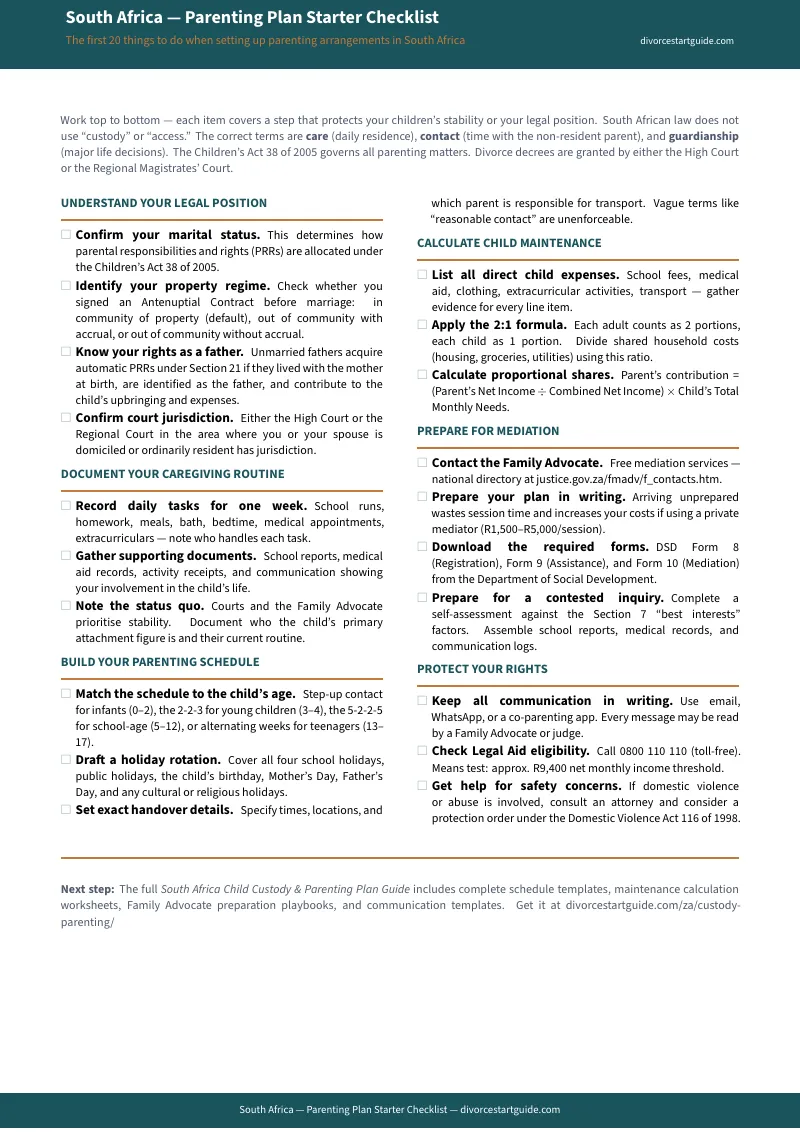
The free Parenting Plan Starter Checklist gives you a one-page overview of every element a South African parenting plan must include. It is a solid starting point if you want to see the scope before committing.
The full South Africa Child Custody & Parenting Plan Guide goes deeper — with chapter-by-chapter process navigation, age-appropriate schedule templates, worksheets, and the Family Advocate preparation playbook. For less than the cost of fifteen minutes with an attorney, you get a complete system for building an enforceable plan.