
Every Free Custody Form Asks You to State a Schedule. None of Them Help You Choose One.
Your court hands you a blank form with a box that says "parenting time." It expects you to already know the answer: which nights is your child with which parent, all year, for years. But nothing on that form explains whether week-on/week-off will wreck your four-year-old, how many overnights a "50/50" schedule actually gives each parent, or why the rotation that looks fair on paper turns into a screaming match in a parking lot every 48 hours.
So most parents guess. They copy a schedule a friend mentioned, or split the week down the middle because it sounds even, and file it. Then eighteen months later they're back at the negotiating table — or in court — because the schedule quietly decided a dozen things they never thought about: how often the child changes houses, who owns the school-morning routine, and how much each parent pays in child support. A vague or ill-fitting plan isn't a plan. It's a future fight with a delay timer on it.
Contested custody routinely runs past $11,000. Lawyers bill $270–$500 an hour. Co-parenting apps charge $70–$300 per parent, every year — and they still don't tell you which schedule to pick. They just draw the one you already guessed at.
The Schedule Mapping System
This is the piece the free forms leave out: a plain-language system that walks you from "I have no idea which schedule to pick" to a mapped, calendar-ready rotation that fits your child's age, your commute, your work, and your conflict level — before you fill in a single official form.
It's not legal advice, and it deliberately doesn't reproduce your court's forms (those are free — get them from your court). It's the strategist that prepares you before you file, walk into mediation, or pay a lawyer to draft the order. You score your family on five factors, look up your rotation's exact day-by-day calendar and overnight count, sanity-check it against your child's age, and map it onto a real calendar with every holiday, exchange, and expense rule spelled out. When you finally touch the free form, filling it in is a five-minute transcription instead of a guess.
What's Inside
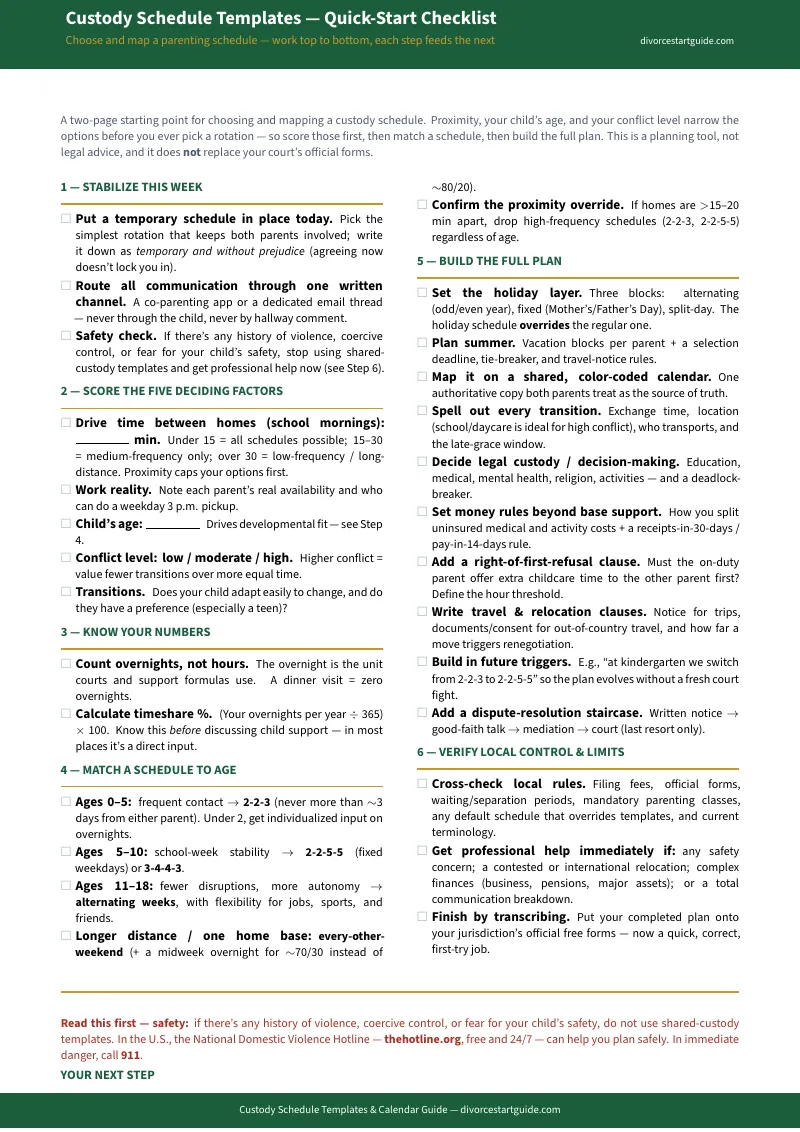
A complete 12-chapter guide, a two-page quick-start checklist, and 8 standalone printable worksheets you can bring to mediation or stick on the fridge — every rotation mapped, every worksheet you need to decide instead of guess:
- Every common rotation, mapped day by day — 2-2-3, 2-2-5-5, 3-4-4-3, week-on/week-off, every-other-weekend and more, each with a copyable two-week calendar grid, the exact overnight count, and the timeshare percentage
- The Five-Factor Scorecard — score your proximity, work schedules, child's age, conflict level, and your child's temperament to shortlist the right rotations before you look at any of them
- The developmental fit matrix — which schedule actually works for an infant vs. a preschooler vs. a tween vs. a teenager (the single place generic templates fail hardest)
- The overnight & timeshare math — count overnights the way courts and child-support formulas actually do, and know your timeshare number before you negotiate support
- The holiday & summer layer — alternating (odd/even year), fixed, and split-day building blocks, plus a summer-vacation-block planner with notice deadlines and tie-breakers
- The 100+ provision checklist — right of first refusal, transportation, decision-making deadlocks, expense splits, relocation, and travel clauses that free forms omit and future fights come from
- Ready-to-send co-parenting scripts — neutral, judge-proof messages for late pickups, schedule swaps, hostile messages, and more, built on the BIFF method
- The expense ledger & transition log — a reimbursement formula, a monthly shared-expense ledger, and a factual violation log that turns "they're always late" into something a mediator can act on
- The temporary-schedule starter — a one-paragraph, without-prejudice interim agreement to stabilize your child this week without setting a bad precedent
- Verify Local Control protocol — exactly which local rules to cross-check (default schedules, waiting periods, mandatory parenting classes, current terminology) and the four situations where you must stop and get a professional
Who This Is For
- You're choosing between rotations and want to compare week-on/week-off, 2-2-3, 2-2-5-5, and alternating weekends side by side instead of picking blind
- You just separated and need a predictable, stabilizing schedule this week that won't lock you into a bad precedent
- You're heading into mediation and want to walk in with a structured, mapped proposal instead of improvising
- You're drafting a permanent parenting plan and need every provision — holidays, expenses, right of first refusal — decided while you're still cooperating
- Your existing schedule stopped working because your child outgrew it or someone moved, and you want to evaluate options before you file to modify
Why Not Just Use Free Forms and Scheduling Apps?
Your court's free forms are the destination. This guide is the map. Blank forms give you a box to write a schedule in — they never explain how to pick one that fits your child's age, your commute, or your conflict level. That gap is exactly where self-represented parents make the mistake they spend the next two years paying for.
Scheduling apps like Custody X Change ($72–$288/year) draw a beautiful calendar of the schedule you already chose. OurFamilyWizard ($110–$300/year per parent) and TalkingParents help you communicate after you have a plan. None of them do the upstream thinking — comparing rotations, matching them to your child's development, and pressure-testing the choice against your real life. And every one of them is a recurring subscription your co-parent often has to join too.
This is a one-time purchase — , instant download, no subscription, no co-parent buy-in. It does the deciding those tools charge you monthly to merely display.
100% Satisfaction Guarantee
If this guide doesn't give you a clear, confident way to choose and map your custody schedule, email [email protected] and we'll make it right — no hoops, no time limit.
— Less Than a Fraction of One Attorney Hour
A single hour of a family lawyer's time runs $270–$500. A contested custody fight runs past $11,000. This guide gives you every rotation mapped, the worksheets to choose the right one, and the full provision checklist to make it durable — for less than the cost of a 15-minute phone call, and you keep it for the entire life of your parenting plan.