
Your divorce decree is signed. Nobody told you that untangling your life takes longer than ending the marriage.
The Family Court justice signed the Decision. The nisi clock ran. The Final Judgment is entered. The marriage is over. And now you're staring at a stack of life admin that nobody prepared you for: a Social Security card in the wrong name, joint bank accounts your ex can still drain, a 401(k) that still names them as beneficiary, a mortgage with both names on it, and a will that leaves everything to the person you just divorced.
Rhode Island makes this harder than most states. Your divorce wasn't final when the judge ruled — it sat in a three-month nisi waiting period while you stayed legally married. Now that the Final Judgment is entered, you have to update records across federal agencies, the Cranston DMV, 39 separate municipal land evidence offices for property deeds, and private institutions that don't monitor court records. Each has its own forms, its own fees, its own processing timeline — and a strict dependency order that nobody tells you about. Update your license before Social Security and the DMV rejects you. Submit a QDRO to the court before the plan administrator pre-approves it and the judge sends it back. File a quitclaim deed at the wrong town clerk and the title transfer never happened.
The Rhode Island courts provide free self-help forms. The court clerk is legally prohibited from telling you which order to complete them in. An attorney will tell you — at $250–$400 an hour. Three of those hours go to explaining SSA procedures and DMV appointments. That's over $750 in administrative hand-holding you can handle yourself — if someone gives you the sequence.
The Rhode Island Post-Divorce Sequencing System
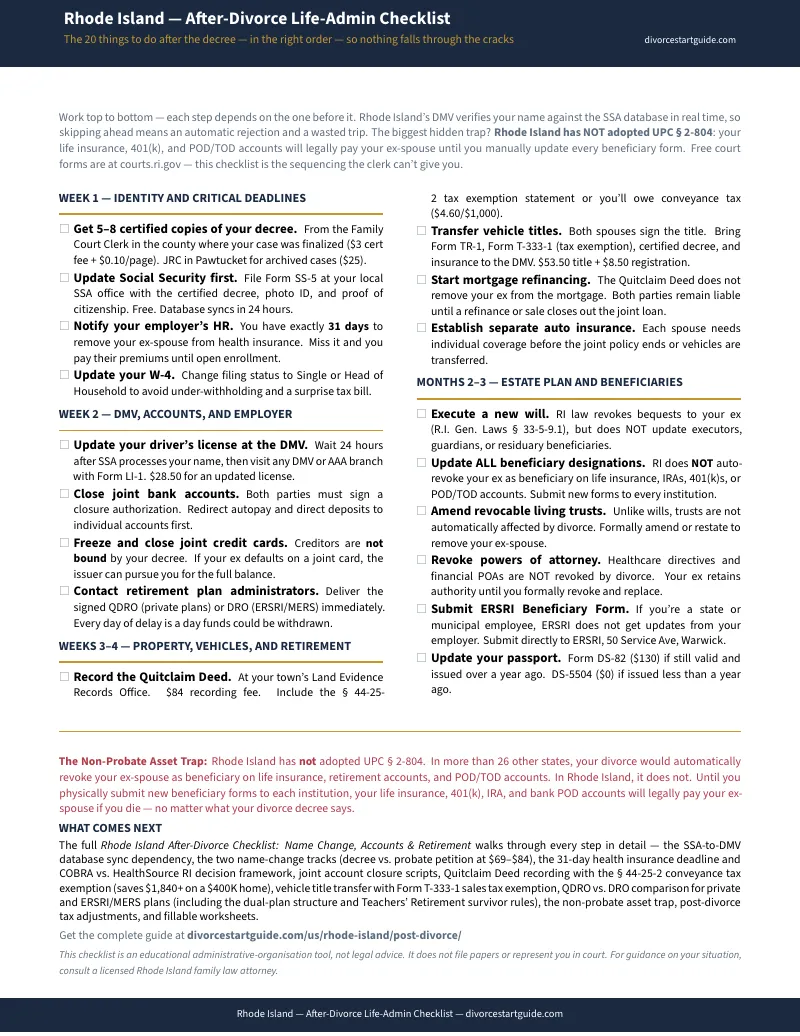
This is a complete, step-by-step guide to every administrative task after a Rhode Island divorce — built around the one thing that free forms and generic checklists get wrong: the dependency order.
At its core is the Post-Divorce Sequencing System — a structured method that walks you through the exact order of federal, state, municipal, and private-institution updates so nothing gets rejected and nothing falls through the cracks. It handles the part everyone gets stuck on: knowing that SSA must come before DMV, that plan administrator pre-approval must come before court filing, that beneficiary designations on ERISA plans follow federal law even after a Rhode Island divorce, and that Rhode Island's lack of automatic beneficiary revocation means your ex could inherit everything if you don't act.
What's inside — the 12-chapter guide, 8 standalone worksheets, and the free checklist
- The Nisi Period Timeline and Final Judgment Entry — Rhode Island's three-month nisi waiting period (or 20 days for three-year separation divorces) is unique. The guide maps the 30-day Decision Pending Entry deadline, the 180-day Final Judgment filing window, and the 270-day absolute deadline that forces a formal motion if missed. Includes where to order certified copies from each of the four Family Court locations and the Judicial Records Center in Pawtucket.
- Name Restoration — Decree Path vs. Probate Court — if the judge included name restoration in the decree, your certified copy is your name change order. If it was omitted, you must file Form PC-8.1 in your local municipal probate court — a separate process with a $30 filing fee, a $4 surcharge, a $5 certified copy fee, newspaper advertising ($25–$40), and a BCI background check ($5). The guide covers both tracks.
- The SSA-DMV Dependency Chain — the exact sequence (SSA Form SS-5 → 24-hour database sync → DMV Form LI-1 → passport) with processing windows and the documents each agency requires. Skip the order and the DMV rejects you.
- Joint Account Separation and Credit Protection — banks refuse to close joint accounts without mutual written consent. The guide covers a bank-by-bank action plan, credit freeze procedures at all three bureaus, authorized user removal, and how to open sole accounts while protecting your credit score from your ex's post-divorce spending.
- QDRO and Retirement Division — ERISA Plans and ERSRI Pensions — the pre-approval workflow for employer-sponsored plans (401(k), 403(b)), the separate DRO process for Rhode Island state employee pensions through ERSRI, the tax-free rollover rules, and the deadline risk that matters most: if your ex retires or withdraws before the order is filed, the money may be gone. Includes when a flat-fee QDRO preparer ($300–$1,200) makes more sense than doing it yourself.
- Real Estate Transfers — 39 Municipal Land Evidence Offices — Rhode Island records deeds at the municipal level, not the county level. A quitclaim deed must be recorded at the right town or city clerk's land evidence office. The guide covers the § 44-25-2 real estate conveyance tax exemption for divorce transfers, the refinance-or-sell decision, and what to do when the mortgage and the deed are out of sync.
- Vehicle Title Transfers — TR-1 and the Tax Exemption — DMV Form TR-1, the casual sale use-tax exemption using Form T-333-1 (saving you 7% sales tax), and the signature and notarization requirements for joint titles.
- The Non-Probate Asset Trap — Rhode Island does not follow the Uniform Probate Code § 2-804 automatic revocation rule. Your ex-spouse remains the named beneficiary on life insurance, retirement accounts, and transfer-on-death bank accounts unless you explicitly change each one. Under federal ERISA rules, the plan administrator must pay the person listed — regardless of the divorce decree. The beneficiary audit worksheet covers every account type.
- Estate Plan Overhaul — wills, trusts, healthcare proxies, and durable powers of attorney all need updating. Rhode Island law revokes some bequests to an ex-spouse upon divorce, but does not rewrite the will or appoint new executors. Joint powers of attorney remain active unless formally revoked.
- Tax Transition Year — filing status changes, withholding adjustments, the December 31 rule, dependent exemption rules for co-parents, and the capital gains trap on deferred property sales.
- Insurance Updates — the 31-day deadline for employer health plan notifications after finalization, COBRA vs. HealthSource RI options, auto and homeowners policy splits, life insurance beneficiary changes, and the disability insurance gap most people miss.
- The 90-Day Action Plan — a week-by-week timeline that sequences every update in the correct dependency order, from decree verification through title transfers, with checkboxes and deadlines.
Who this is for
The person staring at a signed Final Judgment and a list of accounts, IDs, and titles that still have the wrong name on them. The newly single parent who needs to separate joint finances before the ex drains the checking account. The state employee who's been told they need a DRO for their ERSRI pension and has no idea what that means. The homeowner who needs the ex off the mortgage but can't figure out which of Rhode Island's 39 town clerks handles the quitclaim deed. And the person with an attorney who wants to stop paying $300 an hour for someone to explain how the DMV works.
Why not just use the free resources?
Because the free resources give you forms, not sequences. The Rhode Island Court self-help portal provides blank forms — but doesn't tell you that the DMV will reject your application if SSA hasn't synced yet. The Social Security Administration tells you what to bring — but doesn't tell you to wait 24 hours before visiting the DMV. ERSRI provides model DRO language — but doesn't explain the pre-approval workflow or warn you about the withdrawal risk.
The information exists across dozens of disconnected government websites, each one accurate for its own agency and silent about every other agency. This guide connects the dots into one sequenced workflow so you don't spend weeks bouncing between agencies that each point you somewhere else first.
An honest guarantee
Work through the Post-Divorce Sequencing System. If the guide doesn't make your post-divorce administration clearer and faster than any blank form or free article could — email us within 30 days for a full refund. The risk of trying it is a fraction of one attorney billable hour. The risk of missing a beneficiary designation, a QDRO deadline, or a credit freeze is measured in years of financial consequences.
For — less than fifteen minutes of attorney time — you get the sequenced checklist, the QDRO workflow, the beneficiary audit, and the 90-day action plan that the free forms leave out.
Stop bouncing between agencies. Get the guide, work the sequence, and clear your post-divorce to-do list in weeks instead of months.