The Court Will Not Grant Your Divorce Until "Proper Provision" Is Satisfied. This Guide Shows You How to Build a Settlement That Passes.
Irish divorce is not a negotiation between two spouses. It is a negotiation between two spouses that a judge then reviews against a constitutional standard — and rejects if it falls short. Under Section 5 of the Family Law (Divorce) Act 1996, the court must be satisfied that proper provision has been made for both parties and any dependent children before it will grant a decree.
That means every asset needs to be classified, valued, and assigned. Every debt needs an owner. Every pension needs an actuarial position. Your income and outgoings need to be converted to exact weekly figures for the Affidavit of Means. And the entire settlement needs to demonstrate that nobody is being left short.
Most people discover this when they sit down with the blank Form 37A and realise it asks for numbers they have never calculated. Solicitors charge €150 to €300 per hour to help you fill it in. This guide sits in the gap between the free form and the professional fee.
The Proper Provision Settlement System
This is not a summary of Irish family law. It is a step-by-step financial workbook that walks you through every calculation and disclosure the Circuit Court requires — with the actual formulas, fillable worksheets, and decision frameworks used by family law professionals.
You start by understanding how proper provision works and what the court weighs under Section 20. Then you work through the family home, the Affidavit of Means, pensions, maintenance, taxes, and business valuations. By the time you finish, you have a complete settlement-ready financial picture — classified, calculated, and documented in the format the court expects.
Whether you are preparing for mediation, representing yourself, or trying to walk into your solicitor's office without burning hours on basic organisation, this guide turns financial chaos into a numbered process.
What Is Inside — 11 Chapters Plus 10 Standalone Printable Worksheets
The complete guide covers every financial dimension of Irish divorce, with 10 standalone printable worksheets you can bring to solicitor meetings, mediation sessions, or work through at your kitchen table:
- Affidavit of Means Pre-Compiler — the Form 37A asks for weekly income and outgoings but gives you no help calculating them. This worksheet walks you through every income source and expense category, converts monthly and annual figures to weekly, and organises everything in the exact format the court requires. You fill this in once and the sworn statement writes itself.
- Family Home Decision Framework — three paths for the family home (transfer, sell, or defer), with the valuation steps, mortgage consent checks, and tax consequences for each. Includes the deferred-sale timeline when dependent children are involved and what happens to the Family Home Protection Act 1976 consent requirement.
- Pension Adjustment Order Calculator — private agreements cannot split pensions in Ireland. Only a court-issued PAO can bind trustees. This worksheet covers the relevant period, relevant percentage, and the difference between retirement benefits and contingent (death-in-service) benefits — including the strict 12-month post-divorce deadline for contingent claims that catches people out every year.
- Asset Classification Grid — walk every asset and debt through the proper provision framework: jointly acquired, premarital, inherited/gifted, or post-separation. Includes guidance from Y.G. v. N.G. [2011] on how courts treat inheritances and when intermingling strips away their protected status.
- Spousal Maintenance Factors Worksheet — Ireland has no statutory formula for maintenance. The court weighs income, needs, earning capacity, and contributions under Section 20. This worksheet lays out each factor side by side so you can evaluate your likely range before negotiating.
- Tax Consequence Checker — transfers under a formal court order are exempt from CGT, Stamp Duty, and CAT. Informal transfers are taxable disposals at market value. This checklist flags every transfer in your settlement that needs to be inside the court order to preserve the exemption — and warns about the loss of first-time buyer status.
- Settlement Negotiation Matrix — a two-page equalisation worksheet for modelling trade-off scenarios. Compare buyout vs. sale, pension offset vs. PAO, lump-sum vs. periodic maintenance — side by side, with the tax consequences built in.
- Post-Decree Execution Checklist — every title transfer, pension trustee notification, Revenue registration, bank account update, and beneficiary change you need to complete after the decree is granted.
Who This Guide Is For
- Self-represented litigants completing Form 37A without a solicitor — you need the actual calculations, not a blank government form
- Mediation participants who want to arrive with their numbers organised so sessions focus on decisions, not data gathering
- People hiring solicitors who want to save hours of billable time by arriving with a classified, calculated financial inventory
- Anyone dividing an Irish family home, pension, or business interest who needs the specific frameworks Irish courts apply
Why Not Just Use the Free Court Forms?
The Courts Service provides Form 37A (Affidavit of Means), Form 37B (Affidavit of Welfare), and Form 2N (Civil Bill) for free on courts.ie. They are also completely blank. They do not tell you whether your inheritance is still protected after you used it to pay off the mortgage. They do not calculate the relevant percentage for your spouse's pension. They do not warn you that transferring the family home outside a court order triggers a Capital Gains Tax event at market value.
The forms tell you what to disclose. This guide shows you how to calculate what to disclose — and how to negotiate the split once you know your numbers.
DIY divorce platforms like Simple Divorce and Untie the Knot charge €500 to €750 but only work for fully uncontested cases with zero financial complexity. If you have a pension, a family home with children, or any dispute about who gets what, they cannot help you. This guide is built for the financial complexity those platforms refuse to touch.
Satisfaction Guarantee
If the guide does not help you organise and calculate your Irish divorce financial split, email us and we will make it right. No fine print.
— Less Than One Hour of a Family Law Solicitor's Time
Irish family law solicitors charge between €150 and €300 per hour. Most self-represented litigants spend weeks gathering documents and calculating figures from scratch. This guide compresses that work into a structured process with pre-built worksheets and the exact frameworks the court applies.
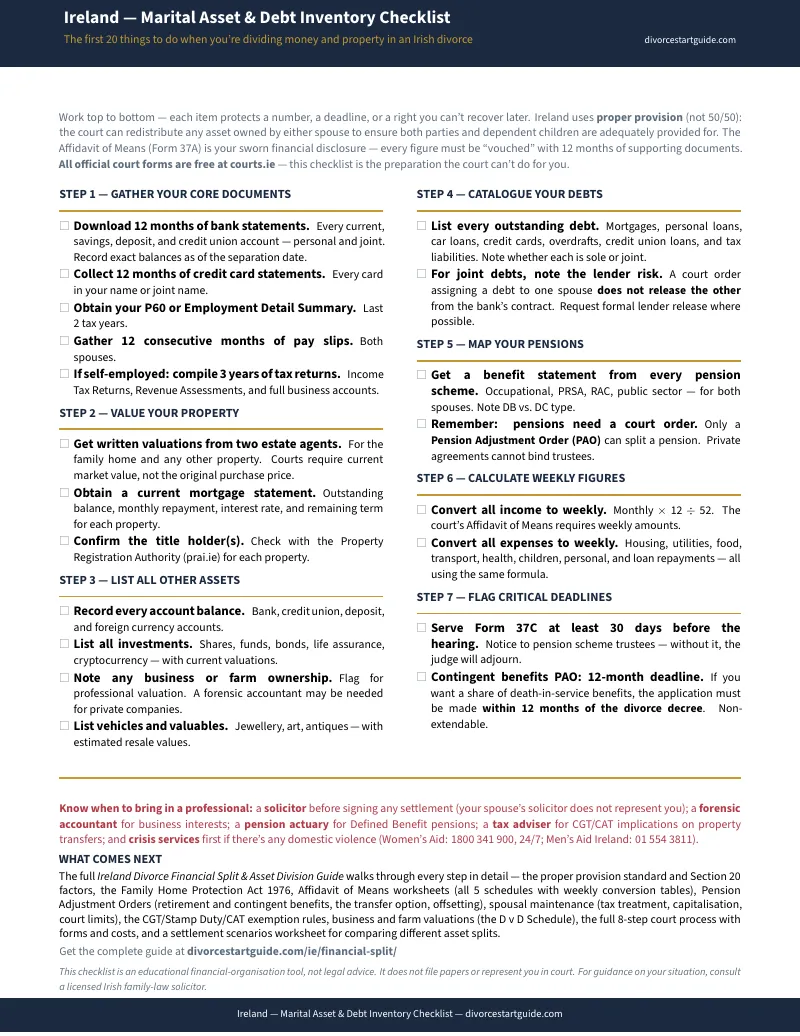
Download the free checklist to start your asset and debt inventory tonight. When you are ready for the full calculation system, the complete guide is here.