Your divorce is final. The court is done with you. But you're not done with the paperwork.
The judge signed the Findings of Fact, Conclusions of Law, and Judgment of Divorce. You walked out of the courtroom thinking the hard part was over. Then you realized: nobody is going to update your Social Security card, retitle your house, split your retirement accounts, change the beneficiary on your life insurance, transfer your car title, or switch your health insurance. You are — and the agencies that handle each of these tasks operate on different forms, different deadlines, and different databases that do not talk to each other.
Visit the DMV before the Social Security Administration processes your name change? Rejected — come back after the 48-hour sync window. Record your quitclaim deed without filing a Real Estate Transfer Return through the DOR portal? The Register of Deeds sends you home. Submit a Domestic Relations Order to the Wisconsin Retirement System that lists a dollar amount instead of a percentage? ETF rejects it.
The court system publishes forms for getting divorced. It publishes nothing for what happens after.
The Post-Divorce Administrative Roadmap
This toolkit replaces the guesswork with a sequenced, agency-by-agency system for completing every post-decree administrative task in Wisconsin. It is not a collection of blank forms (your county Clerk of Courts provides those free). It is the operational layer the court system skips: the correct order, the specific forms and fees, the processing windows, and the workarounds for common rejections — organized into a chronological roadmap from decree day through tax season.
Name Restoration — The 48-Hour Federal-to-State Sequence
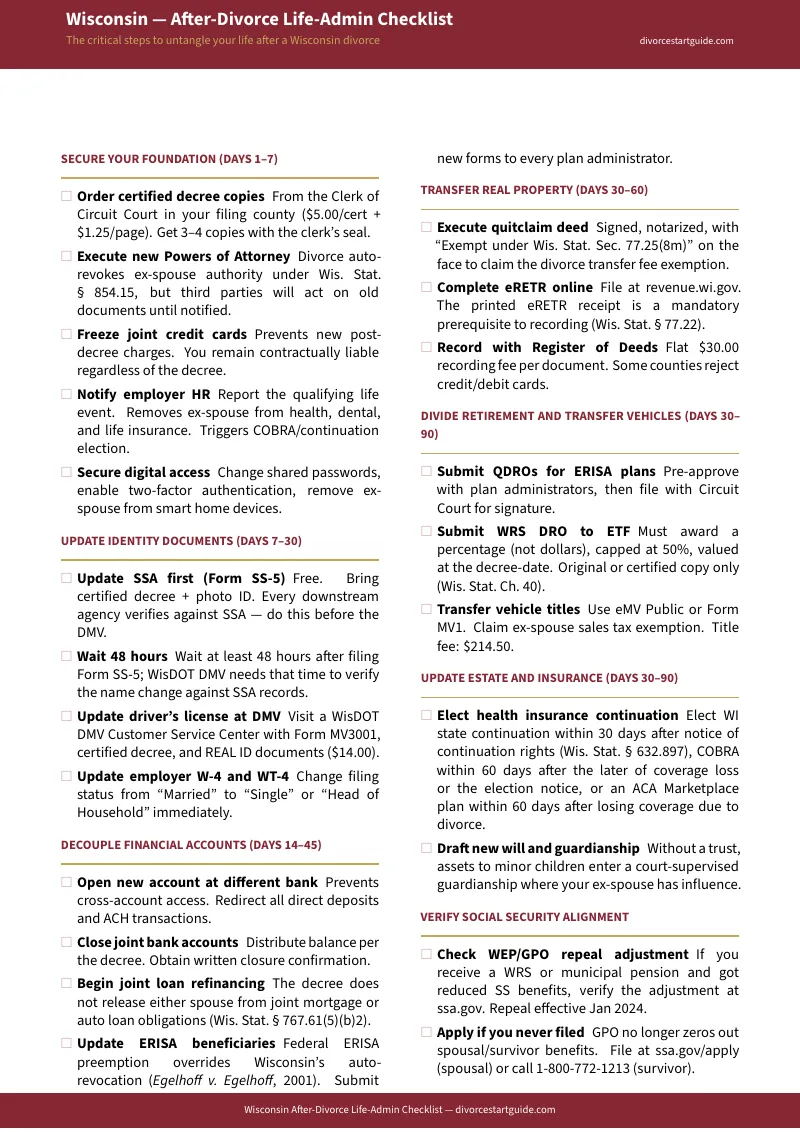
If the court granted your name change under Wis. Stat. § 767.395, the FFCLJ is your proof. But the agencies enforce a strict sequence: Social Security first (Form SS-5), wait 48 hours for the federal database to sync, then WisDOT DMV (Form MV3001). The toolkit maps every step, including passport updates, employer notifications, and what to do if the decree did not include a name change (the Chapter 786 alternative petition, with its separate filing fee, newspaper publication, and court hearing).
Financial Account Separation — Because Creditors Ignore Your Decree
A divorce decree assigns debt responsibility between you and your ex. Creditors are not bound by it. If your ex defaults on a joint credit card the decree assigned to them, the creditor can and will pursue you. The toolkit includes a joint-account closure checklist, authorized-user removal steps, creditor notification letters, and a 30-day credit report verification protocol to catch any accounts that slipped through.
Real Estate Transfers — Quitclaim Deeds and the eRETR Portal
Recording a property transfer in Wisconsin requires a quitclaim deed (or Form FA-4135V), an electronic Real Estate Transfer Return filed through the DOR portal, and county-specific recording fees paid to the Register of Deeds. The toolkit walks through each step, covers the mortgage refinance or release-of-liability decision, and addresses the most common problem: an ex-spouse who refuses to sign.
Vehicle Title Transfers — Including the Tax Exemption
Transferring a vehicle requires Form MV1, the original title signed by the transferring spouse, and a trip to a WisDOT DMV Customer Service Center. The toolkit explains how to claim the ex-spouse sales tax exemption by presenting your FFCLJ, how to use the eMV Public portal, and plate transfer rules under Wis. Stat. § 341.
Retirement Account Division — QDRO, WRS, and IRA Transfers
Private-sector 401(k) and 403(b) plans require a Qualified Domestic Relations Order. Wisconsin Retirement System accounts require a state Domestic Relations Order submitted to ETF — and ETF rejects DROs with dollar amounts (percentages only) or awards exceeding 50% of the account. IRAs use a "transfer incident to divorce" under IRC § 408(d)(6). The toolkit covers each path, the plan-administrator pre-approval process, and drafting requirements.
Health Insurance — Three Windows, Three Deadlines
Dependent health coverage typically ends on the last day of the month the divorce is finalized. Life insurance ends on the exact date of the decree. The toolkit maps the 30-day Wisconsin state continuation window (Wis. Stat. § 632.897), the 60-day federal COBRA election deadline, and the divorce-triggered Special Enrollment Period for marketplace coverage.
Beneficiary Updates — The ERISA Trap
Wisconsin Statute § 854.15 automatically revokes most ex-spouse beneficiary designations. But federal ERISA preemption overrides state law for employer-sponsored 401(k) plans and group life insurance. If you do not manually update those beneficiaries, the plan administrator will legally pay your ex — regardless of what your will or the divorce decree says. The toolkit includes a full beneficiary audit checklist.
Estate Planning Overhaul
Your existing will, trust, powers of attorney, and healthcare directives almost certainly name your ex-spouse in critical roles. The toolkit covers what to revoke, what to draft new, and the specific Wisconsin statutes that govern automatic revocation (and the gaps those statutes leave).
Tax Filing for the Year of Divorce
Your filing status depends on your marital status as of December 31. Wisconsin's Department of Revenue Publication 113 governs joint-income reporting for the divorce year, including Schedule M and Schedule MP adjustments and the Income Reclassification Agreement option. The toolkit walks through Form W-4 withholding updates, IRS Form 8332 (dependency exemption release), and the interaction between federal and state returns.
Support Orders — Making Sure Payments Start
The decree orders support. The Wisconsin Support Collections Trust Fund (SCU) collects it — but only after enrollment. The toolkit covers income withholding setup, direct-pay arrangements, and what to do when payments do not arrive on schedule.
Worksheets and Quick-Start Checklist
Seven printable fillable PDFs: the Post-Divorce Master Checklist, Name Change Agency Tracker, Financial Account Separation Log, Beneficiary Designation Audit, Real Estate Transfer Tracker, Agency Communication Log, and Phone Scripts and Letter Templates — plus a 23-item chronological quick-start checklist organized into first-week, 30-day, 60-day, 90-day, tax-season, and annual cleanup windows.
Who This Is For
- You just received your FFCLJ and need a clear plan. The court gave you the decree. It did not give you the instruction manual for everything that comes after.
- You want to restore your former name and need the exact agency sequence. One wrong step — visiting the DMV before the 48-hour SSA sync — wastes a trip and costs you days.
- You were awarded property, vehicles, or retirement accounts and need to execute the transfers. Each has its own forms, fees, agency, and sequence.
- You earn too much for legal aid but paying an attorney $300–$500 per hour for administrative coordination is not a reasonable use of your money. This is an organizational tool that helps you arrive at each agency with the right documents and the right questions.
Why Not Free Resources?
The Wisconsin court self-help pages at wicourts.gov are excellent for the divorce itself — forms, filing instructions, hearing procedures. But their coverage stops the day the judge signs. They do not explain the 48-hour SSA-to-DMV sync requirement, the eRETR portal for recording deeds, ETF's percentage-only rule for WRS pension division, the ERISA preemption that overrides Wisconsin's automatic beneficiary revocation, or the Pub 113 tax reporting rules for the divorce year.
National legal-tech platforms (LegalZoom, Rocket Lawyer, Nolo) generate generic documents. They do not cover Wisconsin-specific administrative procedures — the eRETR, the WRS DRO requirements, the eMV Public portal, or the state continuation rules under § 632.897.
Etsy planners offer empathetic transition trackers and self-care worksheets. They contain zero statutory accuracy and no Wisconsin-specific procedures.
This toolkit fills the gap between "your divorce is final" and "your life is actually separated" — with Wisconsin-specific forms, fees, deadlines, and sequences.
Satisfaction Guarantee
If the toolkit does not help you organize your post-divorce transition, email [email protected] for a full refund. No forms, no justification required.
Get Started Now
Your decree has a date on it. Some of the deadlines in your post-divorce transition are already running — the 30-day state health insurance continuation window, the 60-day COBRA election, the mortgage refinance deadline in your settlement agreement. The toolkit gives you the full sequence so you do not miss any of them.
Get the Wisconsin Post-Divorce Toolkit
Instant PDF download. Includes the 13-chapter guide, seven fillable worksheets, and the 23-item quick-start checklist. Start checking off your post-divorce to-do list today.
Already know what you need? Download the free checklist to see the full task list at a glance — then upgrade to the complete toolkit when you are ready for the step-by-step instructions.