The judge signed your decree. Washington just handed you a stack of administrative work — and no instruction manual.
Your divorce is legally final the moment the judge signs Form FL Divorce 241. Unlike many states, Washington has no waiting period after entry — the marital community dissolves immediately. But while the legal case is closed, the administrative case is just starting. Your bank accounts, retirement plans, vehicle titles, beneficiary designations, and tax withholding all still reflect a marriage that no longer exists.
The Washington Courts self-help portal covers the divorce filing itself. What it does not cover is the precise order of agency updates, the tax exemptions that carry hard deadlines, and the federal rules your state decree cannot override.
The Post-Decree Execution System
This is not a folder of blank government forms. It is a chronological, dependency-mapped execution plan that sequences every administrative update in the order Washington agencies actually process them — so nothing gets rejected at the counter, nothing gets double-taxed, and nothing slips through while you are figuring out which agency to call first.
Free checklists tell you what to do. This guide tells you in what order, with which forms, by which deadline, and what happens if you get the sequence wrong.
The 30-Day Appeal Window
Washington divorces are immediately effective — but not immediately safe. Under RAP 5.2(a), your former spouse has 30 days to file an appeal. Execute property transfers prematurely, and a successful appeal can force court-ordered reversals. The guide maps which tasks you can safely complete during this window (gathering certified copies, opening individual accounts, auditing automatic payments) and which to hold until it closes.
Name Restoration — the Five-Agency Dependency Chain
The Washington Department of Licensing checks your identity against the Social Security Administration's database in real time. Update your driver's license before updating SSA, and the DOL rejects you on the spot. The guide walks through the exact five-step sequence: certified decree → SSA Form SS-5 → 24–48 hour sync wait → DOL License Express or in-person visit → passport. It covers both paths — the free name restoration included in the divorce decree, and the separate district court petition when the decree omitted the name change. It also covers the middle-name trap: the DOL will not permit middle-name alterations unless explicitly authorized in the decree.
Joint Account Wind-Down
Your bank does not monitor your divorce decree. Your ex-spouse retains full withdrawal rights on every joint account until you act. The guide includes an account separation workflow for cleanly dividing joint accounts, a credit-freeze checklist for all three bureaus, and an automatic-payment audit covering every recurring charge — Good To Go! tolling, utilities, streaming services, insurance — before the account closes and payments start bouncing.
Real Estate Transfers — the REET Exemption You Must Claim
Washington imposes a graduated Real Estate Excise Tax on every deed recording. Court-ordered transfers between former spouses are exempt under WAC 458-61A-203(2) — but only if you file the REET Affidavit with the correct exemption code and present a certified decree to the County Treasurer. Skip this step on a $650,000 home and you face thousands in avoidable tax. The guide covers the quitclaim deed process, the exemption claim procedure, recording fee ranges by county, and the mortgage refinance problem that a quitclaim deed alone does not solve.
Vehicle Title Transfers — the 15-Day Deadline
Washington imposes a strict 15-calendar-day deadline for transferring vehicle titles after finalization. On day 16, a $50 late penalty kicks in, increasing by $2 per day up to $125. The guide covers Form TD-420-001, the odometer disclosure requirement, the Report of Sale that protects the transferring spouse from liability, the Quick Title option, and the use tax exemption under WAC 308-96A-096.
QDRO and Retirement Division
A divorce decree that says "divide the 401(k) equally" is legally insufficient under ERISA. The plan administrator will reject it. You need a separate Qualified Domestic Relations Order — and the plan must pre-approve the draft before the court signs it. Delay filing the QDRO, and compound growth works against you. Worse: your ex-spouse retires, takes a lump-sum distribution, or dies, and your share vanishes. The guide covers the three-stage QDRO workflow (draft, pre-approval, court entry), Washington public pension division through the Department of Retirement Systems (DRS), the DRS Information Release Authorization form, IRA transfer rules, and the tax-free rollover option.
The ERISA Beneficiary Trap
Washington law automatically revokes pre-divorce beneficiary designations naming a former spouse. That protection has a fatal gap: employer-sponsored 401(k)s, group life insurance, and pension plans follow federal ERISA rules, not state law. If you die without updating the beneficiary designation directly with the plan administrator, your ex-spouse receives the payout — regardless of your divorce decree or your new will. The guide includes a beneficiary audit covering every account type: ERISA plans, individual IRAs, private life insurance, transfer-on-death bank accounts, and brokerage TOD registrations.
Tax Filing and W-4 Adjustments
Your filing status depends on your marital status on December 31. Washington divorces are immediately effective, so a December divorce means you file as Single or Head of Household for the entire year — no more Married Filing Jointly. The guide covers W-4 updates to prevent under-withholding penalties, child dependency allocation under Form 8332, and a first-year tax planning framework.
The Social Security Fairness Act
The 2025 repeal of the Government Pension Offset and Windfall Elimination Provision means Washington public employees who were previously penalized now receive full Social Security benefits. If you were married 10+ years, you may also qualify for divorced-spouse benefits on your ex's record. The guide covers what to do if you already receive benefits, what to do if you never applied because of the old penalties, and how Washington DRS plan-level offsets differ from the now-repealed federal rules.
What's Included in Your Download
- The Washington Post-Divorce Navigation Guide — 45 pages covering 13 chapters, from the appeal window through estate planning, with worked examples for REET exemption savings and late vehicle-transfer penalty calculations
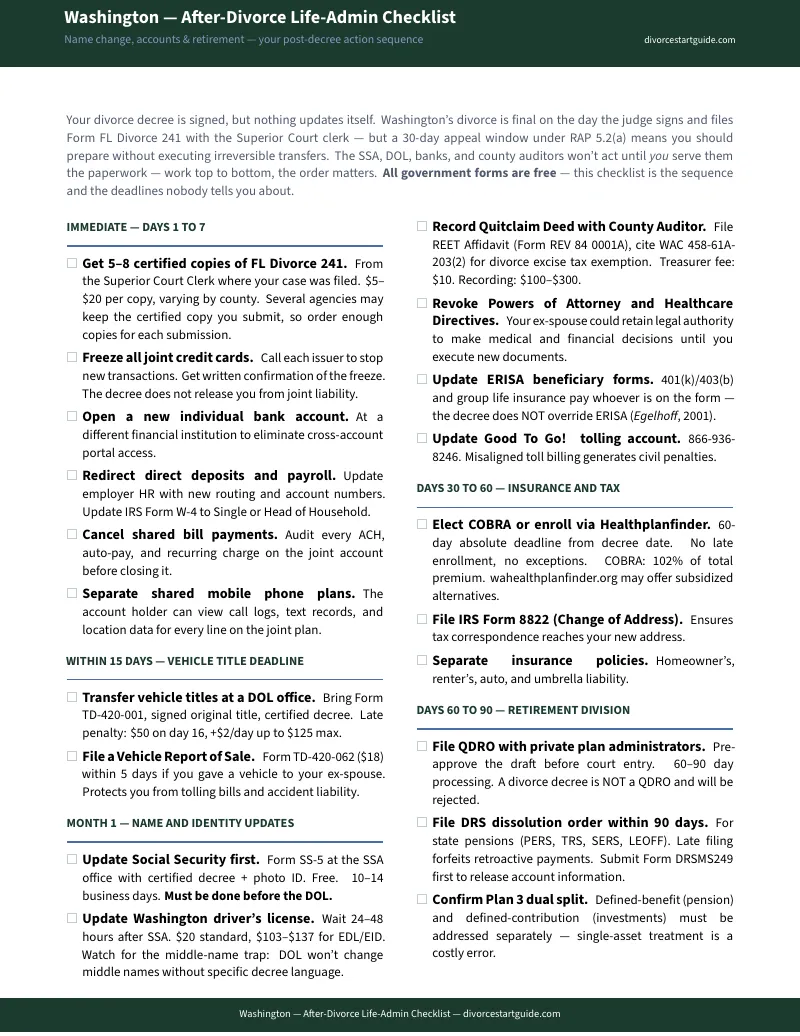
- The Post-Divorce Action Checklist — 23 items organized chronologically in dependency order, so you work through them in the sequence that prevents rejections and missed deadlines
- 8 Printable Worksheets — Post-Divorce Timeline Tracker, Name Change Sequence Worksheet, Financial Account Separation Log, Beneficiary Designation Audit, Real Estate Transfer Checklist, Vehicle Title Transfer Checklist, Retirement Division Tracker, and Agency Communication Log
Who This Guide Is For
- You just received your Final Divorce Order and need the roadmap. The court gave you a signed decree. Nobody explained what to do with it. This guide sequences every administrative step.
- You handle your own post-divorce paperwork. You earn too much for free legal aid but cannot justify Washington attorney rates for tasks you can manage yourself with the right instructions.
- You need to divide a retirement account. QDRO preparation services charge $299–$700. This guide explains the entire process so you understand what you are paying for before you hire anyone.
- You want to avoid the five most expensive post-divorce mistakes in Washington. Delayed QDROs, missed vehicle-transfer deadlines, unupdated ERISA beneficiaries, skipped REET exemptions, and premature property transfers during the appeal window — any one of these can cost hundreds to thousands of dollars.
Why Not Just Use the Free Court Website?
The Washington Courts self-help portal manages the court's litigation process — filing petitions, scheduling hearings, submitting stipulations. The court's responsibility ends the moment the judge signs the decree. Court staff are prohibited from providing administrative guidance on what comes next.
This guide picks up exactly where the court stops: the sequence of agency updates, the tax exemptions and deadlines, the federal ERISA loopholes the court has no jurisdiction over, and the Washington-specific forms and fees that no generic post-divorce checklist covers.
Satisfaction Guarantee
If the guide does not save you time and prevent at least one costly administrative mistake, email us and we will make it right. We read every message.
Get Started
Download the free checklist to see the structure and scope. When you are ready for the full guide — with step-by-step instructions, worked examples, worksheets, and the complete dependency map — upgrade to the full toolkit for less than half an hour of attorney time.
The free checklist gives you the task list. The full guide gives you the execution plan — the forms, the sequence, the deadlines, and the traps to avoid.