
Vermont's courts hand you blank forms. They don't explain how to fill them in.
You've found Form 400-00825 on vtcourts.gov — the Agreement on Parental Rights and Responsibilities. You've realized the form asks for your proposed parenting schedule, your decision-making arrangement, your holiday rotation, and your dispute resolution method. But it doesn't tell you how to calculate whether an every-other-weekend schedule or a 2-2-3 rotation keeps you above the 25% overnight threshold that determines your child support tier. It doesn't explain how Vermont's nine best-interest factors under 15 V.S.A. § 665(b) will shape a judge's evaluation of your proposed plan. And it doesn't walk you through what the court-ordered mediator expects you to bring — or what happens when you show up without a draft proposal.
Meanwhile, a family law attorney in Vermont charges $200–$400 per hour. A typical contested custody case runs $10,000 to $50,000. Two or three of those billable hours go to the lawyer asking you questions you could have answered yourself — if someone had told you what the questions were and how to think through the answers.
You don't need someone to write your parenting plan for you. You need to understand what the plan requires before you sit down to draft it.
The PR&R Navigation System
This is a complete, step-by-step guide to navigating child custody in Vermont — built around the specific statutes, court rules, and procedural requirements that make this state different from every other. It is not legal representation and it does not generate court forms. It is the planning intelligence that blank forms and generic legal websites leave out.
At its core is the PR&R Navigation System — a structured method that takes you from "I know I need a parenting schedule but I don't know what the court expects" to a comprehensive, child-focused arrangement that meets the best-interest standard under 15 V.S.A. § 665(b). It handles the part everyone gets wrong: understanding that Vermont uses entirely different terminology from other states — "Parental Rights and Responsibilities" instead of "custody," and "legal responsibility" and "physical responsibility" instead of "legal custody" and "physical custody." Mapping parenting time templates against the 25% and 30% overnight thresholds so your schedule doesn't accidentally trigger a child support recalculation you didn't anticipate. Preparing structured proposals before court-ordered mediation so you walk in with options rather than starting from zero on the mediator's clock. And navigating the 90-day nisi waiting period — including when waiving it makes financial sense and when keeping it preserves your health insurance.
What's inside — the 12-chapter guide, 10 standalone worksheets, and the free starter checklist
- The Vermont PR&R Translation Guide — a plain-language breakdown of how Vermont's unique terminology maps to the custody concepts you've seen elsewhere. Legal responsibility vs. physical responsibility, sole vs. shared arrangements, and why Vermont courts cannot order shared responsibility unless both parents agree under 15 V.S.A. § 665(a). Because using the wrong term in your filing signals to the judge that you copied a template from another state.
- The 9 Best-Interest Factors — Explained and Applied — every factor a family court judge evaluates under 15 V.S.A. § 665(b), from the child's relationship with each parent to the ability of each parent to foster the child's relationship with the other parent. Translated from legal language into concrete evidence you can gather and organize. Includes a self-assessment worksheet so you can evaluate your own position on each factor before your first hearing.
- Parenting Schedule Templates with Overnight Calculations — detailed walkthroughs of 2-2-3, 2-2-5-5, and week-on/week-off rotations, each with exact overnight counts mapped against the 25% threshold (92 nights) and 30% threshold (110 nights). Includes age-appropriate adaptations for infants, toddlers, school-age children, and teens, plus separate scheduling guidance for parents living apart under the same roof during the six-month separation period.
- Holiday Rotation Planner — a printable worksheet covering every major holiday with alternating odd/even year options, specific transition times, and rules for when holidays override regular weekly schedules. Includes Vermont-specific considerations like school break calendars and Town Meeting Day.
- Child Support and Overnight Worksheets — Vermont's Income Shares Model explained with calculation worksheets that show how sole custody, shared custody (25%+ overnights), and the Partial Shared Costs Table (25–30% range) affect your obligation. Helps you run the numbers before you propose a schedule.
- Form 400-00825 Section-by-Section Guide — a walkthrough of every section of the state's official parenting plan form, with pre-written customizable clauses for scheduling, holiday rotations, medical decision-making, communication rules, and dispute resolution. Because filling in a form is easy — knowing what to write in each section is the hard part.
- Mediation Preparation Guide — a step-by-step walkthrough of what to expect in court-ordered mediation under Rule 18 of the Vermont Rules of Family Procedure, including the state's subsidized mediation program for qualifying families. Comes with a worksheet for drafting structured proposals before the session.
- High-Conflict and Protective Provisions — pre-drafted plan language for supervised exchanges, mandatory communication apps, substance testing requirements, and relocation notification protocols under 15 V.S.A. § 665a. Clear guidance on when a self-help approach is safe, when to use subsidized mediation, and the exact indicators that require professional representation or a domestic violence advocate.
- Modification Assessment Worksheet — the "real, substantial, and unanticipated change of circumstances" standard under 15 V.S.A. § 668(a), with a worksheet to evaluate whether your situation qualifies and how to document your case. Covers the Hawkes v. Spence framework for relocation disputes.
- The Nisi Transition Playbook — practical guidance on managing the 90-day waiting period after your final hearing, including when to request a waiver, health insurance implications, tax filing considerations, and the financial trade-offs of finalizing your divorce immediately vs. keeping the nisi period intact.
- COPE Class and Court Process Roadmap — the mandatory four-hour COPE seminar (registration, cost, waivers, alternatives), the Case Manager Conference timeline, and a step-by-step reference for both the stipulated (agreed) and contested filing paths. Includes the reduced $90 filing fee for stipulated cases vs. the standard $295.
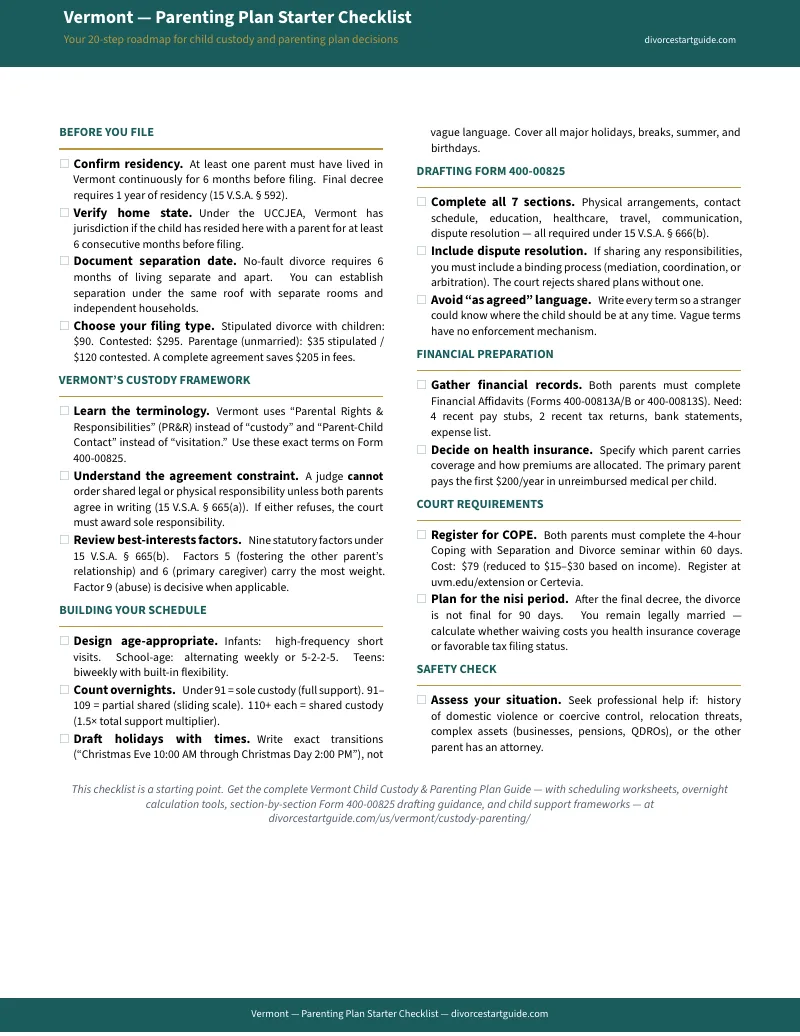
- Free Starter Checklist — a standalone 20-item parenting plan checklist covering custody basics, filing deadlines, required documents, and the COPE class — yours to keep whether or not you get the full guide.
Who this is for
The parent who just learned that Vermont calls it "Parental Rights and Responsibilities" instead of "custody" and has no idea what that means for their week-to-week schedule. The self-represented filer who downloaded the court forms from vtcourts.gov and realized the blanks don't come with instructions. The parent heading into court-ordered mediation who wants to arrive with draft schedules already calculated — not start from scratch while the mediator waits. The parent running the overnight math to see whether a proposed schedule crosses the 92-night threshold into shared custody — and what that means for child support. The parent living separate and apart under the same roof during the six-month waiting period who needs a temporary arrangement that keeps the household functional. And the parent with an existing custody order that no longer works because jobs changed, children got older, or someone wants to relocate.
Why not just use the free resources?
Because free resources give you definitions, not decisions. The Vermont Judiciary Self-Help Center and VTCourtForms portal provide blank forms and basic filing instructions. Vermont Law Help explains the difference between legal and physical responsibility in general terms. Law firm blogs discuss the best-interest factors to get you to call for a $275 consultation. None of them give you a worksheet that maps your specific week across two households and calculates whether you meet the 25% overnight threshold. None provide mediation preparation worksheets for drafting structured proposals. None walk you through the child support formula with your actual income numbers — or show you exactly how shifting one overnight per week changes your obligation.
The co-parenting apps — Custody X Change at $72+ per year, OurFamilyWizard at $150–$300 per year per parent — are built for ongoing schedule tracking and parent-to-parent messaging, not initial plan drafting. They don't map Vermont's specific PR&R terminology, the COPE requirement, the nisi period, or the court filing timeline. They are useful tools after you have an agreement. This guide helps you write the agreement.
A straightforward guarantee
Work through the PR&R Navigation System. If the guide doesn't give you a clearer, more organized understanding of Vermont's custody process than any free government page or blank court form could — email us within 30 days for a full refund. The cost of trying it is a fraction of one attorney consultation. The cost of filing an incomplete or poorly structured parenting plan is a rejected motion, a reclassified custody tier, or months of additional litigation.
For — less than fifteen minutes of attorney time — you get the scheduling worksheets, the overnight calculations, the mediation preparation tools, and the Form 400-00825 drafting guide that the blank forms leave out.
Stop guessing what the court expects. Get the guide, build your parenting plan, and walk into your next step — whether that's mediation, a lawyer's office, or the courthouse — with the work already done.