Texas Hands You the Forms for Free — Then Leaves You to Guess the Order, the County Rules, and What to Say to the Judge
You can download every Texas divorce form tonight without spending a dime. What you can't download is the answer to the questions that actually stall people: Am I even allowed to file in this county yet? Does my county attach automatic Standing Orders the second I file? Why did the clerk reject my petition? My spouse signed the waiver — is it valid? And what exactly am I supposed to say at the prove-up hearing before the judge signs anything?
Get the sequence wrong and the costs are real. File in the wrong county because your 90-day residency clock restarted after a move, and your case is dismissed — filing fee gone. Have your spouse sign the Waiver of Service on the same day you file, and you've built a hidden defect that can void your Final Decree. Upload your petition and standing order as one PDF to eFileTexas, and the clerk rejects the envelope — they are legally prohibited from telling you why in plain terms. And even when everything is agreed, Texas still makes you stand before a judge and deliver sworn testimony. Most people have no idea that's coming until the court tells them.
The Texas Divorce Filing Process Guide is a Petition-to-Prove-Up Roadmap — a step-by-step process navigation system that takes you from confirming your eligibility to file, through e-filing, service, and the waiting period, all the way to delivering your sworn testimony at the prove-up hearing. It contains zero blank forms (Texas gives you those free, and you should use them). What it gives you is the assembly manual the forms don't come with: the exact sequence, the county-level rules, the deadline math, and the rehearsal scripts.
What's Inside the Guide
The guide ships with eight printable worksheets and trackers alongside it — fill them in, print them, and bring them to the courthouse:
- Residency & Venue Eligibility Worksheet — Calculate your exact filing-eligibility date under the 6-month state / 90-day county rule (Texas Family Code § 6.301), including how a move between counties restarts the clock — so you never file into a dismissal and lose your fee
- Track Selection Decision Tree (guide chapter) — Agreed, default, or contested: the honest criteria that tell you which path you're on, what each one demands, and when DIY stops being safe
- County Standing Orders Registry — Which counties (Dallas, Bexar, Travis, Collin, Denton, Fort Bend, and more) attach automatic injunctions the moment you file — restricting bank transfers, insurance changes, and travel with your kids — and how Harris and Tarrant filers get the same protections through a TRO instead. Violating one of these is contempt of court; most filers don't know they exist
- E-Filing Rejection-Proof Checklist — The exact formatting rules clerks reject filings for: text-searchable OCR PDFs, file names under 50 characters with no special characters, one pleading per Lead Document, the correct filing code (Divorce with Children vs. without), and complete signature blocks on every document
- Service of Process Walkthrough — The Waiver of Service timing trap (it cannot be signed until at least one day after filing — an early waiver can void your decree), plus constable and private process service, and citation by publication when your spouse can't be found
- Default Judgment Roadmap — How to calculate the answer deadline (10:00 a.m. on the Monday after 20 days from service), the 10-day Return of Service requirement, and the exact evidentiary showing a judge needs before signing a default decree
- "Just and Right" Property Worksheets — Map your community property and debts and build a division that fits your actual lives instead of a mechanical 50/50 split — with the transfer steps free templates never mention, like Special Warranty Deeds for real estate and QDROs for retirement accounts
- 60-Day Waiting Period Tracker — When the clock starts, why no judge can sign before day 61, the family-violence exception, the parenting class requirement, and how to use the wait productively so you finalize the moment you're eligible
- Prove-Up Testimony Scripts — Word-for-word rehearsal scripts for the sworn hearing, with and without minor children: residency, insupportability, your agreement, and the "just and right" confirmation — so you walk in knowing every question before the judge asks it
- Fee Waiver Guide — How to complete the Statement of Inability to Afford Payment of Court Costs, what income evidence supports it, and what happens if the court questions it — because the $300–$440 filing fee shouldn't be what stops you
Who This Guide Is For
- You and your spouse agree on the terms and want to file without a $2,500–$10,000 attorney retainer — but you need the exact order of operations, not a stack of PDFs
- You recently moved within Texas and aren't sure your county's 90-day residency clock has run out
- Your spouse is unresponsive, uncooperative, or can't be located — and you need the default or publication path mapped out deadline by deadline
- You're anxious about the prove-up hearing and want to rehearse exactly what you'll say under oath
- You can't afford the filing fee and need the fee-waiver process explained in plain language
- You plan to hire a lawyer for advice but want to handle the administrative filing work yourself — and stop paying $300+ an hour for clerical tasks
Why Not Just Use the Free Forms — or a $159 "Online Divorce" Site?
TexasLawHelp.org provides excellent free, state-approved forms — and this guide tells you to use them. But the forms assume you already know the process. They don't tell you whether your county enforces Standing Orders, that your spouse's waiver is invalid if signed a day too early, that eFileTexas rejects PDFs that aren't text-searchable, or that a judge will question you under oath before signing anything. The state gives you car parts. This guide is the assembly manual.
The national alternatives are worse in a different way. Document generators like LegalZoom and 3StepDivorce charge $99–$399 for generic state-level packages that routinely miss county-level e-filing codes and Standing Orders — the exact things that get Texas filings rejected. The "$159 online divorce" sites that dominate the ads are widely reported to hide $34.99 monthly subscription traps and deliver little more than links to the same free government PDFs. And none of them prepare you for the prove-up hearing at all.
This guide is the missing layer between free forms and a full-scope attorney: county-specific, current (including the September 2023 discovery-rule changes that made mountains of online advice obsolete), and built around the administrative reality of Texas district clerks — for , less than the fee you'd lose to a single rejected filing or dismissed case.
Our Guarantee
This is an educational process-navigation guide — not legal advice, and not a substitute for an attorney. It's also honest about its limits: an entire chapter is devoted to the red flags (contested issues, business ownership, hidden assets, family violence) that mean you should stop and hire a professional, with guidance on exactly which kind. If the guide doesn't give you a clearer picture of your filing process than you had before, email us at any time and we'll refund you.
Get Started Tonight
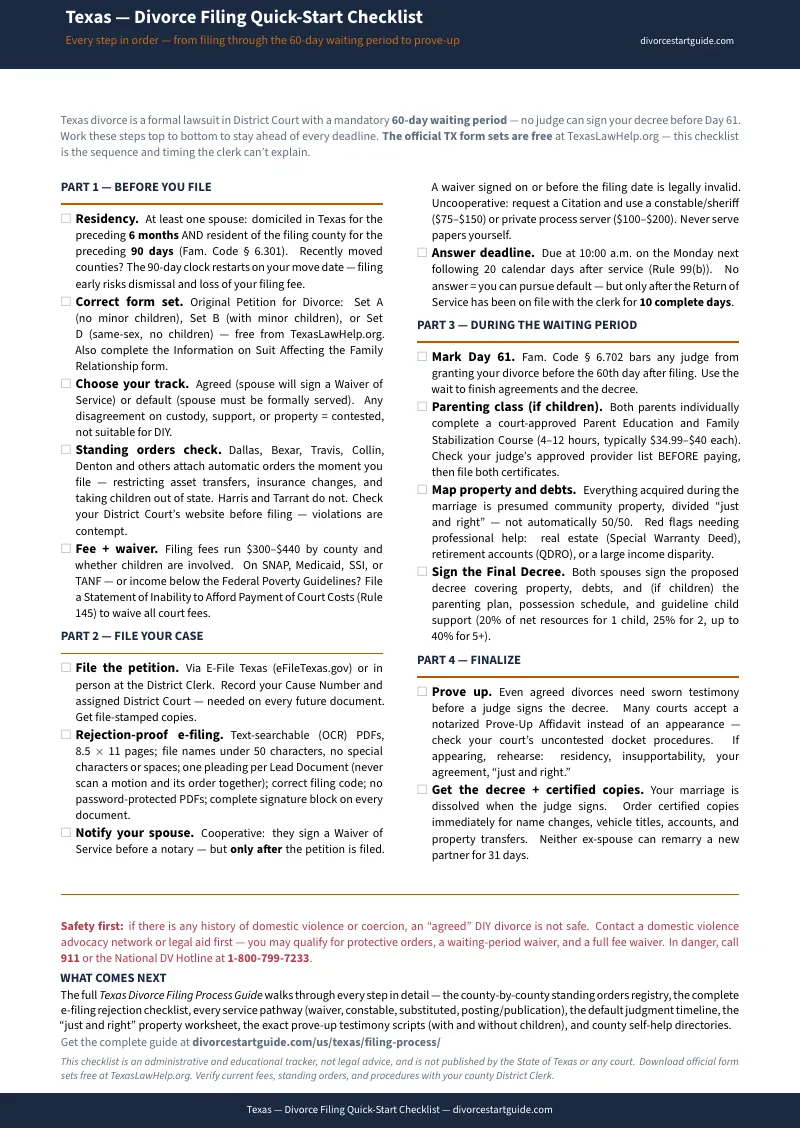
Not ready to buy? Download the free Texas Divorce Filing Quick-Start Checklist — a one-page overview of the filing steps, residency rules, and waiting period — and verify your eligibility before you spend anything.
Ready to file with confidence? Get the complete Petition-to-Prove-Up Roadmap and work through your filing step by step, worksheet by worksheet, until the judge signs your decree.