
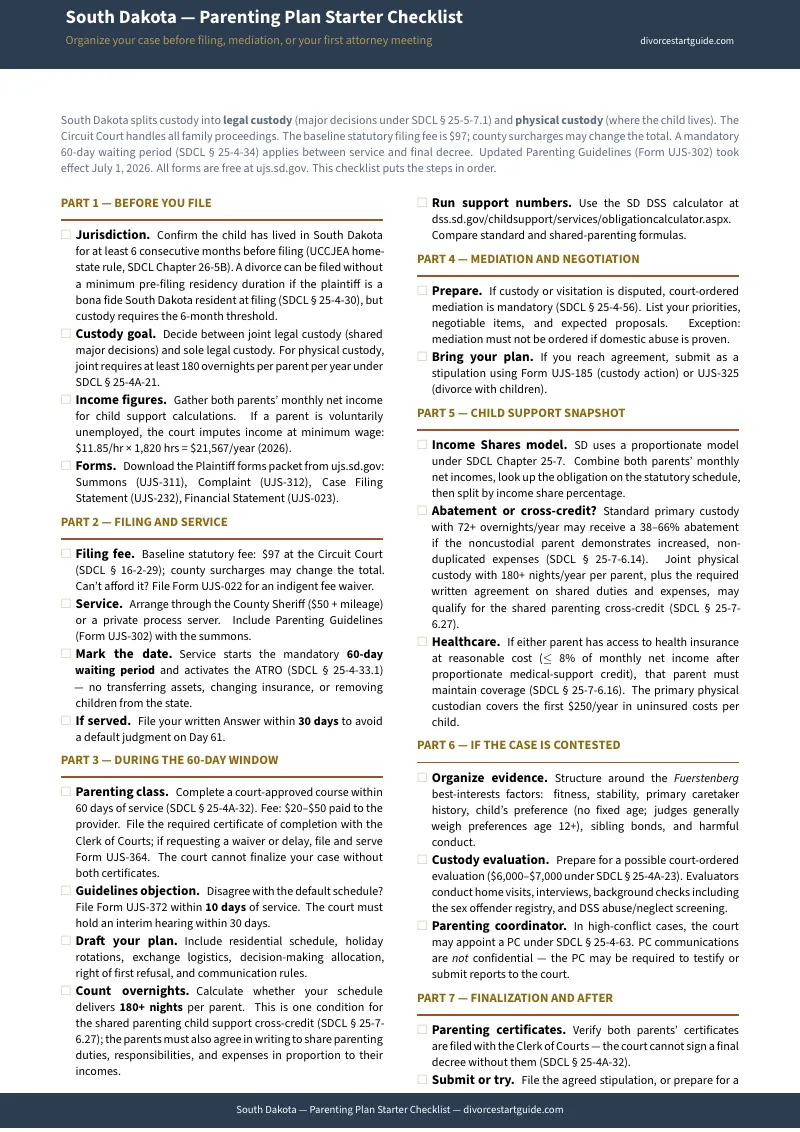
The SD Custody Navigator — Because Blank Court Forms Don't Tell You What to Write
South Dakota's custody timeline starts the moment someone gets served. From that day, two clocks are running: you have 60 days before the court can finalize anything, and both parents must complete a mandatory parenting education course within those same 60 days. Miss the course deadline under SDCL 25-4A-32 and the court holds up your entire case. File a sloppy Answer past the 30-day window, and the other parent can pursue default judgment — finalizing custody terms you never agreed to.
Here's what most parents don't realize until it's too late: the schedule you live under during the case tends to become the permanent one. Accept "every other weekend" as a temporary arrangement while you figure things out, and three months later a judge calls it the established routine your child has adjusted to. Agree to 179 overnights instead of 180, and you fall off the shared parenting child support formula entirely — a difference that can cost hundreds of dollars every month under South Dakota's Income Shares Model.
The Unified Judicial System posts the forms for free. Form UJS-185 for stipulations, UJS-311 and UJS-312 for motions, the UJS-302 Parenting Guidelines that become an automatic temporary order when served. But by law, court staff cannot tell you what to write in those blanks, which custody structure to pursue, or how the schedule you pick shifts your child support number. And a South Dakota family lawyer charges between $118 and $415 per hour, with retainers starting around $2,500 for contested cases.
The South Dakota Child Custody & Parenting Plan Guide is the SD Custody Navigator: the exact decision-making sequence from the day you separate through the 60-day waiting period, mandatory mediation, and your final parenting plan — with step-by-step drafting frameworks for every provision the court expects, the child support math that turns your schedule into a financial decision, and evidence-organization worksheets built around the Fuerstenberg best-interests factors South Dakota judges actually apply. Written for South Dakota statutes and circuit court procedures, not adapted from a national template.
What You Get
The Guide (12 Chapters, 48 Pages)
How Custody Actually Works in South Dakota — the two independent axes of custody (legal vs. physical), why joint legal custody is not the same as joint physical custody, the unmarried-parent default under SDCL § 25-5-10 that gives the mother sole custody until the father takes formal action, and why temporary informal arrangements can harden into permanent orders if you don't document their intended end date.
The Fuerstenberg Best-Interests Factors — the multi-factor framework from the South Dakota Supreme Court that circuit judges must apply in every contested case: parental fitness, stability, primary caretaker history, sibling integration, the child's intelligent preference (no fixed minimum age — the judge decides), and the "friendly parent" factor that penalizes parents who obstruct the other parent's relationship. You'll know exactly what the court weighs before you walk into a hearing.
The 2026 Parenting Guidelines (Form UJS-302) — what changed effective July 1, 2026, how the guidelines function as an automatic temporary custody order from the moment of service, what the age-specific schedules actually require for infants through teenagers, and why these guidelines are a floor (minimum parenting time), not a ceiling.
Building Your Parenting Plan — the complete list of provisions the court expects: residential schedules, holiday rotations, exchange logistics, decision-making allocation by category, right of first refusal, communication protocols, and transportation responsibilities. You'll draft each section using the same structure circuit judges review every day.
The Court Process — Filing Through Final Decree — the 30-day Answer deadline, the 60-day waiting period under SDCL 25-4-34, temporary orders, the Automatic Temporary Restraining Order under SDCL 25-4-33.1 that freezes assets and insurance from the moment of service, and the step-by-step filing process for both plaintiffs and defendants.
Mandatory Mediation and Dispute Resolution — how court-ordered mediation works under SDCL 25-4-56, what to prepare before your session, how to structure proposals and fallback positions, confidentiality protections, cost-sharing rules, and when a parenting coordinator may be appointed under SDCL 25-4-63 for high-conflict cases.
Relocation Rules — the 45-day written notice requirement under SDCL 25-4A-17, the 30-day objection window, what constitutes a qualifying relocation, and the exceptions that apply in emergency situations.
Child Support and the 180-Night Threshold — step-by-step walkthrough of South Dakota's Income Shares Model, the shared parenting cross-credit formula (1.5× multiplier, income-proportional offset), the standard monthly abatement for 6+ overnights, and worksheets to calculate your obligation under different schedule scenarios before you agree to anything.
Emergency Custody and Enforcement — when and how to seek an emergency temporary order, the legal standard for immediate irreparable harm, contempt proceedings for parenting-plan violations, and the UCCJEA jurisdiction rules that govern interstate custody disputes.
The Checklist (25 Items)
A chronological action checklist that maps every step from pre-filing preparation through finalization — jurisdictional checks, document assembly, the parenting education course requirement, mediation preparation, and the evidence-gathering tasks that feed each Fuerstenberg factor. Two compact pages. Designed to sit beside your calendar.
The Worksheets (6 Printables)
Parenting Plan Timeline Tracker — enter your date of service and map every statutory deadline: the 10-day guidelines objection window, the 30-day Answer, the 60-day parenting education and waiting-period deadlines, and Day 61.
Parenting Time Schedule Planner — sketch your two-week pattern, tally a full year of overnights per parent, and check whether your schedule clears the 180-night threshold before you agree to it.
Child Support Estimation Worksheet — run both formulas with your real numbers: the standard primary-custody calculation and the shared parenting cross-credit, plus the healthcare, childcare, and uninsured-cost allocations the court will make.
Mediation Preparation Worksheet — a position grid for must-haves, negotiables, and the proposals you expect from the other parent, with space for your opening proposal, fallback concessions, and walk-away point.
Evidence Organizer — a factor-by-factor evidence map built on the Fuerstenberg framework, plus an evidence inventory linking every document and witness to the factor it supports.
Agency Communication Log — a landscape log for every call and filing with the clerk, mediator, evaluator, or DSS: who said what, when, and what follow-up is required.
Who This Guide Is For
- Uncontested parents who agree on the basics and want to draft a parenting plan that a circuit judge will approve without an evidentiary hearing — and want to understand the financial math before they sign
- Contested parents preparing for mandatory mediation who need to show up with structured proposals, organized evidence, and a clear understanding of what the court will weigh
- Unmarried fathers establishing paternity and seeking enforceable custody or parenting time for the first time
- Parents who were just served and need to understand the 30-day Answer deadline, the 60-day timeline, and how to protect their parenting time while the case is pending
- Parents considering whether to hire a lawyer — the guide's consultation-threshold chapter helps you decide when self-representation makes sense and when the complexity of your case requires professional counsel
Why Not Just Use Free Resources?
South Dakota's UJS Self-Help portal provides the forms and basic instructions. DivorceNet and Custody X Change provide general overviews. LegalZoom sells automated forms for $150 to $300 that pull from national templates without South Dakota-specific detail. And co-parenting apps like OurFamilyWizard are built for after the order — they don't help you navigate the process of getting one.
What none of these tools do is connect the decisions. The schedule you choose determines your child support. The evidence you gather maps to specific Fuerstenberg factors. The provisions in your parenting plan either match what UJS-302 requires or they don't. Each piece depends on the others, and making them work together is the part where parents get stuck — and where a $2,500 retainer starts looking inevitable.
This guide connects those decisions into one sequence. You'll understand how changing your schedule from 179 to 180 overnights shifts your support obligation, how to organize evidence around the specific factors a judge will evaluate, and how to draft plan provisions that a circuit court will approve. The free forms tell you what to submit. This guide tells you what to write.
What You Won't Find Here
This is not legal advice, and we don't sell blank court forms (those are free from the Unified Judicial System). This is a process navigator and decision-making workbook. It explains how South Dakota custody law works, walks you through the decisions you need to make, and gives you frameworks to organize your case — whether you handle it yourself or bring the work to an attorney.
100% satisfaction guarantee. If the guide doesn't help you navigate your custody case with more clarity and confidence, email [email protected] for a full refund.
The free checklist covers the what — the steps you need to take. The full guide covers the how — the decisions, calculations, and evidence-building that make each step work.