Your Divorce Is Final. Your Life Admin Is Just Starting.
The judge signed your Judgment of Absolute Divorce. After a full year of mandatory separation, you finally have the decree. But your Social Security card still carries the old name. Your bank still lists your ex as a joint account holder. Your 401(k) beneficiary form still names the person you just divorced. And every agency you call tells you to visit a different agency first.
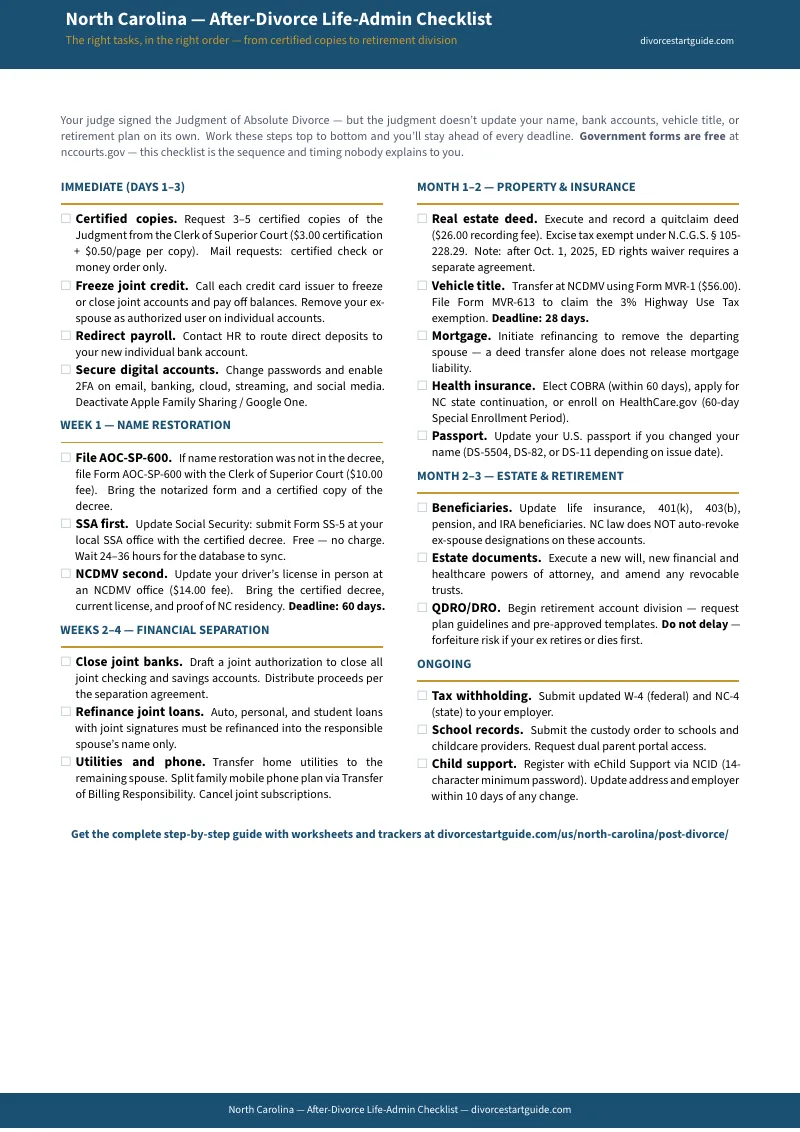
The North Carolina After-Divorce Checklist is a post-decree navigation system — the operational sequence that picks up exactly where your attorney (or your courthouse paperwork) left off. It maps every agency, every form, every dependency chain, and every deadline into one plain-English roadmap with tracking worksheets.
The Chasm Between "Legally Divorced" and "Actually Divorced"
North Carolina's court system provides free forms and the eCourts Guide & File portal. The Clerk of Superior Court hands you a signed decree. What nobody hands you is the operational manual for what comes next — the exact order of agency visits, which forms each institution requires, and what happens when your ex-spouse refuses to sign a quitclaim deed or cooperate with a retirement account division.
This creates a dangerous gap. Update the NCDMV before Social Security and your application gets rejected — the DMV's online verification system checks SSA records in real time. Submit a QDRO to the court before the plan administrator pre-approves it and the judge sends it back. File a quitclaim deed without the divorce excise tax exemption language and the Register of Deeds charges you $1 per $500 of property value. Miss a beneficiary update on an ERISA-governed retirement plan and your ex-spouse inherits the account regardless of what the divorce decree says.
This guide closes that gap.
What's Inside
Name Restoration Sequence — AOC-SP-600 and the Agency Chain
If your decree includes a name restoration order, you already have what you need. If it was omitted, Form AOC-SP-600 (Notice of Resumption of Former Name) must be filed with the Clerk of Superior Court — $10 filing fee, notarization required. Either way, the agency sequence is the same: Clerk of Court first, then Social Security (Form SS-5, free), then NCDMV (within 60 days of the change), then passport (Form DS-82), then everything else. The guide maps every step with the documents each agency requires and the processing windows between them.
SSA-NCDMV Dependency Chain
The NCDMV uses the Social Security Online Verification System to confirm name changes in real time. If you visit the DMV before SSA has processed your update, the system flags a mismatch and rejects your application — wasting a trip and delaying everything downstream. The guide maps the exact wait window (24–48 hours minimum after SSA submission) and the documents the NCDMV requires: certified decree or AOC-SP-600, current license, and proof of liability insurance.
Joint Account Separation Playbook
Banks are not parties to your separation agreement. If the agreement assigns a joint credit card to your ex-spouse, the bank can still legally pursue you for the full balance. Meanwhile, your ex retains full withdrawal rights on every joint deposit account until you act. The guide includes a bank-by-bank action plan for closing or converting joint accounts, a credit freeze checklist for all three bureaus, and the steps to redirect automatic deposits and recurring payments without leaving gaps.
QDRO and Retirement Division — NC State Plans, 401(k), and Pension
Dividing retirement accounts is the highest-stakes post-divorce task — delay it, and if your ex retires or withdraws before the court order is filed, the money may be permanently gone. ERISA-governed plans (401(k), 403(b)) require the plan administrator to pre-approve the draft QDRO before the court will sign it. North Carolina state and local government pension plans administered by the NC Department of State Treasurer use their own Domestic Relations Order format with state-specific model language. The guide covers the pre-approval workflow, the difference between a QDRO and a DRO, the tax-free rollover rules (direct transfer to your own IRA avoids the 20% mandatory withholding), and the timeline for each plan type.
Real Estate Deed Transfers and the Excise Tax Exemption
Court-ordered property transfers require a quitclaim deed, notarized and recorded with the county Register of Deeds. Under N.C. Gen. Stat. § 105-228.29, deed transfers incident to divorce are exempt from the state's real property excise tax ($1 per $500 of value) — but the deed must state the exemption on its face. Miss this and you pay an unnecessary tax on the full property value. The guide covers the exemption language, the October 2025 waiver rule for the seven coastal counties, and the critical distinction: a quitclaim deed transfers ownership, but it does not remove your ex from the mortgage. That requires refinancing.
Vehicle Title Transfer — MVR-1 and the Highway Use Tax Exemption
Transferring a vehicle title after divorce uses Form MVR-1 (Application for Title) plus Form MVR-613 (Highway Use Tax Exemption). Without the MVR-613, the NCDMV assesses highway use tax on the transfer as if you purchased the vehicle. The guide covers the required documents, the title transfer sequence, and how to coordinate it with a name change to avoid making two separate trips to the DMV.
Estate Plan Overhaul and the ERISA Gap
North Carolina's automatic revocation statute (N.C. Gen. Stat. § 31-5.4) revokes certain will provisions that benefit an ex-spouse upon divorce. But it does not touch ERISA-governed retirement plans, life insurance policies governed by federal law, or POD/TOD designations on bank and brokerage accounts. If you do not update these manually, your ex-spouse may inherit assets the divorce was supposed to separate — even if your will says otherwise. The guide includes a beneficiary audit worksheet that covers every account type and the federal-vs-state priority rules.
Handling an Uncooperative Ex-Spouse
If your ex refuses to sign a quitclaim deed, execute a retirement account order, or complete any court-ordered transfer, you do not need to chase them. Under Rule 70 of the North Carolina Rules of Civil Procedure, the court can appoint a commissioner to sign on behalf of the non-compliant party. The guide covers contempt motions, Rule 70 relief, and the documentation the court requires to grant enforcement.
90-Day Action Plan + 9 Standalone Printable Worksheets
A chronological, week-by-week timeline that sequences every update in the correct dependency order — from obtaining certified copies of the decree through title transfers, retirement divisions, and estate plan rewrites. Includes 9 standalone printable worksheets: 90-day action plan, critical deadline tracker, document update worksheet, account separation tracker, beneficiary audit, name change agency sequence, QDRO quick reference, deed transfer checklist, and vehicle title transfer checklist.
Who This Guide Is Built For
- People who just received their Judgment of Absolute Divorce and have a stack of accounts, IDs, and titles to update — but no project plan for the order of operations
- Self-represented filers whose attorney relationship ended when the decree was signed and who need to execute the administrative uncoupling themselves
- Attorney-represented filers whose lawyers handled the courtroom but left the DMV visits, bank separations, and beneficiary updates to the client
- People who need to divide a state pension or 401(k) and want to understand the QDRO process before paying a specialist $1,500–$3,000 to draft the order
- Homeowners who need to transfer a deed, understand the excise tax exemption, and figure out whether refinancing is required
- Anyone dealing with an uncooperative ex-spouse who won't sign transfer documents or comply with the court order
Why Not Just Use the Free Court Forms?
You should absolutely use the free forms from nccourts.gov and the eCourts Guide & File system — this guide is designed to work alongside them.
But consider what the state portal doesn't provide:
- No post-decree sequence — the court's job ends when the judge signs the decree; nobody tells you which agency to visit first, second, or third
- No dependency mapping — updating the NCDMV before Social Security guarantees a rejection; the court portal doesn't explain these chains
- No retirement division walkthrough — the QDRO pre-approval workflow, the DRO model language for NC state plans, and the tax-free rollover rules are scattered across plan administrator websites and federal statute
- No excise tax exemption guidance — the quitclaim deed must state the exemption on its face; the Register of Deeds office won't tell you this until you're standing at the counter
- No enforcement tools — when your ex won't cooperate, the court's self-help resources don't cover contempt motions or Rule 70 commissioner appointments
The state gives you the decree. This guide gives you the operational blueprint for executing it — every agency, every form, every deadline, in the right order.
Satisfaction Guarantee
If the guide doesn't give you a clearer understanding of your post-divorce administrative path within 24 hours of download, email us for a full refund. No forms to fill out, no hoops.
— Less Than One Hour of Attorney Time
North Carolina family law attorneys charge $200–$600 per hour. Flat-fee firms charge $395–$900 just for the divorce filing. QDRO specialists charge $1,500–$3,000 to draft one retirement order. This guide gives you the complete post-decree sequence, tracking worksheets, and enforcement roadmap for a fraction of a single billable hour — and you can reference it every time you hit a procedural question.
The free checklist gives you the quick-start overview. When you're ready for the full guide with step-by-step instructions, financial separation playbook, retirement division walkthrough, and printable tracking worksheets — the complete toolkit is here.