Your divorce decree is signed. Nobody told you the real work starts now.
The New Mexico district court entered your Final Decree of Dissolution of Marriage. The marriage is legally over. And now you're looking at a Social Security card in the wrong name, joint bank accounts your ex can still drain, retirement plans that still name them as beneficiary, a mortgage with both names on it, and a will that leaves everything to the person you just divorced.
Each agency has its own forms, fees, and processing timeline — and a strict dependency order nobody explains. Visit the MVD before updating Social Security and your application gets rejected. Submit a QDRO to the court without plan administrator pre-approval and the judge sends it back. File a quitclaim deed without recording it at the county clerk's office and the title transfer never happened. As a community property state, New Mexico presumes everything acquired during the marriage is jointly owned 50/50 — but the decree doesn't execute those splits. You have to do it yourself, in the right order, with the right documents.
New Mexico courts provide free forms through the Guide & File portal. Court clerks are legally prohibited from telling you which order to complete them in. An attorney will tell you — at $250–$450 an hour. Three of those hours go to explaining SSA procedures and MVD appointments. That's over $750 in administrative hand-holding you can handle yourself — if someone gives you the sequence.
The Post-Divorce Sequencing System
This is a complete, step-by-step guide to every administrative task after a New Mexico dissolution — built around the one thing that free forms and generic checklists get wrong: the dependency order.
At its core is the Post-Divorce Sequencing System — a structured method that walks you through the exact order of federal, state, and private-institution updates so nothing gets rejected and nothing falls through the cracks. It handles the part everyone gets stuck on: knowing that SSA must come before the MVD, that plan administrator pre-approval must come before court filing, that New Mexico PERA won't accept a QDRO and requires its own DRO forms, that NMERB has a completely separate approval process through its Office of General Counsel, and that beneficiary designations on public pensions do not expire upon divorce.
What's inside — the 14-chapter guide, 9 standalone worksheets, and the free checklist
- Certified Copies and Decree Verification — how many certified copies to order (6–8 minimum), per-page costs at the district court clerk, mail-in request procedures for the Second Judicial District, and how to get copies from other judicial districts across New Mexico.
- Name Restoration vs. Post-Decree Petition — if your decree includes name restoration, you're set. If it was omitted, you can file a separate petition under the Name Change Act. House Bill 31 (effective June 2023) eliminated the newspaper publication requirement — but you still need the $137 filing fee and the correct petition forms. The guide covers both paths.
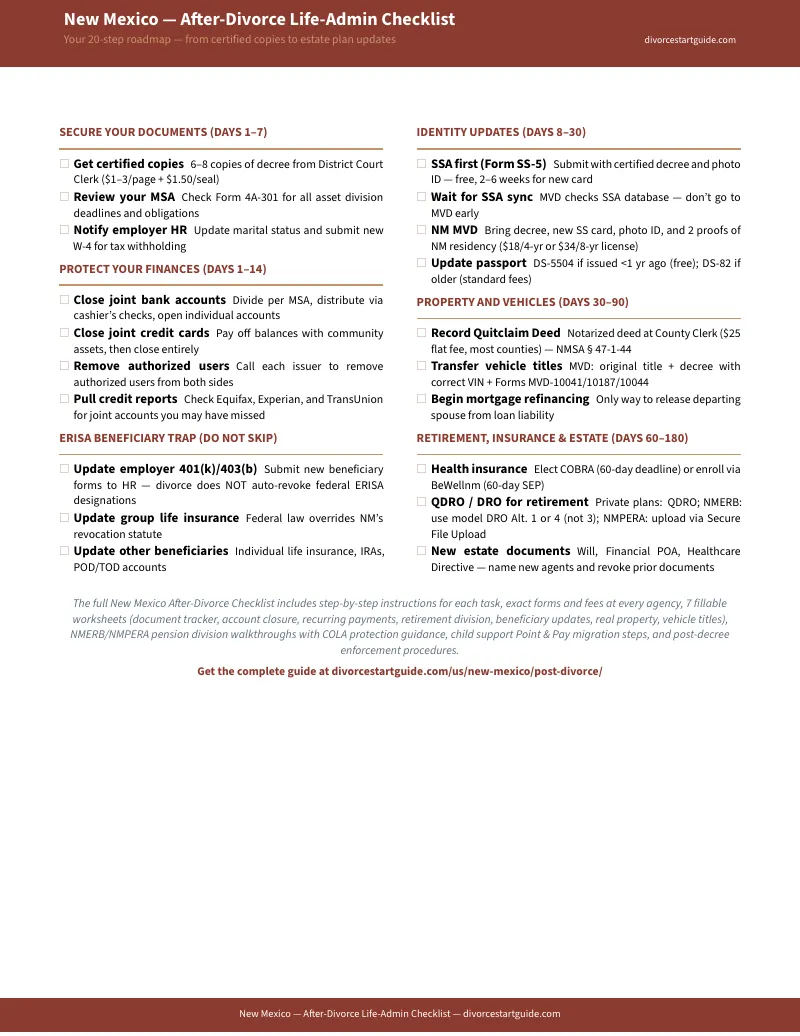
- The SSA → MVD Dependency Chain — the exact sequence (SSA Form SS-5 → wait for database sync → MVD field office with decree + new Social Security card + two proofs of residency → U.S. Passport DS-82) with processing windows and the documents each agency requires. The MVD checks your name against the SSA database in real time — skip the SSA step first and you'll be turned away.
- Joint Account Separation and Credit Protection — under New Mexico's community property rules, creditors are not bound by your divorce decree. Both parties remain jointly and severally liable until the account is formally closed or refinanced. The guide covers the bank-by-bank action plan, credit freezes at all three bureaus, authorized user removal, and how to protect your credit score from "ghost debts" — liabilities your ex-spouse was assigned by the court but that still show up on your credit report.
- QDRO for Private Plans vs. DRO for NMERB and PERA — two completely separate tracks. Private employer plans (401(k), 403(b), corporate pensions) require a Qualified Domestic Relations Order under federal ERISA law. NMERB (teachers and educational employees) requires a state-specific DRO drafted to comply with the Educational Retirement Act and approved by NMERB's Office of General Counsel. PERA (state and municipal employees) requires its own DRO forms under the PERA Act. The guide walks through both tracks with model orders and submission requirements.
- Beneficiary Designation Audit — under New Mexico administrative rules, pre-retirement beneficiary designations on NMERB and PERA accounts do not automatically expire or update upon divorce. The same applies to private life insurance policies. You must manually submit updated forms to each plan or insurer — the decree changes nothing. The guide includes a beneficiary audit worksheet covering every account type.
- Real Estate and the Mortgage Trap — a quitclaim deed transfers property ownership but has no effect on mortgage liability. The departing spouse remains fully responsible in the lender's eyes. Removing mortgage liability requires a refinance — and lenders require documented income history and proof of future support income continuance. The guide covers the 90-to-180-day execution window and what to do when your ex won't cooperate.
- Vehicle Title Transfers — the MVD title transfer process, required documents, and how to handle transfers when one spouse can't or won't sign the original title.
- Child Support via Point & Pay — how New Mexico's electronic payment system works, how to set up or modify automated payments, and what to do when payments are missed or the income withholding order needs updating.
- Health Insurance Transition — the critical 30-day Special Enrollment Period to secure new coverage after losing an ex-spouse's employer-sponsored plan, COBRA continuation costs and deadlines, and BeWellnm marketplace enrollment for New Mexico residents.
- Estate Plan Overhaul — updating wills, trusts, powers of attorney, and healthcare directives. New Mexico law may revoke some spousal provisions automatically — but federal ERISA law preempts state law for employer-sponsored plans. If you fail to manually update your beneficiary forms with HR, your ex keeps the entire benefit regardless of the decree.
- The 72-Hour / 30-Day / 90-Day / 180-Day Timeline — a phased action plan that sequences every update in the correct dependency order, with checkboxes and deadlines.
Plus 9 standalone printable worksheets
Each worksheet is its own PDF — print the ones you need and bring them to each appointment:
- Post-Divorce Document Tracker — every name, ID, and account update in one place with the SSA → MVD dependency order
- Joint Account Closure Tracker — audit all joint accounts, track balance division, and document closure confirmations
- Recurring Payment Migration Tracker — move every autopay and subscription before closing joint accounts
- Retirement Account Division Tracker — plan-by-plan tracker covering the private QDRO track and the separate NMERB/PERA DRO tracks
- Beneficiary Designation Audit — every account type checked, including ERISA-governed plans that follow federal law regardless of your decree
- Real Property Transfer Tracker — quitclaim deed recording steps, county clerk procedures, and refinancing timeline
- Vehicle Title Transfer Tracker — MVD title transfer forms, lien releases, and insurance switchover
- Health Insurance Transition Worksheet — COBRA deadlines, BeWellnm enrollment windows, and coverage comparison
- Critical Deadlines Reference — key time limits and New Mexico agency contacts at a glance
Who this is for
The person staring at a signed decree and a list of accounts, IDs, and titles that still have the wrong name on them. The newly single parent who needs to separate joint finances before the ex drains the checking account. The NMERB or PERA member who's been told they need a DRO and has no idea what that means or what forms to use. The homeowner who needs the ex off the mortgage but can't get them to cooperate. And the person with an attorney who wants to stop paying $300 an hour for someone to explain how the MVD works.
Why not just use the free resources?
Because the free resources give you forms, not sequences. The New Mexico Judiciary's Guide & File portal provides dissolution forms — but doesn't tell you that the MVD will reject your application if SSA hasn't synced yet. The Social Security Administration tells you what to bring to their office — but doesn't tell you to wait for database confirmation before visiting the MVD. NMERB provides model domestic relations orders on their website — but doesn't explain that PERA uses entirely different forms and a separate approval process.
The information exists across dozens of disconnected government websites, each one accurate for its own agency and silent about every other. This guide connects the dots into one sequenced workflow so you don't spend weeks bouncing between agencies that each point you somewhere else first.
An honest guarantee
Work through the Post-Divorce Sequencing System. If the guide doesn't make your post-divorce administration clearer and faster than any blank form or free article could — email us within 30 days for a full refund. The risk of trying it is a fraction of one attorney billable hour. The risk of missing a beneficiary designation, a PERA DRO deadline, or a credit freeze is measured in years of financial consequences.
For — less than fifteen minutes of attorney time — you get the sequenced checklist, the NMERB/PERA DRO workflow, the beneficiary audit, and the phased action plan that the free forms leave out.
Stop bouncing between agencies. Get the guide, work the sequence, and clear your post-divorce to-do list in weeks instead of months.