
Montana Can Divide Everything You Own — Even the Assets You Had Before the Marriage
Most states draw a line between marital property and separate property. Montana doesn't. Under MCA § 40-4-202, the District Court has statutory authority to divide all assets and debts — however and whenever acquired. Premarital homes, personal inheritances, retirement accounts you funded before you met your spouse — none of it is automatically off the table.
That legal reality creates a problem most people don't see coming until they're staring at the MP-500 Proposed Property Distribution form and realizing they have no idea what numbers to write on it. The Montana Judicial Branch provides the blank forms for free. What it doesn't provide is the math, the strategy, or the step-by-step sequence for figuring out a fair split.
The Montana Divorce Financial Split & Asset Division Guide bridges that gap. It's a process-navigation toolkit — 13 chapters of structured worksheets, decision trees, and Montana-specific instructions that walk you through identifying, valuing, and dividing every asset and debt in the marital estate.
The Equitable Division Blueprint
This guide doesn't guess at "fair." It gives you the structured system to build your own case for equitable division — using the same nine statutory factors Montana judges evaluate, the same tracing methods Montana attorneys use to protect separate property, and the same pension-division mechanics that MPERA and TRS require by law.
Whether you're representing yourself, preparing for mediation, or organizing your financial dossier before meeting with an attorney, the guide turns the overwhelming complexity of Montana property division into a clear, sequential process.
What's Inside — 11 PDFs
The complete toolkit includes a 13-chapter guide, a document-gathering checklist, and 9 standalone printable worksheets you can bring to mediation, your attorney, or the courthouse:
- The Four-Column Asset Allocation Ledger — a printable worksheet where you list every asset and debt, assign filing-date valuations, allocate each item to Spouse 1 or Spouse 2, and calculate an equalization payment. This is the backbone of your MP-500 preparation.
- Separate Property Tracing Workbook — the step-by-step diagnostic from the Montana Supreme Court's In re Marriage of Funk decision. Evaluate each premarital asset, inheritance, or gift against the statutory factors that determine whether a judge will insulate it from division or fold it into the marital estate.
- Home Buyout Feasibility Worksheet — calculate buyout equity, compare rate-and-term refinance versus cash-out refinance, and evaluate Fannie Mae's limited cash-out guidelines that may offer better terms. Covers all three paths: sell and split, buyout via refinancing, or continued co-ownership.
- QDRO Administrative Tracker — the six-step lifecycle for dividing private retirement accounts (401(k), IRA, 403(b)) without triggering early-withdrawal penalties. From requesting the model plan to receiving the final distribution.
- Montana Public Pension FLO Instructions — a reference card for PERS, TRS, JRS, and other MPERA-administered plans that don't accept federal QDROs. Covers the state-specific Family Law Order process under MCA § 19-2-907, including TRS Form A–F selection and the critical difference between Defined Sum and Proportionate FLOs.
- Debt Severance Plan — inventory every joint debt, plan the severance strategy by debt type, and track each account through decoupling completion. Includes the creditor liability trap warning and post-decree monitoring log.
- Spousal Maintenance Estimation Worksheet — the two-step statutory test under MCA § 40-4-203. Model potential maintenance scenarios based on the statutory factors, understand how maintenance and property division interact, and prepare for negotiation or court.
- MP-500 and MP-510 Preparation Sequence — a printable checklist for translating your completed worksheets directly into the official court forms. Covers the Proposed Property Distribution (MP-500) and Income and Expenses (MP-510) packets step by step, with a filing and decree timeline tracker.
- Post-Decree Actions Checklist — everything that needs to happen after the judge signs the final decree: deed transfers, beneficiary designation updates, account closures, insurance notifications, and QDRO/FLO filing deadlines.
- Tax Considerations Chapter — IRC § 1041 protections on division, built-in capital gains on real estate, tax implications of retirement withdrawals, and how to compare the after-tax value of different asset types when negotiating your split.
Who This Guide Is For
- Self-represented litigants filing a dissolution of marriage without an attorney — you get the structured process sequence that court self-help centers are legally barred from providing.
- Couples preparing for mediation — use the shared worksheets and neutral framework to document your agreement before the session, so you spend mediation time negotiating instead of organizing paperwork.
- Anyone hiring an attorney — hand your lawyer a clean, pre-organized financial dossier and save significant billable hours on document discovery and asset tracing.
- Spouses protecting premarital or inherited assets — the separate-property tracing workbook gives you a structured way to evaluate your exposure under Montana's all-property system.
Why Free Resources Aren't Enough
The Montana Judicial Branch publishes free court forms (MP-500, MP-510) and instructional cheat sheets. County self-help law centers provide assistance to pro se filers. These resources are genuine and useful — but they are limited by design.
The court forms give you blank spaces. They do not tell you how to calculate the numbers that go in those spaces. The self-help centers provide legal information but are legally prohibited from giving legal advice, interpreting statutory terms, or recommending asset-division strategies. You are left to figure out concepts like "active appreciation of separate property," "rate-and-term refinance buyouts," and "actuarially equivalent pension divisions" entirely on your own.
Online platforms like DivorceWriter ($137) generate populated forms but offer zero strategic guidance on valuation or negotiation. Hello Divorce ($100–$3,500+) provides excellent state-by-state guides but is not deeply localized to Montana's unique pension rules or all-property framework.
This guide fills the gap between free blank forms and expensive professional services — at .
Satisfaction Guarantee
If the guide doesn't help you organize your financial split, email [email protected] and we'll make it right.
Start With the Free Checklist — Then Go Deeper
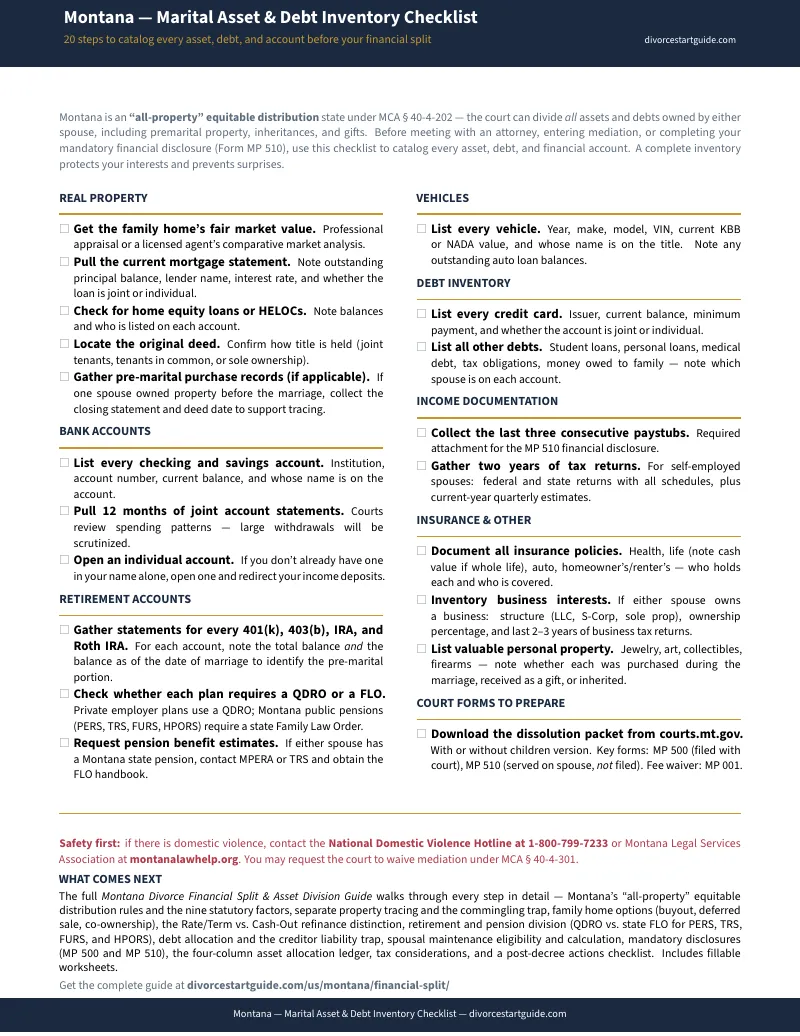
Download the Montana Marital Asset & Debt Inventory Checklist at no cost. It walks you through gathering every financial document you need — mortgage statements, retirement account records, tax returns, vehicle titles, and Montana-specific pension forms from MPERA and TRS. Once you've gathered your records, the full guide shows you exactly what to do with them.
Get the Montana Divorce Financial Split & Asset Division Guide →