
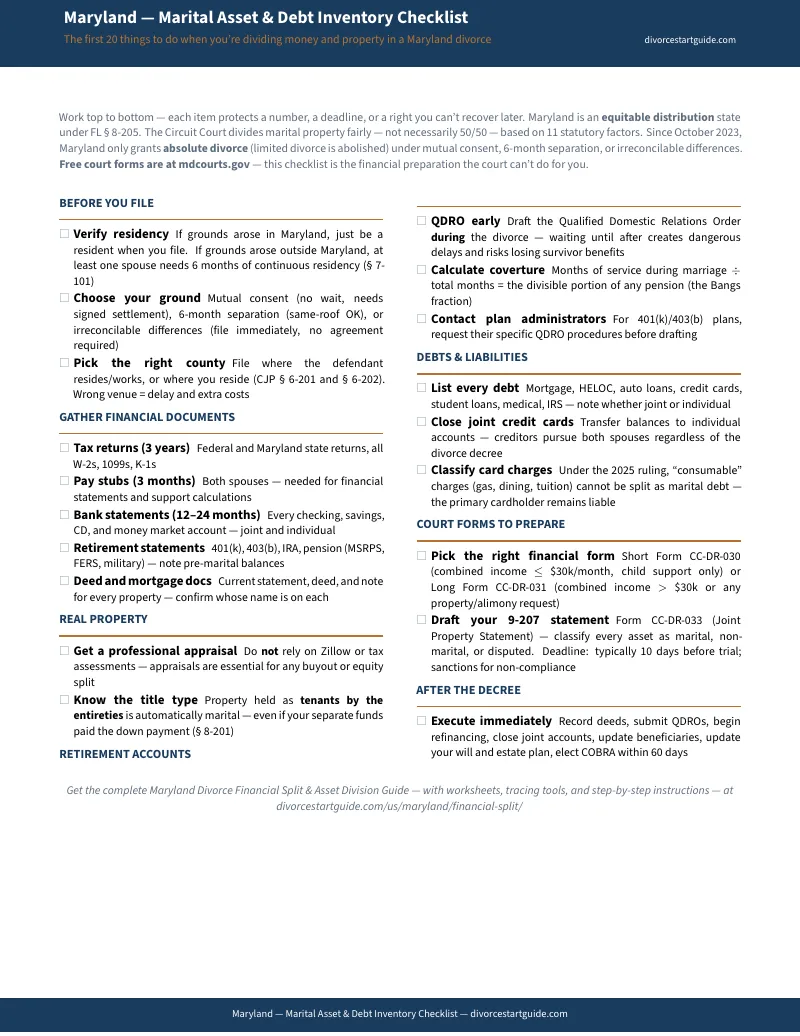
Your Marriage Built a Financial Estate. Maryland's Rules Decide How It Splits.
You've spent years — maybe decades — building a life together. Joint accounts, a mortgage, retirement contributions, shared debts. Now all of it has to be unwound, and Maryland's equitable distribution system gives the judge broad authority to split your assets in any proportion they consider fair.
The court's free forms ask you to list every asset and state its value. They don't explain how to calculate the marital share of a home your spouse owned before the wedding but you helped pay off for fifteen years. They don't show you how to trace commingled inheritance funds back to their non-marital source. And they definitely don't warn you that credit card debts spent on groceries, gas, and tuition may not count as "marital debt" under a 2025 appellate ruling — leaving the primary cardholder fully exposed.
The Maryland Divorce Financial Split & Asset Division Guide is the step-by-step financial workspace the court forms leave out. It's built specifically around Maryland's equitable distribution statutes, the source-of-funds tracing doctrine, and the 2023 no-fault divorce reforms that compressed the entire timeline.
What's Inside the Guide
- Source-of-Funds Tracing Worksheets — Maryland uses a precise mathematical formula to calculate what portion of a hybrid asset belongs to the marriage and what portion stays separate. These worksheets walk you through the calculation step by step, so you can show the court (or your spouse) exactly how much of the home equity, retirement balance, or investment account is marital versus non-marital.
- Rule 9-207 Joint Statement Planner — The mandatory Joint Statement of Marital and Non-Marital Property (Form CC-DR-033) is the single most important financial document in your divorce. Under Rule 9-207(d), failing to file it on time can result in the court accepting your spouse's classifications as truth, or ordering you to pay their attorney's fees. This planner organizes every asset, debt, and valuation into the exact format the court requires.
- Home Equity Buyout Calculator — Model the three most common outcomes for the marital home: refinance and buyout, sell and split, or use-and-possession occupancy under Family Law § 8-208 (which can grant the custodial parent exclusive use for up to three years). Each scenario includes the numbers you need to negotiate intelligently.
- Retirement & Pension Division Roadmap — Your 401(k), IRA, and defined-benefit pension are likely the most valuable assets in your estate. The guide explains how each account type is valued and divided, warns you about the 20% immediate withholding tax on improperly transferred funds, and includes a QDRO preparation checklist so your retirement split doesn't stall after the decree is signed.
- Debt Classification Ledger — A 2025 Maryland appellate ruling drew a sharp line: credit card debts spent on consumable expenses — dining, gas, tuition, home renovation labor — have no "exchangeable value" and cannot be classified as marital property. The primary cardholder is 100% liable. This ledger helps you categorize every debt so you know which ones are negotiable and which ones aren't.
- Alimony Cash-Flow Planner — Estimate your real post-divorce monthly budget under Maryland's current rules, including the fact that alimony is no longer tax-deductible for the payer or taxable income for the recipient (post-2018 IRS rules). Covers pendente lite, rehabilitative, and indefinite alimony scenarios.
- Financial Disclosure Organizer — The court requires detailed financial statements under Rule 9-203. Whether you file the short form or the long form depends on whether alimony or attorney's fees are at issue. This organizer tells you which form you need and walks you through assembling every supporting document — pay stubs, tax returns, bank statements, and appraisals.
Who This Guide Is Built For
- Pre-filing planners who want to run a quiet, private financial audit before raising the subject of divorce or committing to an attorney retainer
- Self-represented litigants facing the Rule 9-207 Joint Statement deadline and needing a structured way to organize their assertions
- Couples headed to mediation who want to arrive with organized, documented figures — reducing expensive billable hours spent on basic paper-sorting
- Post-decree executors who need to follow through on QDRO filings, deed transfers, mortgage refinancing, and account retitling after the judge signs the decree
Why the Court's Free Forms Aren't Enough
Maryland's judiciary provides every blank form you need — the Complaint (CC-DR-020), the Joint Statement (CC-DR-033), the Marital Settlement Agreement (CC-DR-116), even the fee waiver (CC-DC-089). They're free, and you should absolutely use them.
But a blank form is a container, not a strategy. It asks what to split. It doesn't show you how to calculate splits safely. It doesn't explain the financial trade-offs of choosing a buyout date versus a sale date for the house. It doesn't walk you through the difference between debts the court can divide and debts the court has no authority to touch.
This guide is the instruction manual those blank forms were designed to be used with — but that nobody wrote until now.
What You're Protected By
This is a one-time download. No subscription. No auto-renewal. No surprise charges. You own the worksheets, planners, and checklists permanently and can print, annotate, and reuse them throughout your case. If the guide isn't what you expected, email us and we'll make it right.
The free checklist gives you a running start. The full guide gives you the system.