
Maine's court clerk hands you a packet of blank forms. They don't explain how to fill them in.
You've found the forms on courts.maine.gov — the Complaint for Divorce, the Parental Rights and Responsibilities petition, the Child Support Affidavit (FM-050). You've discovered the problem: the forms ask you to choose between "shared," "allocated," and "sole" parental rights — but they don't explain what those terms actually mean for your week-to-week life with your child. They don't tell you how to decide whether a 2-2-3 rotation or alternating weeks makes sense for your school district's pickup schedule. They don't walk you through how the Income Shares Model changes your child support number when you shift from every-other-weekend to a substantially-equal-care arrangement. And they definitely don't prepare you for what happens at the mandatory CADRES mediation — or what the magistrate expects at your Case Management Conference.
Meanwhile, a family law attorney in Portland or Bangor charges $200 to $400 per hour. A contested custody retainer runs $3,000 to $10,000. Several of those billable hours go to the lawyer asking you questions you could have answered yourself — if someone had told you what the questions were and how to think through the answers.
You don't need someone to write your parenting plan for you. You need to understand what the plan requires before you sit down to draft it.
The Parental Rights Navigation System
This is a complete, step-by-step guide to navigating child custody in Maine — built around the specific statutes, court rules, and procedural requirements that make this state different from every other. It is not legal representation and it does not generate court forms. It is the planning intelligence that blank forms and generic legal websites leave out.
At its core is the Parental Rights Navigation System — a structured method that takes you from "I know I need a parenting schedule but I don't know what the court expects" to a comprehensive, child-focused arrangement that meets the best-interest standard under Title 19-A. It handles the part everyone gets wrong: understanding that Maine does not use "legal custody" and "physical custody" like other states — here, you're choosing between shared, allocated, and sole parental rights and responsibilities, and that choice determines who makes decisions about your child's education, healthcare, and religion. Building a parenting schedule specific enough that no magistrate sends it back for vagueness — and no co-parent can exploit an ambiguous "reasonable contact" clause. Preparing your Child Support Affidavit with the Income Shares Model calculations already worked through so you walk into your Case Management Conference with figures that hold up, not numbers you guessed at.
What's inside — the 16-chapter guide, 8 standalone worksheets, and the free starter checklist
- Maine's Terminology Decoded — a plain-language breakdown of "parental rights and responsibilities," "primary residence," and "rights of contact" under Title 19-A. Because Maine replaced the custody terms every other state uses, and confusing "shared parental rights" with "joint legal custody" can lead you to inadvertently waive decision-making authority over your child's schooling, medical care, or religious upbringing.
- The Best-Interest Factors — Explained and Applied — every factor the court evaluates under § 1653(3), from the child's relationship with each parent to the history of domestic abuse, translated from statutory language into concrete evidence you can gather and organize. Includes a self-assessment worksheet so you can evaluate your own position on each factor before you file.
- Parenting Schedule Templates with Time Calculations — detailed walkthroughs of 2-2-3, 2-2-5, and alternating-week rotations, each with exact overnights and practical considerations for school transitions, extracurricular schedules, and distance between households. Age-appropriate adaptations for infants, school-age children, and teenagers.
- Holiday and Vacation Rotation Planner — a printable worksheet covering every major holiday including school vacations and summer breaks, with alternating odd/even year options, specific transition times, and rules for when holidays override the regular weekly schedule.
- Child Support Math Worksheets — the Income Shares Model calculation using the Child Support Affidavit (FM-050) and Worksheet (FM-040), with step-by-step instructions for adjusted gross income, childcare costs, health insurance allocation, and the Supplemental Worksheet (FM-040-A) for substantially-equal-care arrangements. Walk through the math with your actual numbers before the court does it for you.
- CADRES Mediation Preparation Guide — a step-by-step walkthrough of Maine's mandatory court-connected mediation program, including what to bring, what to expect, and how to organize your scheduling preferences into a structured proposal. Comes with a worksheet for drafting three custody scenarios — optimal, acceptable, and compromise — so you arrive prepared to negotiate instead of starting from zero on the mediator's clock.
- Case Management Conference Prep Kit — everything you need for the mandatory early-case appearance: required financial documents, what the magistrate will address, how interim orders work, and how to present your position on temporary parenting arrangements and child support.
- Protective Clauses and Communication Protocols — pre-drafted plan language for right of first refusal, non-disparagement, travel notifications, social media boundaries, and introduction of new partners. These clauses cost nothing to include in your agreement now — and prevent the small disagreements from escalating into $300-per-hour court motions later.
- Modification and Relocation Chapters — the "substantial change in circumstances" standard, the 60-mile relocation notice requirement, the three-year child support review rule, and a step-by-step walkthrough of the Motion to Modify (FM-062) process.
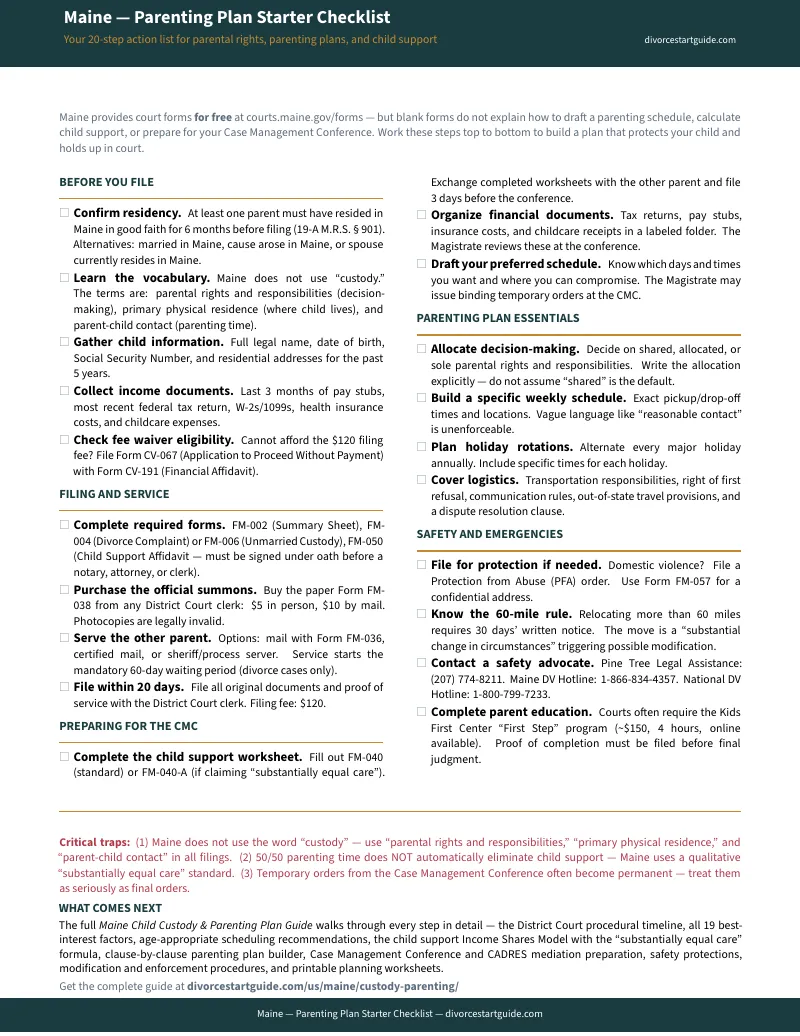
- Free Starter Checklist — a standalone 20-item overview of the custody process, Maine-specific terminology, key filing steps, and CADRES mediation basics — yours to keep whether or not you get the full guide.
Who this is for
The parent who just learned that Maine doesn't use "legal custody" and "physical custody" like every other state — and has no idea what "allocated parental rights and responsibilities" actually means for their daily life. The self-represented filer who downloaded the FM-004 Complaint for Divorce and realized the blanks don't come with instructions. The parent heading into mandatory CADRES mediation who wants to arrive with draft schedules already calculated — not start from scratch while the mediator waits. The parent trying to figure out whether their proposed parenting schedule qualifies as "substantially equal care" and what that means for child support. And the parent with an existing order that no longer works because jobs changed, children got older, or someone needs to move more than 60 miles away.
Why not just use the free resources?
Because free resources give you definitions, not decisions. The Maine Judicial Branch Self-Help Portal provides blank forms and basic procedural summaries. Pine Tree Legal Assistance and the Volunteer Lawyers Project offer high-quality guides — for parents who meet their income eligibility requirements. Law firm blogs from Dirigo Divorce and The Maine Divorce Group discuss the best-interest factors in terms designed to get you to call for a $300-per-hour consultation. None of them give you a worksheet that maps your specific week across two households and calculates whether your proposed schedule qualifies as substantially equal care. None provide mediation preparation worksheets for drafting structured custody proposals. None walk you through the child support formula with your actual income numbers.
The co-parenting apps — Custody X Change at a monthly subscription, OurFamilyWizard at an annual fee — are built for ongoing schedule tracking and parent-to-parent messaging, not initial plan drafting. They don't map the Maine-specific CADRES mediation process, the Case Management Conference timeline, or the state's unique parental-rights terminology. They are useful tools after you have an agreement. This guide helps you write the agreement.
A straightforward guarantee
Work through the Parental Rights Navigation System. If the guide doesn't give you a clearer, more organized understanding of Maine's custody process than any free government page or blank court form could — email us within 30 days for a full refund. The cost of trying it is a fraction of one attorney consultation. The cost of filing a vague or poorly structured parenting plan is a rejected motion, an unenforceable agreement, or months of additional litigation over ambiguities a precise plan would have prevented.
For — less than ten minutes of attorney time — you get 10 PDFs: the complete guide, 8 standalone printable worksheets (best-interest self-assessment, parenting plan builder, schedule comparison, holiday rotation planner, child support math, CADRES mediation prep, case management conference checklist, and court forms directory), plus the free starter checklist.
Stop guessing what the court expects. Get the guide, build your parenting plan, and walk into your next step — whether that's CADRES mediation, a lawyer's office, or the District Court — with the work already done.