Louisiana Gives You Free Forms — Then Gives You Two Filing Tracks, a Separation Clock That Resets on Contact, and a Two-Year Deadline That Kills Your Case
You can download every Louisiana divorce form tonight from the Louisiana Legal Navigator or your parish self-help desk — without spending a dime. What you can't download is the answer to the questions that actually stall self-represented filers: Am I filing under Article 102 or Article 103, and what's the real difference? When does my separation clock actually start — the day I moved out, or the day my spouse was served? Does one night together reset the entire 180-day countdown? And what exactly am I supposed to ask my two witnesses under oath at the hearing the court requires?
Get these wrong and the costs are real. File under Article 102 when you could have finished under Article 103 in weeks, and you've added months to your timeline plus a mandatory court hearing. Reconcile for a weekend — even briefly resume physical intimacy — and your 180-day or 365-day separation clock resets to zero. File your Article 102 petition but let two years pass without executing the Rule to Show Cause, and your case is legally abandoned under Louisiana law — dismissed, filing fee gone, you start over from scratch. These aren't hypotheticals. They are the procedural traps that catch self-represented filers across Louisiana's 64 parishes every day.
The Louisiana Divorce Filing Process Guide is a Petition-to-Judgment Navigation System — a step-by-step process manual that takes you from choosing the right filing track and confirming your residency through service, the separation period, and finalization, whether that's a formal Article 102 hearing with witnesses or a paper-based Article 103 default confirmation. It contains zero blank forms (Louisiana provides those for free, and you should use them). What it gives you is the assembly manual the forms don't come with: the correct filing sequence, the separation rules, the deadline math, and the courtroom scripts.
What's Inside the Guide
The guide ships with 10 standalone printable worksheets, tracking logs, and hearing scripts alongside the main process manual — fill them in, print them, and bring them to the courthouse:
- Article 102 vs 103 Decision Tree — A structured comparison of the file-then-wait and wait-then-file tracks: which one allows interim custody and support orders, which one can bypass a court hearing entirely, which one carries the two-year abandonment risk, and which one matches your specific timeline
- Residency & Venue Worksheet — Confirm your six-month Louisiana domicile requirement, determine the correct parish for filing (domicile vs last matrimonial domicile), prove residency with documentation, and handle the special rules for military personnel stationed in the state
- Separation Rules Explainer & Tracking Log — What "living separate and apart" actually means under Louisiana's Civil Code (no in-home separation recognized), how reconciliation or resumed intimacy resets the entire 180-day or 365-day clock to zero, and a structured log to document continuous separation so it holds up at your hearing
- Service of Process Walkthrough — Formal sheriff service, private process servers, notarized Acceptance of Service and Waiver of Citation, and long-arm service for out-of-state spouses — with the critical detail that your Article 102 separation clock doesn't start until service is completed or waived
- Two-Year Abandonment Tracker — The overlooked deadline that kills Article 102 cases: if you don't file and execute your Rule to Show Cause within two years of service, your petition is legally abandoned and you must refile from scratch with new fees. The tracker calculates your deadline and gives you reminders
- Article 102 Witness Script — Word-for-word questions for your two corroborating witnesses at the final hearing, covering continuous physical separation, lack of reconciliation, and the specific sworn testimony the judge needs before signing your judgment
- Article 103 Default Confirmation Roadmap — The step-by-step sequence for securing a preliminary default after your spouse fails to respond (15 days in-state, 30 days out-of-state) and finalizing via Affidavit of Correctness in parishes that allow it — bypassing a court hearing entirely
- Parish Filing Fee Guide — Fees range from roughly $200 to $450+ across Louisiana's 64 parishes. The guide covers filing costs, sheriff and private process server fees, notary charges, and co-parenting class registration
- In Forma Pauperis Worksheet — How to use the standardized Supreme Court IFP affidavit to delay (not waive) court costs, the income eligibility threshold, the third-party witness requirement, and parish-level renewal deadlines
- Fault-Based Exceptions Summary — When you qualify for an immediate divorce without a waiting period: physical or sexual abuse, adultery, or a felony conviction resulting in imprisonment at hard labor
- Covenant Marriage Track — The separate, more restrictive rules for dissolving a covenant marriage, including mandatory counseling requirements and the narrower grounds Louisiana imposes
- Community Property & Children Worksheets — Organize and classify assets and debts under Louisiana's community property regime, plus the custody and child support worksheets for cases involving minor children
- Post-Decree Update Checklist — Estate plan updates, beneficiary designations, retirement account division preparation (including QDRO basics and the LASERS Sims formula for state pensions), and name change filings
Who This Guide Is For
- You and your spouse agree on the terms and want to file without a $2,000–$5,000 attorney retainer — but you need to know whether Article 102 or Article 103 gets you to a judgment faster
- You've been living apart for months and aren't sure whether your separation already qualifies you to file under Article 103 — or whether one night back together reset everything
- Your spouse is out of state, unresponsive, or uncooperative — and you need sheriff service, long-arm service, or a waiver handled correctly so your timeline isn't voided
- You're approaching your Article 102 hearing and have no idea what questions to ask your two corroborating witnesses under oath
- You filed months ago and just learned about the two-year abandonment rule — if you don't finalize before the deadline, your case is dismissed and you start over
- You can't afford the filing fee and want to understand how In Forma Pauperis actually works — it defers costs, it doesn't erase them, and the details matter
- You plan to hire a lawyer for advice but want to handle the administrative filing yourself — and stop paying $150–$350 an hour for clerical steps
Why Not Just Use the Free Forms — or a $137 "Online Divorce" Site?
The Louisiana Legal Navigator and your parish self-help desk provide blank forms for free — and this guide tells you to use them. But the forms assume you already know the process. They don't tell you which article fits your timeline, that your separation clock starts on service and not on move-out day, that any resumed intimacy resets the entire countdown, that your Article 102 case dies after two years of inaction, or what your witnesses need to say under oath. The state gives you car parts. This guide is the assembly manual.
The national alternatives are worse in a different way. Document generators like DivorceWriter ($137) and 3StepDivorce ($299) charge you to auto-fill forms the state provides for free — and then leave you on your own for service, the separation period, the two-year abandonment trap, and the final hearing. They sell form completion. They don't sell process navigation. And none of them prepare you for the Article 102 courtroom appearance at all.
This guide is the missing layer between free forms and a full-scope attorney: Louisiana-specific, current, and built around the administrative reality of navigating Louisiana's civil-law divorce system — for , less than the fee you'd lose to a single dismissed petition or abandoned case.
Our Guarantee
This is an educational process-navigation guide — not legal advice, and not a substitute for an attorney. It's also honest about its limits: an entire chapter is devoted to the red flags (contested issues, complex community property, hidden assets, domestic violence) that mean you should stop and hire a professional, with guidance on which kind. If the guide doesn't give you a clearer picture of your filing process than you had before, email us at any time and we'll refund you.
Get Started Tonight
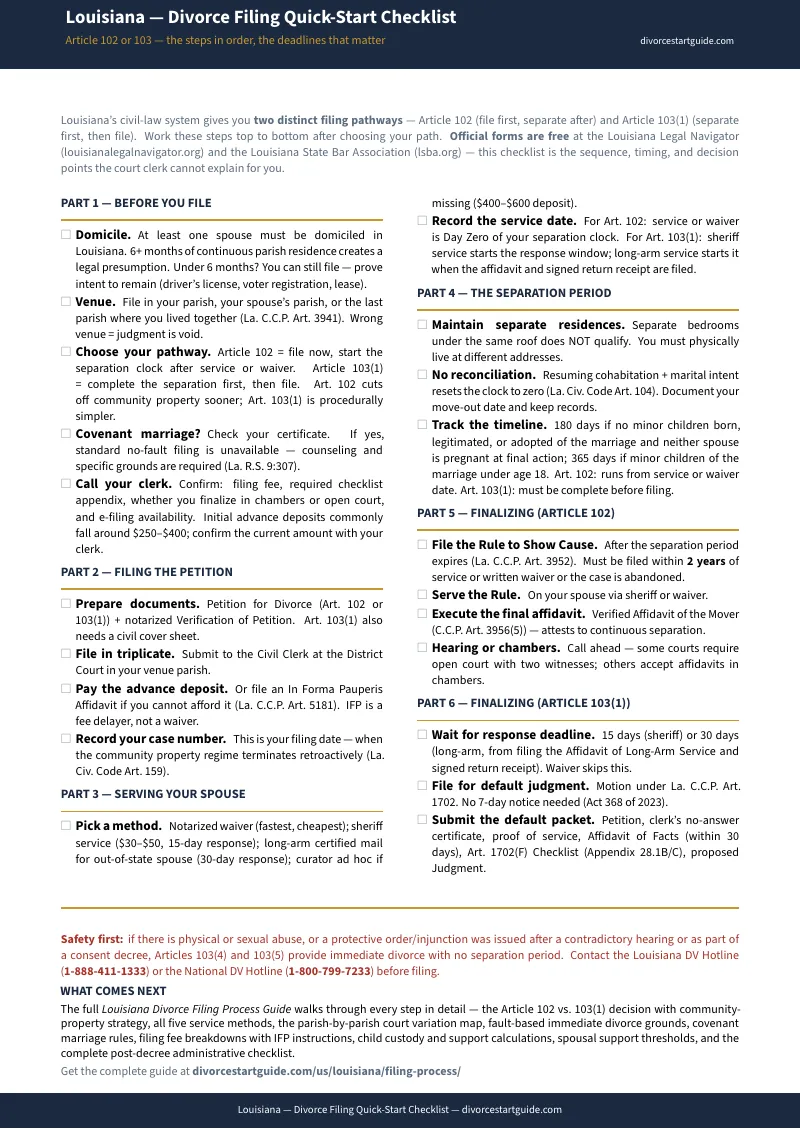
Not ready to buy? Download the free Louisiana — Divorce Filing Quick-Start Checklist — a one-page overview of the filing steps, Article 102 vs 103 comparison, residency rules, and waiting period — and verify your eligibility before you spend anything.
Ready to file with confidence? Get the complete Petition-to-Judgment Navigation System and work through your filing step by step, worksheet by worksheet, until the judge signs your judgment.