You've downloaded the free court forms from illinoiscourts.gov. You've run through the Illinois Legal Aid Online guided interview. You've even created your Odyssey eFileIL account. Now you're staring at five separate PDFs, a filing portal that rejects merged documents without telling you why, and a court clerk who is legally prohibited from explaining what to write on any of them.
Here's what nobody explains: Illinois gives you every blank form for free, but not one resource maps the chronological sequence — which form triggers which deadline, which pathway unlocks the fastest timeline, what to enter in the Cross-Reference ID field (Cook County and DuPage County: it's 99500 — leave it blank and you're rejected), how to choose between sheriff service and a private process server under the 2025 rules, or how to prepare a Financial Affidavit that doesn't get you sent home from your prove-up hearing.
The problem isn't the forms. It's the filing sequence.
Self-represented litigants in Illinois don't fail because the court is hiding documents. They fail because nobody puts the documents in order. The Odyssey portal accepts your PDFs one by one but doesn't tell you what to upload first. The clerk's office processes your filings but can't advise you on what to file. The free Legal Aid forms generator builds your initial packet but leaves you alone for service, disclosures, and the prove-up. The average contested divorce in Illinois costs $10,000 to $30,000 in attorney fees — and many of the people paying those fees started out trying to do it themselves before a preventable procedural error forced them into a courtroom with a lawyer.
Introducing the Clerk-Ready Filing System
This is the Illinois Divorce Filing Process Guide — a step-by-step execution manual that starts where the free forms leave off. Not a set of blank PDFs. Not a generic "how to file in Illinois" article. A chronological roadmap built around Illinois's actual statutes (750 ILCS 5/), Supreme Court Rules, Odyssey e-filing procedures, and county-specific practices, organized so every action builds on the one before it and every deadline is visible before you hit it.
The core idea is the Clerk-Ready Filing System: every form, fee, deadline, and court procedure placed in the exact order Illinois circuit courts require — so your filing is accepted the first time, your service method matches your situation, and you walk into the prove-up hearing with every document the judge needs to sign your decree.
What's inside
- The Four-Pathway Decision Engine. Standard uncontested, Joint Simplified Dissolution, default, or contested — four distinct tracks with different forms, fees, timelines, and hearing requirements. A structured worksheet that identifies your pathway in five minutes based on whether you have children, marital assets, combined income, and spouse cooperation. For anyone overwhelmed by the branching options who needs one clear answer before touching a single form.
- The Odyssey E-Filing Co-Pilot. Step-by-step instructions for creating your account, selecting the correct case category, entering the Cross-Reference ID code, and uploading each document as a separate filing component with the right designation. Includes the formatting rules that cause the most clerk rejections: merged PDFs, embedded active fonts, resolution problems, and wrong filing codes. For the filer who opened the Odyssey portal, got confused by the third dropdown, and closed the tab.
- The Service-of-Process Playbook. Entry of Appearance (free, cooperative spouse). County sheriff ($50–$100). Licensed private process server ($50–$150, any county as of January 2025). Service by publication (last resort, court approval required). Each method explained with the exact form, cost, and deadline math — plus what to do when your spouse won't cooperate and your 30-day service window is closing. For the filer whose spouse is avoiding papers and needs a backup plan before the clock runs out.
- The Fee Waiver Navigation Guide. Illinois's Application for Waiver of Court Fees covers more than just the filing fee — an approved waiver can extend to sheriff service fees and other court costs. A walkthrough of the application process, the sliding-scale income thresholds, and how to link an active waiver to your Odyssey account so you aren't charged when submitting. For anyone who can't afford $300–$400 in filing fees but doesn't know the waiver exists or how to apply.
- The Financial Disclosure Workbook. Three printable worksheets — Marital Asset and Debt Inventory, Monthly Budget and Maintenance Worksheet, and Co-Parenting Allocation Blueprint — designed to be completed before you open the court's standardized Financial Affidavit. Plain-language instructions for gathering tax returns, pay stubs, bank statements, and retirement account statements, plus child support calculation prep using Illinois's income-shares model. For the spouse who wants to negotiate from documented numbers, not guesswork.
- The QDRO vs. QILDRO Retirement Division Guide. Private-sector retirement accounts require a QDRO. Illinois public pensions (IMRF, CTPF, SERS, TRS) require a QILDRO — a different legal instrument that plan administrators will reject if you submit the wrong one. This section explains which instrument applies to each type of account and when you need professional help. For anyone with retirement accounts on the table who doesn't want to discover the difference between these two orders after the decree is signed.
- The Prove-Up Hearing Preparation Guide. A complete checklist of every document the judge needs at the final hearing — signed Marital Settlement Agreement, proposed Judgment of Dissolution, Certificate of Dissolution, Financial Affidavit, and (if children) Parenting Plan, parenting class certificates, and Child Support Worksheet. Includes guidance for Zoom and WebEx prove-ups offered by many Illinois counties. For the filer who doesn't want to be the one sent home because they forgot the Certificate of Dissolution.
- The Deadline Timeline Tracker. Every critical deadline mapped on a printable timeline: 90-day residency, 6-month separation presumption, 30-day service window, financial disclosure exchange, 120-day parenting plan deadline, 60-day parenting class deadline, and the case management conference. So you never miss a deadline you didn't know existed.
Who this is for
You're filing for divorce in an Illinois circuit court — or seriously thinking about it. You don't qualify for Legal Aid's direct representation. You're not ready to spend $260 to $330 an hour on a family attorney for a case you believe you can handle yourself. You want a clear, honest roadmap that tells you what to file, when to file it, what it costs, and what happens next — without the anxiety of guessing whether you've missed a form or blown a deadline.
Why not just use the free court resources?
Because they end at the individual form. The Illinois Supreme Court publishes every standardized form you need — and you should never pay anyone to generate them. Illinois Legal Aid Online's guided interview builds your initial filing packet. County self-help centers and the court's Self-Represented Litigant Resource Center answer general questions. None of these resources map the complete filing sequence — which form to file before which deadline, how to navigate the Odyssey portal without triggering a clerk rejection, which service method to choose when your spouse is uncooperative, or how to prepare your financial disclosures before the court requires them. 3 Step Divorce charges $299 for document assembly that leaves you alone for service and the hearing. DivorceWriter charges $137 for form generation that misses county-level procedures. This guide fills the gap between "I have the forms" and "I filed correctly the first time."
A quick, honest boundary
This is a process-navigation and organization tool, not legal advice and not a law firm. It helps you gather the right documents in the right order before you contact the clerk's office, a mediator, or an attorney. For cases involving domestic violence, contested custody, complex business valuations, hidden assets, or situations where your spouse has retained a lawyer, it will tell you plainly when to bring in a professional — and save you money on everything that doesn't require one.
Our guarantee
If this guide doesn't make your Illinois divorce filing process clearer and calmer within 30 days, email us for a full, no-questions-asked refund. The risk is entirely ours.
— less than one hour with an Illinois family attorney
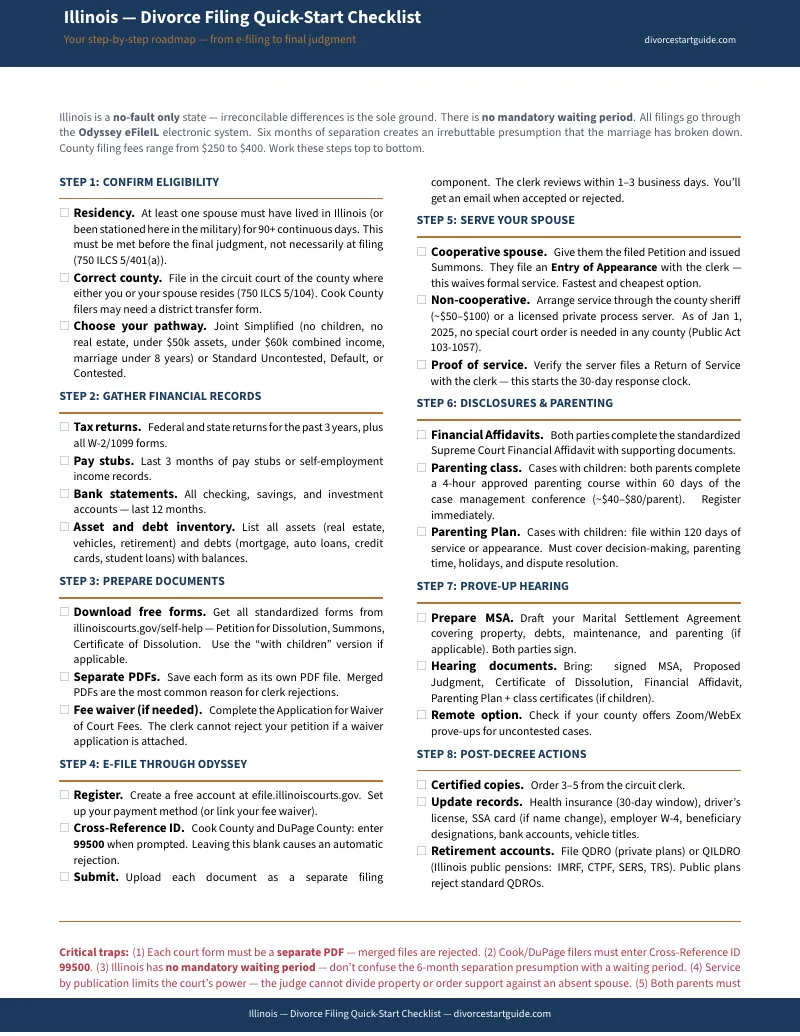
Not sure yet? Start with the free Illinois — Divorce Filing Quick-Start Checklist — a 20-step action plan covering every filing milestone from residency confirmation through post-decree tasks. When you're ready for the full Clerk-Ready Filing System — the comprehensive guide plus 7 standalone printable worksheets and trackers (four-pathway decision tree, asset-debt inventory, monthly budget worksheet, co-parenting blueprint, prove-up hearing checklist, deadline timeline tracker, and service-of-process tracker) — the paid toolkit is waiting.
Get the Illinois Divorce Filing Process Guide →
Illinois gives you every form for free. This guide tells you what to write on them — and what order to file them in.