Hawaii's court forms ask for your parenting plan. They don't tell you how to write one.
You've found the Hawaii State Judiciary forms — the Proposed Parenting Plan (Form 1F-P-796), the Parenting Plan Agreement (Form 1F-P-859), the Motion for Pre-Decree Relief (Form 1F-P-816). And you've discovered the problem: the forms have blank boxes for your residential schedule, your decision-making arrangement, and your holiday rotation. But they don't tell you how to structure a schedule where the precise number of annual overnights determines which child support formula applies to your family. They don't tell you how to prepare for the mandatory Kids First class that every parent must complete before the court will finalize anything. And they don't explain whether a 2-2-3 rotation or an alternating-week schedule is the right fit for your child's age, your work schedule, and the geographic reality of co-parenting across different islands.
Meanwhile, a family law attorney in Hawaii charges $300–$450 per hour. A $5,000 retainer buys you roughly fourteen hours. Two or three of those hours go to your lawyer asking you questions you could have answered yourself — if someone had told you what the questions were and how to think through the answers.
You don't need someone to write your parenting plan for you. You need to know what the court expects before you sit down to draft it.
The Custody Navigation System
This is a complete, step-by-step guide to building a parenting plan in Hawaii — designed for the specific rules, formulas, and court processes that make this state different from every other. It is not legal representation and it does not file your papers. It is the planning and structuring intelligence that the blank court forms leave out.
At its core is the Custody Navigation System — a structured method that walks you from "I know we need a parenting schedule but I don't know what the court expects" to a comprehensive, child-focused agreement that meets the best-interests standard under HRS § 571-46. It handles the part everyone gets wrong: understanding the 143/183 overnight thresholds that determine whether your child support is calculated under the standard formula, the extensive time-sharing formula, or the equal time-share payout method. Preparing for mandatory mediation at your circuit's community mediation center with organized, child-focused arguments — not emotional accusations. Navigating the Kids First parent education program across all four judicial circuits so non-compliance doesn't delay your case. And building modification-proof plan language for holidays, inter-island travel, and 'ohana connections so you don't end up back in court six months from now.
What's inside — the 13-chapter guide, 5 standalone worksheets, and the free checklist
- Parenting Plan Drafting System (Chapter 5) — turns vague "we'll share time" into a documented, court-ready schedule. Covers your regular weekly rotation, holiday alternation matching the Form 1F-P-859 structure, summer and school-break schedules, decision-making authority across education, healthcare, religion, and extracurriculars, and transition logistics including exact times and locations. Includes inter-island travel clauses with flight notification timelines, cost-sharing formulas, chaperone requirements, and airport handoff protocols — because "we'll figure out the flights" is not enforceable language when your co-parent is on Maui and you're on Oʻahu.
- Overnight-Tracking Worksheet (Appendix A) — the standalone fillable that calculates exactly where your proposed schedule falls relative to Hawaii's three child support thresholds. Maps regular-schedule overnights across 52 weeks, adds holiday and vacation adjustments, and produces your annual total so you know whether you're at 142 or 143 before you sign anything. Because the difference of a single overnight can shift annual child support by hundreds of dollars.
- Child Support Formula Walkthrough (Chapter 7) — breaks down Hawaii's modified Melson formula step by step: the Self-Support Reserve, the Primary Child Support Need, and the Standard of Living Adjustment (10% for one child, 20% for two, 30% for three or more). Explains the Table of Incomes, imputed income rules, the $91 minimum support floor, and post-majority extensions for children still in high school at 18. Because the state's online calculator gives you a number — this guide explains why that number is what it is and how your parenting schedule directly changes it.
- Best-Interest Self-Assessment (Appendix B) — a structured worksheet aligned with all 16 statutory factors under HRS § 571-46(b). Helps you document your history of caregiving, cooperation in developing a plan (Factor 5), your ability to separate parental needs from child's needs (Factor 12), and your support for 'ohana and hānai relationships (Factor 11). Because judges evaluate these factors whether you prepare for them or not — this worksheet ensures you prepare.
- Kids First Program Roadmap (Chapter 6) — circuit-by-circuit guide to the mandatory parent education program. Covers required videos, the child Feelings Quiz, attendance verification procedures, and what happens if you miss the class. Includes contact numbers for all four circuits so you can register without hunting through the judiciary website. Because non-compliance can delay your decree and weigh negatively in custody determinations.
- Safety Planning and DV Provisions (Chapter 8) — structured protocols for invoking the HRS § 571-46(a)(9)/(14) domestic violence presumption, requesting supervised visitation at Family Visitation Centers, obtaining a Temporary Restraining Order (TRO), and building corroborated evidence. Explains the mediation waiver for family violence cases and the protection for parents who relocate to escape abuse. Because high-conflict cases require the most precise preparation — not emotional accusations.
- Modification Guide (Chapter 9) — the Waldecker v. O'Scanlon standard explained with concrete examples of what the court considers when evaluating modification requests. Covers the relocation process (60-day notice for inter-island moves, 90-day for out-of-state), the three-year review right, and evidence organization worksheets. Because knowing when and how to modify matters as much as the original order.
- Decision-Making Allocation Worksheet (Appendix C) — a fillable that helps co-parents divide major decisions across education, healthcare, religious upbringing, extracurriculars, and travel. Includes tiebreaker provisions and escalation protocols. Because "joint legal custody" without clear allocation rules creates deadlocks that send you back to court.
- Child Expense Tracker (Appendix D) — a structured log for medical bills, extracurricular costs, childcare expenses, and inter-island travel costs. Designed to align with the Hawaii Child Support Guidelines calculation. Because organized financial records strengthen your position during both mediation and court hearings.
- 'Ohana and Cultural Preservation Provisions (Chapter 11) — specialized drafting templates that secure your child's right to maintain relationships with grandparents, aunts, uncles, and hānai relatives. Covers standalone grandparent petitions and plan language that honors Hawaii's unique cultural framework. Because no other state integrates extended family connections into custody law the way Hawaii does.
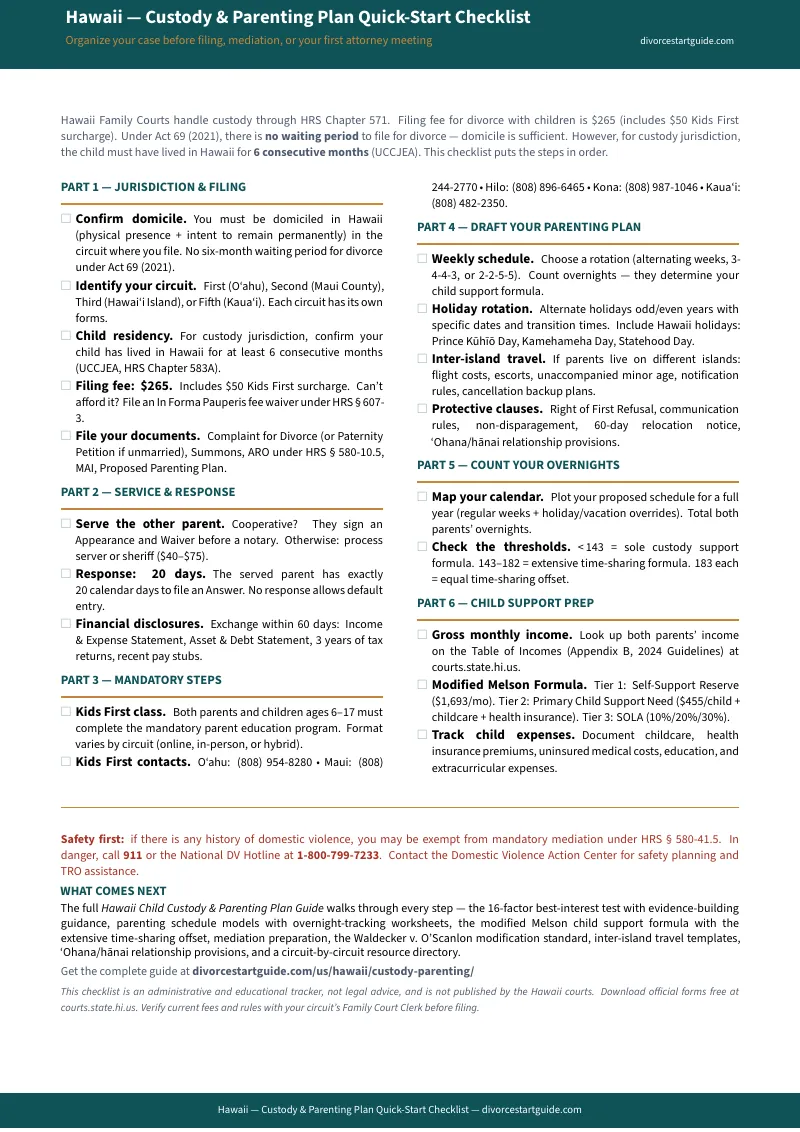
- Parenting Plan Starter Checklist — the free lead magnet. A standalone one-page checklist covering the 20 items your parenting plan must address before you walk into mediation or file with the court. Start here to see exactly what the full guide covers in depth.
Who this is for
The parent who just discovered that Hawaii has no automatic presumption for or against joint custody — and needs to understand how the judge will actually decide using all 16 best-interest factors. The self-represented filer preparing a parenting plan who needs to know which forms to use in their specific judicial circuit. The parent heading into mandatory mediation at the Mediation Center of the Pacific, Ku'ikahi, or another community center who wants to arrive with a documented schedule and clear proposals — so the mediator sees preparation, not confusion. The parent calculating whether a proposed parenting schedule puts their overnight count at 142 or 143, and what that one-night difference means for child support. The military parent on Oʻahu whose deployment schedule needs accommodations the standard templates don't cover. And the parent with an existing decree that no longer works because the children are older, school districts have changed, or one parent needs to relocate to another island.
Why not just use the free resources?
Because free resources give you definitions, not decisions. The Hawaii State Judiciary website provides blank court forms and basic filing instructions. But it does not tell you how to structure a holiday rotation, how to count overnights for child support purposes, or how to document your caregiving history against the 16 statutory factors. It provides forms. This guide provides the strategic preparation you complete before you fill them out.
The co-parenting apps — OurFamilyWizard at $150–$300 per year per parent, Custody X Change at $97–$480 per year — are built for ongoing communication logging and schedule tracking, not initial plan drafting. They require both parents to pay, both parents to participate, and they don't address Hawaii's Kids First program requirements, the modified Melson child support formula, or the cultural 'ohana provisions that make Hawaii custody law different from every other state. They are useful tools after you have an agreement. This guide helps you write the agreement.
An honest guarantee
Work through the Custody Navigation System. If the guide doesn't make your parenting plan clearer, better organized, and more court-ready than any free government page or blank judiciary form could — email us at any time for a full refund. The risk of trying it is a fraction of one mediation session. The risk of filing an incomplete parenting plan is a mediator who sees confusion instead of preparation and a support calculation based on numbers you didn't understand.
For — less than fifteen minutes of attorney time — you get the overnight-tracking worksheet, the child support formula walkthrough, the Kids First roadmap, and the step-by-step filing guide that the blank forms leave out.
Stop guessing what the court expects. Get the guide, build your parenting plan, and walk into your next step — whether that's mediation, a lawyer's office, or the Family Court filing window — with the work already done.