Georgia courts give you the blank forms. They don't tell you what numbers to put in them.
The Domestic Relations Financial Affidavit has rows for every asset, debt, and income source in your marriage. The court clerk will hand it to you. What the clerk won't hand you is a method for deciding which assets are marital, which are separate, how to trace a premarital down payment through fifteen years of mortgage payments, or what happens to your pension when your plan administrator says they don't accept QDROs.
Georgia's equitable distribution system gives judges wide discretion — "fair" doesn't mean 50/50, and two households with identical assets can get very different outcomes depending on how each spouse presents their case. The difference between a good result and a bad one usually comes down to preparation: knowing what you own, what you owe, and how Georgia law classifies each dollar.
The Equitable Division Workbook
This is a 55-page guide plus six printable worksheets designed for one purpose: helping you organize, classify, calculate, and present the financial picture of your Georgia divorce. It is not a collection of blank forms. It is the strategy layer that shows you exactly what belongs in those forms and why.
The guide covers every financial decision in a Georgia divorce — from the initial property classification through the final tax return — with Georgia-specific rules, case law references, and worked examples you can adapt to your situation.
What's Inside
- Marital vs. separate property classification framework — a decision tree for categorizing every asset in your estate, with the commingling and transmutation traps that turn separate property into marital property
- Thomas v. Thomas tracing worksheet — the five-step calculation Georgia courts use to split mixed-equity assets like a premarital home with years of marital mortgage payments, with a worked example you can follow line by line
- Family home disposition analysis — equity buyout calculations, refinancing deadlines, deferred-sale arrangements, and the PT-61 transfer tax exemption most guides skip
- Retirement and pension division roadmap — QDRO timelines for ERISA plans, the TRSGA and ERSGA rules that differ from private-sector plans, IRA transfer procedures, and the coverture fraction formula
- Debt allocation strategy — joint vs. individual liability, the creditor liability trap (a divorce decree doesn't bind your creditors), and paydown sequencing to protect your credit score
- Alimony factor analysis — Georgia's statutory factors broken down, including the adultery bar, how duration affects awards, and the DRFA expense documentation method that establishes support need
- DRFA preparation guide — section-by-section instructions for completing the mandatory Domestic Relations Financial Affidavit accurately, with the Fulton County discovery timeline and document gathering checklist
- Tax consequences chapter — IRC Section 1041 carryover basis, post-2018 alimony deduction rules, filing status timing, and the capital gains exclusion for the marital home
Who This Guide Is For
- Self-represented spouses filing uncontested or low-conflict divorces in Georgia who need a structured method for the financial division
- Attorney-retained spouses who want to organize their records and run preliminary calculations before their first consultation — turning a three-hour intake into a focused 40-minute strategy session
- Mediation-bound couples preparing for mandatory ADR who need clear, data-backed settlement proposals instead of emotional reactions
Why Free Resources Fall Short
Georgia's court self-help packets give you the blank DRFA form and a filing checklist. They do not include a property classification decision tree, a Thomas tracing worksheet, retirement plan division rules, or any strategy for optimizing your settlement. The court staff legally cannot advise you on what numbers to put in the boxes.
Online divorce platforms generate document packets for uncontested cases. They handle the paperwork — but they don't cover Georgia-specific tracing formulas, the ERSGA pension trap, or the tax consequences of choosing a home buyout over a sale. If your financial picture involves a premarital home, retirement accounts, or joint debt, those platforms leave the hardest decisions to you.
This guide fills that gap: the calculation methods, classification rules, and strategic sequencing that sit between "here are your blank forms" and "hire a $350/hour attorney to figure it out."
What You Get
- The full guide — 55 pages, 14 chapters, two worked examples
- Thomas Tracing Worksheet — the five-step source-of-funds calculation for any mixed-equity asset
- Home Equity Buyout Calculator — model sell-and-split, buyout-and-refinance, and deferred-sale scenarios side by side
- Marital Asset & Debt Inventory — classify every asset and debt as marital, separate, or mixed, with its supporting documentation
- Retirement Division Planner — map each account to its correct division instrument, with the QDRO timing checklist
- DRFA Preparation Worksheet — organize income, deductions, expenses, assets, and debts in the affidavit's exact format
- Settlement Scenario Planner — compare competing proposals on after-tax value, not nominal totals
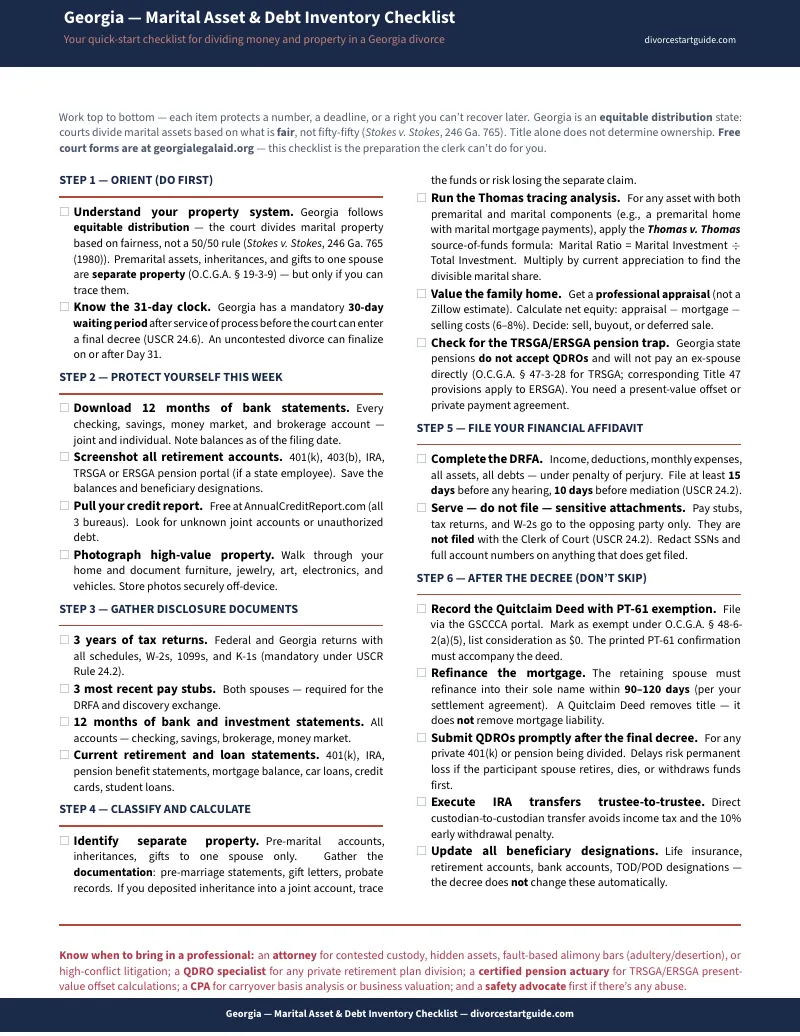
- The asset and debt inventory checklist — a structured quick-start checklist that walks you through every category of marital and separate property
All eight files are delivered as downloadable PDFs immediately after purchase.
Satisfaction Guarantee
If the guide doesn't help you organize your financial picture for your Georgia divorce, email us and we'll refund your purchase — no hoops, no time limit.
Start With the Free Checklist
Not ready to commit? Download the free Georgia Marital Asset & Debt Inventory Checklist to start cataloging your property and debts right now. When you're ready for the full calculation methods, worksheets, and strategy guide, come back for the complete toolkit.