You know you need to file for divorce in Delaware. You've opened the Family Court website and found dozens of PDF forms — 442, 240, 441, 400, 406, 446, 447 — with no explanation of which ones apply to your situation, what order to file them in, or what happens if you check the wrong box. You've closed the browser, reopened it, and closed it again.
Here's what makes Delaware divorce filings feel so disorienting: the forms are free, but the sequence is invisible. The court provides a Petition for Divorce (Form 442) but doesn't tell you that you also need Forms 240, 441, and 400 filed at the same time. It doesn't tell you whether to email your filing packet to [email protected] or drive to the courthouse. It doesn't explain that if you don't specifically request property or financial relief in your initial petition, the court cannot award it to you later — even if your spouse never responds. And it never mentions that you can skip the courtroom hearing entirely by filing Forms 446 and 447 to finalize your divorce "on the papers."
The problem isn't the paperwork. It's knowing what to do when.
People filing for divorce in Delaware don't get stuck because the forms are hard to find. They get stuck because nobody sequences the process from start to finish. File your petition before the 6-month separation requirement is satisfied, and the court holds your case — which is fine, but only if you know to expect it. Skip the Affidavit of Children's Rights (Form 279) when you have minor children, and the court halts everything. Serve your spouse via sheriff but forget to track the 20-day response window, and you miss your window to request a default judgment. Get the default — but realize you never requested the house or the retirement account in the original petition, so the judge can't award them. Every step depends on the one before it, and the court's free resources don't connect the dots.
Introducing the Filing Sequence Navigator
This is the Delaware Divorce Filing Process Guide — a chronological roadmap that takes you from "do I even qualify to file?" through the final decree, in the exact order Delaware Family Court requires. Not blank forms. Not a blog post with generic advice. A step-by-step administrative sequence built around Delaware's actual statutes, Family Court rules, and the forms that real clerks process every day across New Castle, Kent, and Sussex counties.
It's built on one idea we call the Filing Sequence Navigator: every decision, document, and deadline placed in chronological order so you always know the single next thing to do — and more importantly, what to avoid doing out of turn.
What's inside
- The Residency & Separation Qualifier. A clear yes/no framework for the 6-month residency rule (13 Del. C. § 1504), the 6-month separation requirement (13 Del. C. § 1505), and the same-roof separation provision — so you know before you drive to the courthouse whether Delaware will accept your case. Includes the military-station exception and the civil union jurisdictional pathway. For anyone who needs to confirm they qualify before spending a dollar on filing fees.
- The Complete Filing Packet Builder. Every form in the initial filing packet — Petition (Form 442), Civil Case Information Sheet (Form 240), Affidavit of Property (Form 441), and Financial Report (Form 400) — explained line by line. Which boxes to check. Which ones to leave blank. What happens if you check the wrong box on Form 441 and accidentally waive your right to equitable distribution. Plus the three filing methods: in person, by mail, or by email — with the strict 25-page and PDF-format rules for email filings. For anyone who wants their petition accepted on the first attempt.
- The Service of Process Playbook. The sheriff service pathway, the Chief-Judge-approved Special Process Server route (Form 593), and the Affidavit of Appearance shortcut (Form 406) for cooperative spouses — with the exact 3-day return deadline for process server affidavits. Plus a complete section on what to do when your spouse is evading service or simply cannot be found. For anyone terrified of serving papers and unsure what happens next.
- The 20-Day Response Window Manager. What happens when your spouse responds, what happens when they don't, and the precise steps for requesting a default judgment. Includes the critical warning: the court will not award any property, support, or relief that you did not explicitly request in the original petition — so skipping a request is permanent. For the filer whose spouse isn't responding and needs to know the exact next move.
- The "On the Papers" Finalization Path. How to use Forms 446 (Request for Decision on the Papers) and 447 (Affidavit for Decision on the Papers) to finalize an uncontested divorce without ever stepping into a courtroom. The requirements for the Separation Agreement, what a commissioner reviews, and the common submission errors that get paperwork sent back with weeks of delay. For couples who agree on everything and want the fastest, most private finish line.
- The Children's Requirements Coordinator. The mandatory 4-hour Parent Education Class, the Affidavit of Children's Rights (Form 279), approved course providers across all three counties, and how to sequence parenting class completion alongside your filing timeline so the court never puts your case on hold. For divorcing parents who can't afford a surprise court delay because they missed a parenting requirement.
- The Risk Assessment Checklist. A plain-language decision framework that tells you exactly when a DIY divorce has crossed into territory where you need a lawyer — retirement accounts requiring a QDRO, a spouse who has hired counsel, custody disagreements, hidden assets, or business valuations. For anyone who wants to handle what they can and only pay an attorney for what they can't.
- 8 Standalone Worksheets & Reference Cards. Separation date calculator, filing fee calculator, service of process decision tree with tracking log, document tracking log, financial disclosure deadline tracker, parent education compliance tracker, risk assessment checklist, and form reference card — each a printable PDF you can use independently.
Who this is for
You and your spouse have decided to divorce. You live in Delaware (or have for at least 6 months) and you'd rather navigate the Family Court process yourself than pay a $3,000–$8,000 attorney retainer for what should be a straightforward administrative filing. Maybe you agree on everything. Maybe your spouse won't respond and you need to pursue a default. Maybe you have children and need to coordinate parenting class requirements. Whatever the situation, you want a clear, honest process map — not a blank stack of PDFs and a wish for good luck.
Why not just use the free court forms?
Because the forms are only half the picture. The Delaware Family Court provides every PDF you need to file for divorce — for free, from any courthouse or by email. What the court doesn't provide is a sequence. It doesn't tell you that filing Form 442 without Form 400 gets your packet rejected. It doesn't explain the strategic difference between requesting "equitable distribution" on the petition versus leaving the box unchecked. It doesn't map the timeline from separation date to decree. National sites like DivorceWriter ($137), 3StepDivorce ($299), and LegalZoom ($499) will generate completed forms, but they charge monthly subscription fees that add up over the months your divorce takes to finalize — and they don't explain why you're filing each form or what happens if the court pushes back. This guide is the missing layer between free blank forms and a retainer you don't need.
A quick, honest boundary
This is a process-navigation tool, not legal advice and not a law firm. It tells you what to file, in what order, and what to expect — but it does not represent you in court or draft legal documents on your behalf. For complex property division, contested custody, or situations involving domestic violence, it will tell you plainly when to bring in a professional and how to find affordable limited-scope help through the Delaware State Bar Association's Lawyer Referral Service.
Our guarantee
If this guide doesn't make your Delaware divorce filing clearer and more manageable within 30 days, email us for a full, no-questions-asked refund. The risk is entirely ours.
— less than 15 minutes with a Delaware family attorney
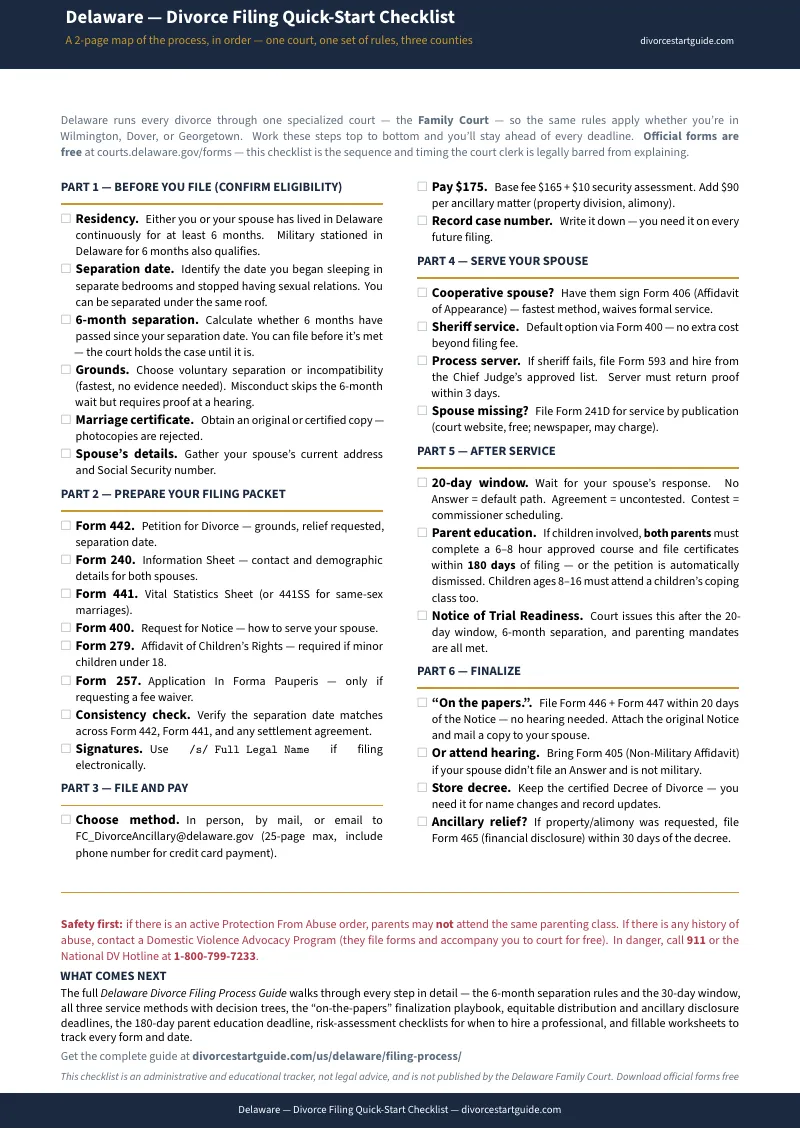
Not sure yet? Start with the free Delaware Divorce Filing Quick-Start Checklist — a one-page overview of the filing steps, residency rules, and waiting period. When you're ready for the full Filing Sequence Navigator — every form explained, every deadline mapped, every decision point flagged — the complete guide is waiting.
Get the Delaware Divorce Filing Process Guide
The court provides the forms for free. This is how you file them right the first time.