The judge signed the dissolution decree. Everyone said that was the finish line. So why does it feel like someone handed you a second job with no instruction manual?
Here's what nobody warns you about a Connecticut divorce: the decree isn't the end of the paperwork — it's the starting gun. The Superior Court dissolved your marriage and issued a judgment file. It didn't update your driver's license at the DMV. It didn't separate your joint bank accounts. It didn't revoke the beneficiary designation on your ex's 401(k) that federal law still honors. It didn't file the quitclaim deed at the Town Clerk or prepare the QDRO your plan administrator needs before touching a single pension dollar. Each of those requires a separate application, to a different agency, with specific forms, in a specific order — and getting that order wrong can quietly cost you thousands.
The problem isn't the forms. It's the sequence.
Newly divorced people in Connecticut don't get stuck because they can't find a form. They get stuck because nobody tells them what to do first, what documents to bring, and which agency to contact before which other agency. Update your license at the DMV before the Social Security Administration has processed your name change, and Form E-78 gets rejected — the DMV verifies directly against the SSA database and won't proceed until the records match. Close a joint account before redirecting your payroll, and your next paycheck bounces. File a quitclaim deed without Form OP-236, and the Town Clerk sends you home. The whole thing is a chain — one weak link stops everything downstream.
Introducing the Post-Decree Administrative Sequence
This is the Connecticut After-Divorce Checklist: Name Change, Accounts & Retirement — an execution manual that picks up exactly where your lawyer left off. Not blank government forms. Not a scattered court self-help portal organized by category. A step-by-step roadmap built around Connecticut's actual agencies, statutes, and filing rules, organized on a chronological timeline so you always know the single next thing to do.
It's built on one idea we call the Administrative Sequence: every task placed in the exact order the state requires it, so each agency accepts your paperwork the first time and you never make a wasted trip to the DMV or Town Clerk.
What's inside
- The Name-Restoration Sequence. The exact SSA → DMV order, including the mandatory 48-hour database sync before the DMV will touch Form E-78. Plus the fallback paths if your decree omitted name restoration: post-judgment motion (no hearing) or Probate Court petition via Forms PC-901/PC-910. For the person who doesn't want a rejected license application and a second trip to the DMV hub.
- The Quitclaim & Conveyance Tax Kit. How to prepare a valid Connecticut quitclaim deed — margins, notary, two witnesses — file it with the Town Clerk, and claim Exemption Code 15 on Form OP-236 to avoid the state conveyance tax entirely on a divorce-related title transfer. For the homeowner who doesn't want a surprise tax bill on a property they're giving up.
- The Retirement & QDRO Road Map. The critical difference between private plans (ERISA-governed QDROs) and Connecticut public pensions (SERS, MERS, TRB — which require a Plan Approved Domestic Relations Order through the Office of the State Comptroller). Including the 4-to-6-month approval timeline you need to plan around and how to request the plan's free Model Order before paying an attorney to draft from scratch. For anyone splitting retirement who can't afford a rejected filing or a premature withdrawal penalty.
- The ERISA Beneficiary Trap Briefing. Why CGS § 45a-257c automatically revokes your ex from your will — but does not protect your 401(k), 403(b), or group life insurance under the Supreme Court's Egelhoff v. Egelhoff ruling. If you don't manually update every private-plan beneficiary form, your ex-spouse legally inherits the funds. For the parent who wants their retirement and life insurance going where they actually intend.
- The Joint Liability Exit Guide. Closing joint bank accounts without tanking your credit, removing authorized users from credit cards, and understanding why a divorce decree that assigns debt to your ex does not bind the original creditor — they will come after you for the full balance. For anyone who needs to separate finances before an ex can run up shared balances.
- The Vehicle Title Playbook. DMV Form H-13B for title transfers, Form B-301 for registration changes, the sales tax exemption for divorce-related transfers, and what to do when a lienholder won't release. For the person who needs the car in their name only and doesn't want to pay sales tax on their own vehicle.
- The Estate Plan Revision Blueprint. Rebuilding your will, powers of attorney, and healthcare proxies so your estate no longer defaults to your former spouse — with clear guidance on what CGS § 45a-257c actually covers and where the gaps are.
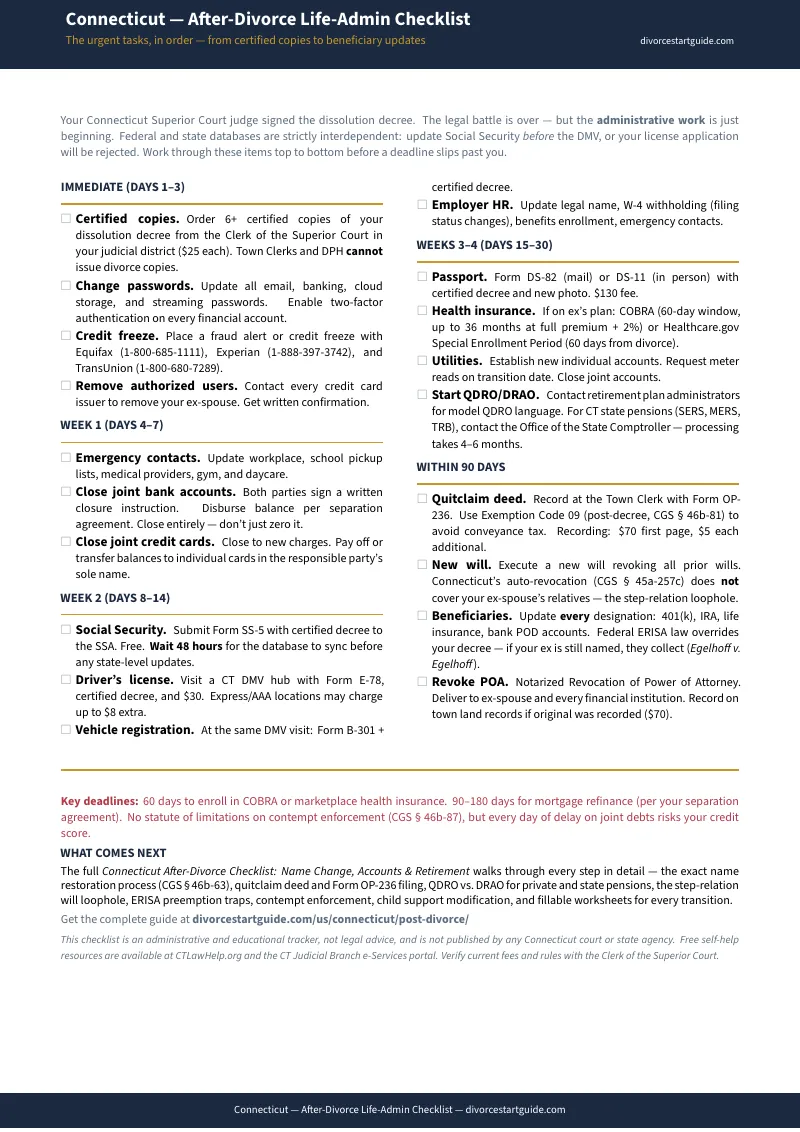
- Chronological Execution Worksheets. Your whole to-do list sorted into Days 1–7 (security and digital), Days 8–30 (identity and agency), and Days 31–90+ (property, retirement, and estate) — so you're never guessing what's urgent and what can wait.
- 8 Printable Standalone PDFs. The name-restoration sequence, quitclaim deed guide, retirement division roadmap, vehicle title transfer sheet, certified copy tracker, joint account closure tracker, beneficiary update tracker, and post-divorce timeline planner — extracted from the guide so you can print each one and bring it to the relevant agency or bank appointment.
Who this is for
You have a final judgment of dissolution from the Connecticut Superior Court and now you own property, retirement accounts, joint debt, or a name you want back. You'd rather not pay an attorney $250–$600 an hour to walk you through routine paperwork the court no longer helps with. You want a clear, honest roadmap — and you want to stop lying awake wondering what you've forgotten.
This works whether you went through a full contested trial, mediated settlement, or the nonadversarial track under CGS § 46b-44a — the post-decree administrative steps are the same.
Why not just use the free government resources?
Because they can't help you here. CTLawHelp.org's self-help portal covers getting a divorce — not executing one. The Connecticut Judicial Branch provides individual forms but no cross-agency sequence. The DMV, the Social Security Administration, Town Clerks, and the Office of the State Comptroller each handle their piece in isolation — none of them tells you what to do first, what order the agencies require, or which step depends on which. This guide is the missing manual for the gap between "your divorce is final" and "your life is actually separated" — and that gap is where the mistakes happen.
A quick, honest boundary
This is a process-navigation and organisation tool, not legal advice and not a law firm. It helps you gather the right documents in the right order before you contact a government agency, plan administrator, or attorney. For a contested enforcement action, hidden assets, or a complex SERS pension audit, it will tell you plainly when to bring in a professional — and save you money on everything else.
Our guarantee
If this guide doesn't make your post-divorce to-do list clearer and calmer, email us at any time for a full, no-questions-asked refund. The risk is entirely ours. We'd rather earn your trust than hold your money.
— less than five minutes of attorney time
Not sure yet? Start with the free one-page After-Divorce Life-Admin Checklist — the first 48 hours of identity and security steps, yours to download right now. When you're ready for the complete administrative sequence — quitclaim deeds, QDRO filings, beneficiary updates, debt separation, and the full chronological timeline — the paid guide is waiting.
Get the Connecticut After-Divorce Checklist →
The decree closed one chapter. This is how you close the file for good — and finally exhale.