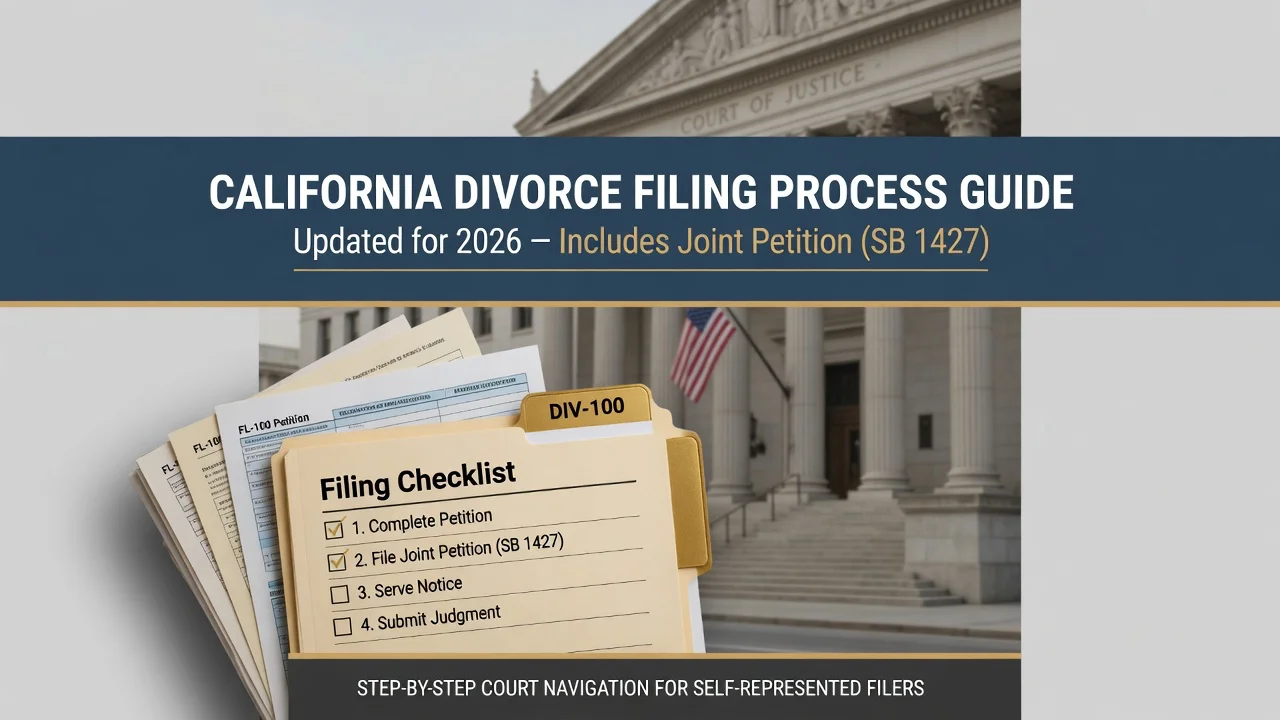
The Court Forms Are Free. Knowing What to Do With Them Is the Hard Part.
California gives you every divorce form you need — and zero instructions on how to use them. The Judicial Council publishes FL-100, FL-110, FL-150, FL-180, and dozens more, all free to download. What they don't publish is a process manual: which forms to file in which order, which ones get served privately (not filed with the court), when the six-month waiting period actually starts, and what happens when the clerk hands your packet back because a county-specific cover sheet is missing.
That's the gap this guide fills. Not forms — you don't need to pay for those. Process navigation.
The California Divorce Sequencing System
The California Divorce Filing Process Guide is a chronological operations manual that takes you from "I've decided to file" through the signed final judgment. It maps every phase of the California divorce process — Filing, Service, Financial Disclosures, Agreement, and Judgment Assembly — in the exact order you need to complete them, with checklists that tell you what the clerk expects to see before you reach the counter.
California introduced the Joint Petition (FL-700) on January 1, 2026 under Senate Bill 1427, creating a completely new filing track where both spouses file together as co-petitioners instead of adversaries. The guide covers both the traditional Petition path and the new Joint Petition path — including the critical difference in how each one starts the mandatory six-month waiting period.
What's Inside
- Dual-track filing decision tree — a structured walkthrough that determines whether you should file a traditional Petition (FL-100) or the 2026 Joint Petition (FL-700), based on your specific situation. No guessing, no wading through both sets of instructions to figure out which applies to you.
- Service of process tracker — because California law says you cannot hand your spouse the papers yourself, even if you're standing in the same kitchen. The printable tracker covers personal service, mail with Notice and Acknowledgment (FL-117), substituted service, and how the Joint Petition eliminates service entirely — plus deadlines you cannot miss.
- Financial disclosure walkthrough — the disclosure phase trips up more self-represented filers than any other step. The guide explains which forms to exchange privately (FL-140, FL-142, FL-150, FL-160) and which proof form gets filed with the court (FL-141), so your most sensitive financial information stays out of the public record.
- Residency verification worksheet — confirm the six-month California / three-month county tests under Family Code § 2320 before you file, including the legal-separation workaround if you are not there yet.
- Date of separation worksheet — Family Code § 70 requires intent plus consistent conduct. Work the date that goes on FL-100 or FL-700 before you fill the petition.
- Community property worksheet — California is a 50/50 community property state. The structured worksheet lets you list community assets and debts and calculate equalizing payments before you ever touch an official court form, so you can draft your Marital Settlement Agreement without a forensic accountant.
- FL-150 income and expense planner — this form is the single most common source of clerk scrutiny and court rejections. The guided planner walks you through every line, including how to handle irregular income, household contributions, and the written attachments that prevent your budget declaration from being flagged.
- Default divorce pathway — if your spouse doesn't respond within 30 days of being served, you can file a Request to Enter Default (FL-165) and move forward without them. The guide covers both True Default (no response, no agreement) and Default with Agreement (no response, but a signed MSA), with separate checklists for each.
- Judgment assembly checklist — the highest-friction moment of any pro se divorce. This step-by-step checklist shows exactly how to compile FL-130, FL-141, FL-144, FL-170, FL-180, and FL-190 into a final packet the judge will sign, including copy counts, envelope requirements, and the specific formatting errors that trigger clerk rejections.
- County-specific local form alerts — Los Angeles County requires a FAM-020 zip-code courthouse routing sheet; omitting it means instant rejection of your entire initial filing. The guide flags these county-level requirements so you don't learn about them at the clerk's window.
- Fee waiver worksheet — if you receive Medi-Cal, CalWORKs, CalFresh, SSI, or meet low-income thresholds, you may qualify to waive the $435 per-party filing fee. Step-by-step guidance through Forms FW-001 and FW-003.
- Child support and custody worksheet — if you have minor children, capture income, timeshare, legal/physical custody, and the childsupport.ca.gov guideline result before you draft the MSA.
Who This Is For
- You and your spouse agree on the terms and want to handle the court process yourselves — either through the new Joint Petition or a traditional uncontested filing
- You've downloaded the Judicial Council forms and have no idea which ones to file, which to serve privately, or what order they go in
- You're the one initiating the divorce and need to understand service of process, the waiting period clock, and what to do if your spouse doesn't respond
- You can't afford attorney representation for a cooperative case — and you shouldn't have to pay thousands of dollars for someone to explain standard court deadlines and compile public forms
- You want the process context that free court resources don't provide: sequencing, deadlines, common rejection reasons, and county-specific requirements
Why Not Free Tools?
California's court self-help website (selfhelp.courts.ca.gov) is excellent — and it's the first place you should go for official forms and basic statutory explanations. But it doesn't sequence the steps for you. It doesn't provide fillable worksheets for dividing community property. It doesn't flag county-specific local forms. And it doesn't tell you what to do when the clerk rejects your packet without explaining why.
Court facilitators offer in-person help, but they're legally prohibited from giving legal advice, their interactions aren't confidential, and funding limits mean they prioritize child support cases. Wait times in busy counties can stretch for weeks.
Online divorce platforms like Hello Divorce ($100–$1,500+) and 3StepDivorce ($299) charge hundreds of dollars to type your data into form templates — but they don't teach you how the California court system actually processes those files. When a clerk rejects your package because a county-specific cover sheet is missing, those platforms leave you to figure it out alone.
This guide gives you something none of those options do: a chronological operations manual for interacting with the California court system, with worksheets and checklists at every step.
What You're Getting
Your download includes 14 PDFs:
- guide.pdf — the 15-chapter California Divorce Filing Process Guide covering both filing tracks, service, disclosures, community property, default pathways, and judgment assembly
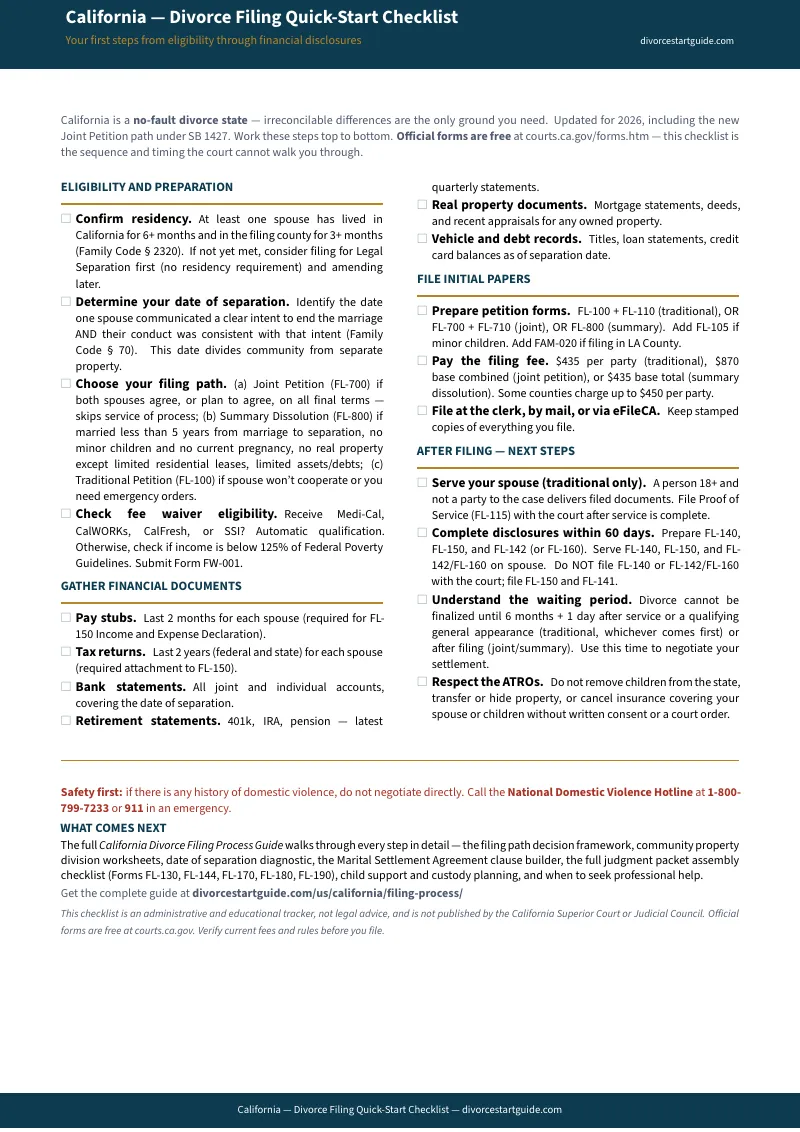
- checklist.pdf — the one-page Quick-Start Checklist (18 items) covering filing steps, residency, and the waiting period
- filing-pathway-decision-tree.pdf — FL-100 vs. FL-700 vs. summary dissolution
- residency-verification-worksheet.pdf — six-month / three-month eligibility dates
- date-of-separation-worksheet.pdf — Family Code § 70 diagnostic for the petition date
- fee-waiver-worksheet.pdf — FW-001 / FW-003 eligibility
- service-of-process-tracker.pdf — personal, FL-117 mail, substituted service, and the 30-day clock
- financial-disclosure-tracker.pdf — 60-day exchange; what you serve privately vs. file
- fl-150-income-expense-planner.pdf — income, expenses, and irregular-income average
- community-property-worksheet.pdf — assets, debts, and 50/50 equalization math
- child-support-custody-worksheet.pdf — timeshare, custody, add-ons, guideline result
- default-pathway-checklist.pdf — True Default vs. Default with Agreement
- judgment-assembly-checklist.pdf — FL-182 packet, copy counts, envelopes
- county-local-form-log.pdf — county extras such as LA FAM-020
All 14 files are yours to keep and reference throughout your case — no subscription, no recurring fees, no software login to worry about.
Money-Back Guarantee
If the guide doesn't give you a clearer path through the California divorce process, email us at any time and we'll refund your purchase — no questions, no hoops.
Get the California Divorce Filing Process Guide →
Or start with the free Quick-Start Checklist — a one-page overview of the filing steps, residency rules, and waiting period — to see if a self-guided approach is right for your situation.