You Have the Free Court Forms. Now What?
Alaska gives you every blank form you need for free — DR-100, DR-105, DR-50, CIV-100, TF-920, all of them. What Alaska does not give you is the order to fill them in, when to file each one, or what happens if you serve your spouse by the wrong method and the judge throws out the case.
That gap between blank forms and a finalized decree is where most self-represented filers get stuck. You miss a 20-day response deadline. You exchange financial disclosures to the court instead of directly to your spouse. You file a Petition for Dissolution when your spouse refuses to sign — and now you have paid a non-refundable $250 filing fee for the wrong track entirely.
The Filing Sequence System
This guide is not a form packet. It is a chronological filing roadmap — the step-by-step sequence that turns Alaska's free blank forms into a completed divorce or dissolution, from your first residency check through the final hearing.
Where the Alaska Court System's Self-Help Center groups forms by category, the Filing Sequence System arranges everything by order of operations: what to file first, what triggers the next deadline, what gets served and what gets exchanged privately, and exactly when to schedule your hearing. It covers all four judicial districts, both the dissolution and divorce tracks, and the TrueFiling electronic filing portal that most filers are now required to use.
What's Inside
- Filing Track Decision Guide — choose the right track before you spend the filing fee. A joint Petition for Dissolution (DR-100/105) requires full agreement; a solo Complaint for Divorce (DR-50/55) does not. This fillable worksheet maps each scenario so you file once, correctly.
- Jurisdictional Eligibility Worksheet — confirms the court has authority over every part of your case: the residency test, the UCCJEA six-month custody rule, and the long-arm property test for out-of-state spouses.
- TrueFiling Registration Walkthrough — step-by-step instructions for AKFile registration, document bundling, electronic signature formatting ("s/ printed name"), and fee payment. Administrative Bulletin 92 now requires electronic filing for most self-represented litigants — this section ensures your first submission is accepted.
- Document Assembly Checklist — every form in your packet organized by filing track, with the signing, notarization, and black-ink requirements checked off before you file.
- Service of Process Tracker — a logging tool for documenting certified-mail restricted delivery, process server receipts, and out-of-state service. Includes the DR-210 Affidavit of Diligent Inquiry workflow for cases where a spouse cannot be located.
- Civil Rule 26.1 Disclosure Organizer — the financial disclosure exchange is mandatory within 45 days of an answer being filed, and it happens directly between spouses (not through the court). This organizer walks you through collecting three years of tax returns, bank statements, pay stubs, and retirement valuations — with a certificate-of-service log to prove compliance.
- Property and Debt Inventory — a fillable inventory of every asset and debt with values and title holders, starting from Alaska's 50/50 presumption and testing the equitable-distribution factors under AS § 25.24.160(a)(4).
- Default Judgment Module — if your spouse is properly served but never responds, the guide walks you through the Default Application (SHC-400) under Civil Rule 55, including the hearing preparation checklist and the documentation you need to bring.
- Hearing Day Protocol — what to expect from a Superior Court Master or Judge, typical questions at uncontested hearings, telephonic participation procedures, and how to request certified copies of your final decree.
- Four-District Court Directory — contact information, clerk hours, and local filing notes for every courthouse across Alaska's First through Fourth Judicial Districts, from Ketchikan to Fairbanks to Nome.
- Progress Tracker & Deadline Calculator — a single-page timeline view showing your filing date, service date, response deadline, disclosure deadline, waiting period, and hearing eligibility date. Fill in your dates and the deadlines calculate themselves.
Who This Is For
- You and your spouse agree on everything and want a joint dissolution — you need the exact filing sequence so no step is missed.
- Your spouse will cooperate but will not help with the paperwork — you need a complete uncontested divorce workflow for filing solo.
- Your spouse is unresponsive or cannot be located — you need the default judgment and service-by-publication pathways.
- You have children under 19 — you need to understand how Civil Rule 90.3 child support calculations and the parenting plan integrate into the filing timeline.
- You are stationed in Alaska through the military — you need to know how the 30-day stationing rule (AS § 25.24.900) establishes filing eligibility.
Why Not Free Resources Alone?
The Alaska Court System's Self-Help Center is genuinely useful — their forms are the same ones clerks accept, their helpline staff are knowledgeable, and their instructional videos cover the basics. But Self-Help Center staff are legally prohibited from telling you what to do, reviewing your paperwork for completeness, or advising you on which track to file under. They hand you the ingredients; they cannot give you the recipe.
Online document-assembly services like 3StepDivorce ($299) and LegalZoom ($100–$500) auto-fill your forms through questionnaires — but they deliver completed documents without guiding you through TrueFiling submission, local clerk requirements, or the post-filing disclosure exchange under Rule 26.1. You pay hundreds of dollars for form generation and still have to figure out the process yourself.
This guide costs a fraction of those services and focuses entirely on what they skip: the chronological process, from case setup through final hearing, with every deadline, every filing step, and every local variation documented in one place.
Satisfaction Guarantee
If you follow the guide's sequencing instructions and a clerk rejects your filing due to a procedural error the guide should have covered, email us and we will refund you in full. No time limit, no fine print.
Start Filing With Confidence
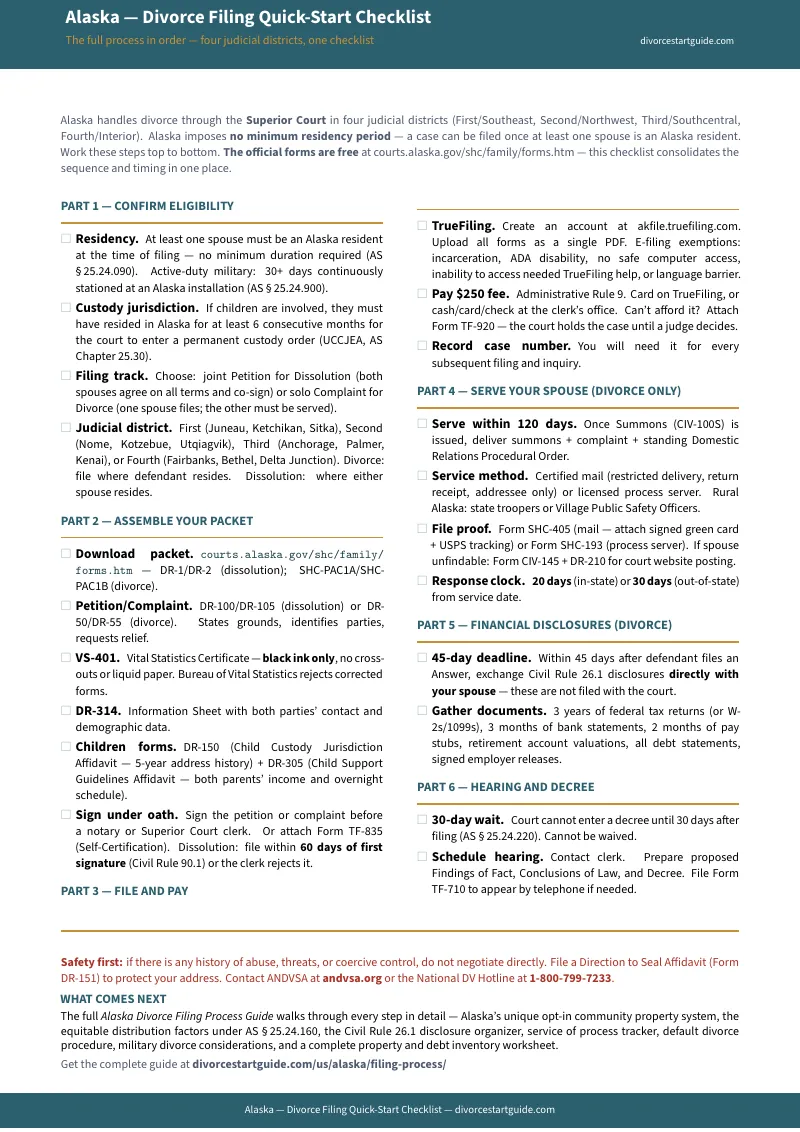
Download the free Alaska Divorce Filing Quick-Start Checklist to see if this guide is right for your situation. It covers the high-level filing steps, residency verification, and the dissolution-vs-divorce decision in a two-page overview.
When you are ready for the full step-by-step process — with worksheets, deadline tracking, the complete TrueFiling walkthrough, and the Civil Rule 26.1 disclosure organizer — the complete Alaska Divorce Filing Process Guide picks up exactly where the checklist leaves off.