The Alaska Custody Navigator — Your Court-Ready Parenting Plan System
You know you need a parenting plan. The court gave you Form DR-475 — nine pages of blank lines. But blank lines don't tell you how to handle the 110-overnight threshold that flips your child support calculation, how to structure a weather-delay clause for regional travel, or what to do with the Permanent Fund Dividend when neither statute nor the form explains who files the child's application.
Between free court forms that leave you guessing and a family law attorney at $374 per hour, there is a gap. The Alaska Custody Navigator fills it — a structured process guide and workbook that walks you through every decision the court expects you to make, in the order you need to make it.
What's Inside
- The Alaska Custody Framework Explained — Legal custody versus physical custody, the 256-overnight primary threshold, and how the nine best-interest factors under AS 25.24.150(c) actually drive the judge's decision.
- Civil Rule 90.3 Child Support Math — Step-by-step walkthroughs of the primary, shared, divided, and hybrid custody formulas with worked examples, so you understand exactly how your parenting schedule changes your financial obligation.
- DR-475 Parenting Plan Architecture — Section-by-section guidance for the court's mandatory parenting plan form: decision-making authority, communication rules, residential schedules, and financial arrangements including PFD allocation.
- Schedule Templates for Alaska Families — Alternating weeks, 2-2-5-5, and 2-2-3 rotations for nearby parents; summer-dominant and holiday-rotation templates for long-distance families; infant and toddler schedules with developmentally appropriate transition frequency.
- Weather-Delay and Travel Protocols — Clause language for bush-plane cancellations, ferry disruptions, and winter road closures — the logistics that make Alaska parenting plans structurally different from any other state.
- PFD Decision Worksheet — A framework for negotiating who files the child's Permanent Fund Dividend application, how the funds are managed, and how to draft enforceable language for Section 4 of Form DR-475.
- Modification Roadmap — How to file Form DR-700, prove the "substantial change in circumstances" threshold under AS 25.20.110, and navigate the two-step relocation test when a parent plans to move.
- Mediation and Dispute Resolution Prep — What to expect from the court's free Parenting Plan Dispute Resolution program, how to file Form MED-405, and how to prepare proposals that hold up in a mediation session.
- DV Protections — The rebuttable presumption against custody for perpetrators of domestic violence under AS 25.24.150(g), what evidence the court requires to overcome it, and how protective orders interact with parenting time.
Who This Guide Is For
- Married parents filing for dissolution or contested divorce who need to draft a parenting plan as part of their case.
- Unmarried parents establishing custody rights for the first time — whether through a Complaint for Custody (Form DR-420) or a paternity action.
- Parents modifying an existing order because of relocation, a new school-age transition, or a breakdown in the current arrangement.
- Anyone preparing for mediation or a custody hearing who wants to walk in with a structured, evidence-backed proposal instead of improvising under pressure.
Why Not Just Use the Free Court Forms?
The Alaska Court System's self-help center is excellent — and the forms are free. This guide does not replace them. It is the workbook that helps you complete them with confidence. Form DR-475 gives you blank fields for "Holiday Schedule" and "Travel Arrangements." It does not show you how to structure a winter-break rotation, calculate whether your proposed schedule crosses the 110-overnight shared-custody line, or write weather-delay contingencies that a judge will actually enforce. Generic national services like Custody X Change and LegalZoom offer templates, but they do not account for Alaska-specific realities: PFD allocation, bush-plane logistics, the Co-Parenting Program, or Civil Rule 90.3's unique 1.5 multiplier for shared custody calculations.
What You Get
Eight downloads, ready immediately:
- The Full Guide (45 pages) — 13 chapters covering the entire custody process from filing through modification, with worked child support examples and schedule templates.
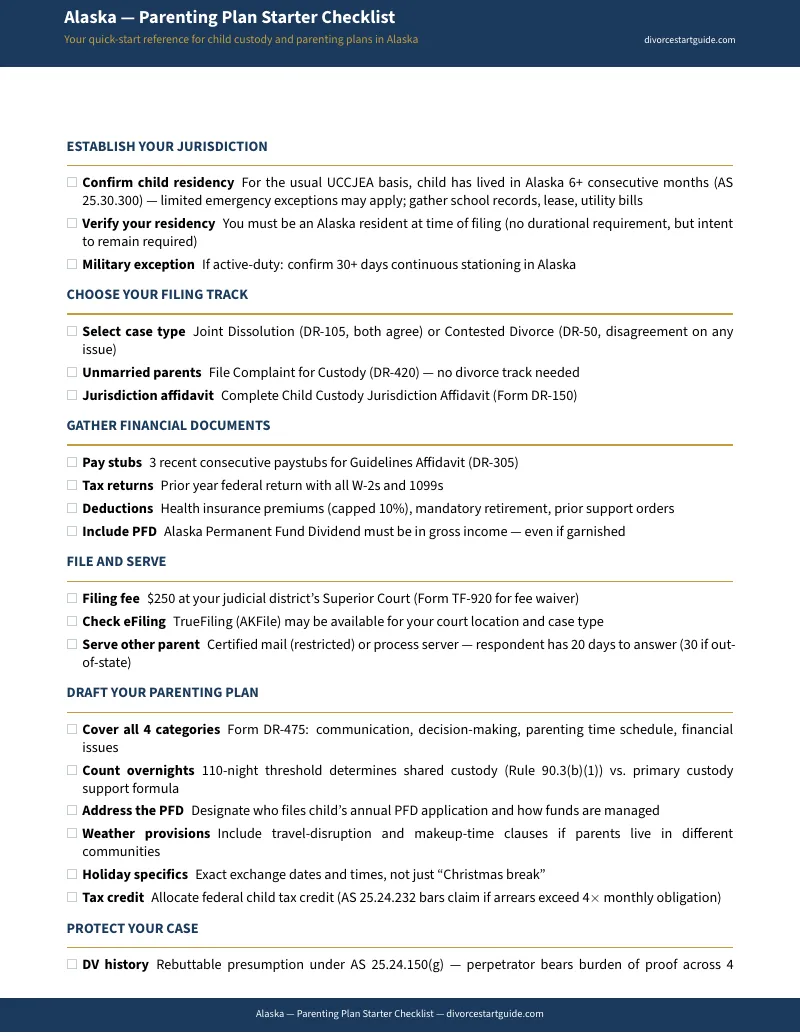
- Parenting Plan Starter Checklist — A two-page overview of every decision point in your parenting plan, designed to ensure nothing falls through the cracks before you submit Form DR-475.
- Overnight Tracking Log — Week-by-week tracker to calculate whether your parenting schedule crosses the 110-overnight shared-custody threshold.
- Child Support Calculation Worksheet — Step-by-step walkthrough of the Civil Rule 90.3 formula for both primary and shared custody.
- Best-Interests Evidence Organizer — Map your evidence to all nine AS 25.24.150(c) factors before preparing Form DR-965.
- Parenting Plan Drafting Worksheet — Structured prompts for each of the four required sections of Form DR-475, including PFD allocation and weather-delay provisions.
- Document Collection Checklist — Every document you need to gather, organized by case phase: pre-filing, financial disclosure, parenting plan, and trial preparation.
- Agency Communication Log — Record every contact with court staff, mediators, attorneys, and government agencies.
For less than the cost of 15 minutes with a family law attorney, you get the strategic workbook that helps you do the heavy lifting beforehand — so if you do hire a lawyer, your retainer goes toward critical advocacy, not basic paperwork.
Get the Alaska Custody & Parenting Plan Guide →
Not ready for the full guide? Download the free Parenting Plan Starter Checklist — no credit card, no commitment.
Satisfaction Guarantee
If the guide does not help you structure a stronger parenting plan, email us at any time for a full refund. No forms, no questions.