
Your Final Order Ends the Marriage. It Doesn't End the Paperwork.
You've navigated mediation, signed the Consent Order, waited through the 20-week reflection period, and finally received the Final Order. The legal process is over.
But the administrative process? That's just beginning.
Your name is still on documents that no longer reflect who you are. Your pension is still linked to an agreement that's been dissolved. Your ex is still listed as your next of kin, your beneficiary, and possibly your attorney under a Lasting Power of Attorney. Joint bank accounts are still accruing shared liability. And every week you wait, the administrative tangle gets harder to unpick.
The problem isn't that the information doesn't exist — it's scattered across HMCTS, HMPO, DVLA, HMRC, Land Registry, pension trustees, and three separate credit reference agencies. Each department tells you what it needs. None of them tell you the right sequence.
The Post-Divorce Transition System
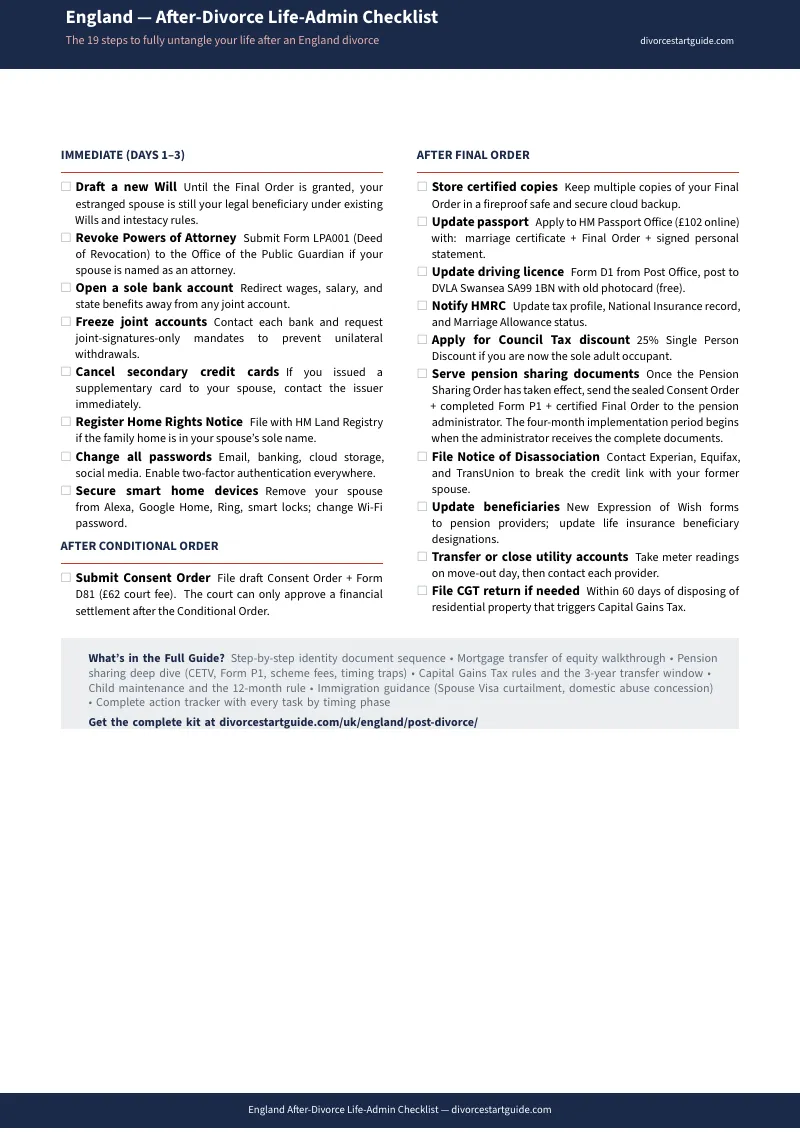
The England After-Divorce Checklist is a chronological transition system that maps every administrative, financial, and legal step to the exact moment you can actually complete it — organised into three timing phases (upon separation, after the Conditional Order, after the Final Order) so you never waste an application or discover a dependency the hard way.
This isn't a list of blank government forms — those are free on GOV.UK. This is the sequencing layer that connects thirteen separate government departments and financial institutions into a single workflow, with the timing traps, form references, and cost breakdowns that none of those departments volunteer.
What's Inside
- The identity document sequence — passport first, then DVLA, then HMRC, then banks. Get this wrong and you'll face rejection loops where each agency wants the document you haven't updated yet
- Name restoration without a Deed Poll — the three-document package that every government agency accepts, and exactly when you actually need an Enrolled Deed Poll (£53.05) instead
- Pension Sharing Order implementation — how to request CETV valuations, complete Form P1, serve documents on the scheme administrator, and navigate the four-month processing window that delays most people's pension transfers by months
- Property transfer of equity — Land Registry forms TR1 and AP1, the lender consent process, and the SDLT exemption that applies to court-ordered transfers
- Capital Gains Tax after separation — the three-year no-gain/no-loss transfer window (Finance Act 2023), the 60-day reporting deadline for property disposals, and current CGT rates (18% basic, 24% higher rate)
- Joint account separation and credit protection — freezing mandates, Direct Debit transfers, and the Notice of Disassociation that breaks the invisible credit link between you and your ex
- Will and estate planning — why the Final Order treats your ex as having predeceased you (which sounds helpful until you realise what happens to failed gifts and unnamed executors)
- Child maintenance, CMS calculations, and the 12-month rule — how the Child Maintenance Service can override your Consent Order after twelve months
- Council Tax, benefits, and immigration — the 25% Single Person Discount, Universal Credit eligibility, and Spouse Visa curtailment rules
- Complete action tracker — every task organised by timing phase, ready to tick off as you work through the transition
Who This Is For
This guide is for anyone in England who has received their Final Order (or is approaching it) and needs a clear, sequential roadmap for the administrative transition that follows.
It's built for people who are handling this themselves — not because they can't afford a solicitor, but because paying £210–£500+ per hour for someone to tell you which form to post to Swansea is not a sensible use of money when the steps are well-defined and the sequence is what matters.
Why Not Free Resources?
Free resources exist, and some of them are excellent. GOV.UK's department pages are accurate. MoneyHelper's pension guides are thorough. Citizens Advice covers benefits eligibility well.
The gap is between them. No free resource connects the HMPO passport timeline to the DVLA licence update to the HMRC name change to the bank account sequence — or explains why doing them out of order creates weeks of delays. No free checklist warns you that your Lasting Power of Attorney still gives your ex legal authority over your finances until you actively revoke it. No government page tells you that the 25% Council Tax discount requires a separate application to your local authority, not an automatic update.
This guide fills that gap: the sequencing, the timing rules, the dependencies, and the traps that sit in the spaces between departments.
What You Get
Your purchase includes instant PDF downloads — 9 files in total. The complete 13-chapter guide, a quick-start checklist, and 7 standalone printable tools you can take to the bank, post office, or pension provider. No subscriptions, no recurring charges, no accounts to create. Download once, keep forever.
The standalone tools include a 38-task action tracker (organised by timing phase), the identity document update sequence, a pension sharing implementation checklist, a financial separation worksheet for auditing joint accounts and debts, a property transfer checklist, a tax reference card (CGT rates and deadlines), and a digital security checklist. Every step includes the specific form reference, the current fee, and the submission route — so you can work through the transition at your own pace without hunting for each detail separately.
A Fraction of the Professional Fee
A single hour of solicitor time to walk through these same post-decree steps would cost £210–£500+. A specialist name-change service charges £29–£126 — and covers only the name change, ignoring pensions, tax, property transfers, and everything else.
For less than the cost of a single name-change kit, this guide covers the entire post-divorce administrative transition — from identity documents to pension sharing to Capital Gains Tax — with the same level of step-by-step detail.
Get the England After-Divorce Checklist →
The free checklist covers what to do. The full guide covers how — with the exact forms, fees, sequences, and timing rules that turn a months-long administrative tangle into a clear, manageable process.