You know the marriage is over. What you don't know is what the court expects from you on Tuesday.
You've read the official pages. You've downloaded a blank Form 2A. And you're still stuck on the same questions: Which track am I on? What do I actually write in the "reasons for breakdown" box? When does the 14-day service clock start? What happens if the Service Bureau counter rejects my filing?
That's not a knowledge problem — it's a sequence problem. Singapore's Family Justice Rules were completely rewritten in October 2024, and most of what's floating around online (forums, older law-firm blogs, even well-meaning friends) still describes the old system: the Writ for Divorce, the Statement of Claim, steps that no longer exist. Following stale instructions doesn't just waste your afternoon — it means rejected filings, wasted Service Bureau fees, and a case that stalls for weeks.
The Filing Sequence System
The Singapore Divorce Filing Process Guide is built around one idea: a civil divorce is not one decision, it's a sequence of roughly twenty administrative steps — and every rejection, delay, and panic attack comes from doing them out of order or half-prepared. So the guide walks the sequence in order, from the eligibility gates to the Final Judgment, telling you at each step what the court expects, what to prepare before you get there, and what a rejection looks like so you never see one.
It's a process-navigation workbook — not legal advice, not forms (the courts give those away free), and not a substitute for a lawyer where you genuinely need one. It's the preparation that makes every free official resource actually work for you.
What's Inside
- The three eligibility gates — domicile or habitual residence, the three-year marriage bar, and a provable fact of irretrievable breakdown under Section 95 — so you find out whether you can file now instead of finding out at the counter.
- Simplified track vs. normal track, diagnosed — because the difference is roughly two months versus eighteen, and thousands of dollars versus tens of thousands. You'll know which track you're on before you file, not after.
- The DMA Joint Statement Architect — Divorce by Mutual Agreement (new since July 2024) is the cleanest ground available, but the Registrar rejects vague, templated statements. You get structured prompts for the three things the joint statement must show: the reasons for the breakdown, the reconciliation efforts, and the proposed arrangements.
- The Service Bureau walkthrough — you can't e-file directly as a self-represented litigant; you file through the eLitigation Service Bureau. The guide maps the counter visit step by step, including the exact fee stack (the S$56 filing fee, per-child and per-property surcharges, transmission and scanning charges) so you arrive with the right payment and the right documents.
- Every deadline that protects you — the 14-day personal service window, the Affidavit of Service (Form 78B), and the respondent's 14-day Notice to Contest and 28-day Reply windows, mapped into a master timeline so nothing lapses on you.
- The respondent's playbook — if papers were served on you, the clock is already running. The guide shows your response windows and what ignoring the papers actually costs (a binding order made in your absence).
- Money and housing prep — the ANJ v ANK contribution framework the courts use to divide assets, CPF refund mechanics, and the pre-MOP HDB questions that decide whether you keep the flat.
- The CPP and FDR mediation, prepared — the mandatory Co-Parenting Programme certificate if you have children under 21, the difference between custody, care and control, and access, and how to walk into court mediation with a parenting schedule that can actually be agreed.
- The fee-waiver route — if you genuinely can't afford the court fees, there's an indigency waiver tied to the Legal Aid Bureau's means test. The guide shows who qualifies and how to apply.
- Eight printable worksheets — the DMA Joint Statement Planner, Filing Timeline Tracker, Fee Budget Worksheet, Service Log, Contribution Ledger, Parenting Schedule Worksheet, Child Expense Worksheet, and FDR Mediation Prep Sheet — so every chapter ends in something filled in, not just read.
Who This Is For
This guide is for you if you're filing — or responding to — a civil divorce in Singapore's Family Justice Courts, especially without a lawyer. You want the sequence, the documents, the deadlines, and the fee picture in one place, in plain language.
It's equally for the person who hasn't filed yet and wants to know what they're signing up for before they start the clock.
One honest boundary: if you were married under Muslim law, your divorce goes through the Syariah Court under the Administration of Muslim Law Act — a separate system with its own procedures. This guide covers civil divorces under the Women's Charter only, and it says so clearly on page one so you don't buy the wrong thing.
Why Not Just Use the Free Court Resources?
You should — and the guide points you to every one of them. The Family Justice Courts' forms, the Divorce eService, the MSF Co-Parenting Programme, and court-appointed mediation are genuinely excellent and genuinely free.
But a blank form doesn't tell you what to write in it. A portal doesn't warn you that your DMA statement is too vague to pass the Registrar, that your parenting proposal uses the wrong legal vocabulary, or that you have 14 days — not "a couple of weeks" — to serve the sealed application. The gap between having the forms and filing them correctly, in order, the first time is exactly the gap this guide closes. It costs — a fraction of one hour of a family lawyer's time (S$300–S$1,000/hr is the going range), and less than a single rejected filing costs you in fees and lost weeks.
Our Promise
If the guide doesn't give you the clarity you expected, email us at any time and we'll refund you — no forms, no interrogation.
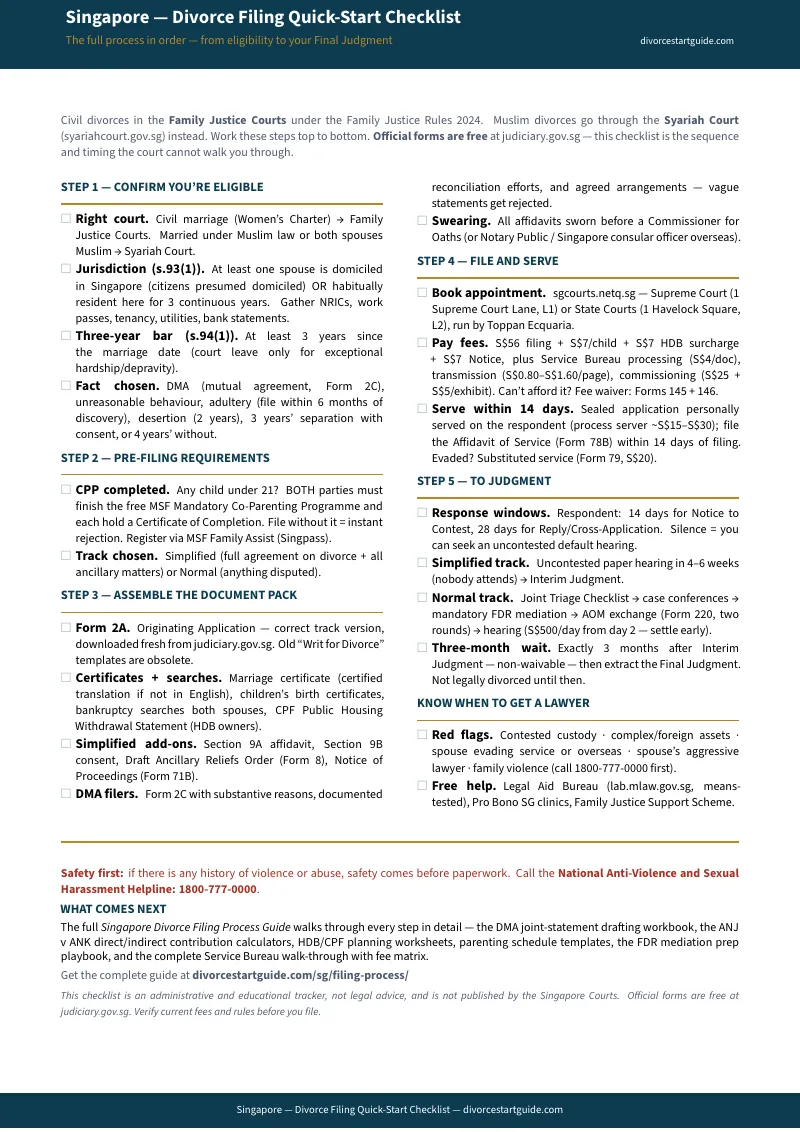
Not ready for the full guide? Start with the free Quick-Start Checklist — twenty items covering eligibility, the document pack, filing, service, and the path to judgment. When you want the full sequence with the worksheets, fee tables, and mediation prep, the complete guide is here.
Get the Singapore Divorce Filing Process Guide — and file it right the first time.