
Your finances just split in half. Your bills did not.
When a marriage ends, one household becomes two — and the math is brutal. Your rent or mortgage becomes yours alone. Utilities barely drop. Groceries fall by far less than 50 percent. Meanwhile, the court hands you a blank financial declaration form and tells you to fill it in under penalty of perjury.
Most people respond by guessing. They estimate their monthly spending from memory, miss the irregular bills that hit every quarter or every year, and double-count credit card charges that are already included in their checking account totals. The result is a financial picture that is wrong in ways that damage their credibility in court and leave them blindsided within months of the final decree.
The Financial Transition System
The Post-Divorce Budget Planner is not another blank worksheet. It is a five-stage financial transition system that walks you through the same sequential process Certified Divorce Financial Analysts use — from pre-filing data gathering through post-decree rebuilding. Each stage pairs a structured process with a specific worksheet, so your raw bank statements and pay stubs become a clear, defensible picture of your financial future.
Where free tools give you empty cells and expect you to know what goes in them, this toolkit shows you how to calculate the numbers, why each one matters, and what to do when the math does not work out the way you hoped.
What's Inside
Transaction Reconciliation Matrix — the single most common error on sworn financial declarations is double-counting credit card spending. This worksheet segregates your direct cash and debit transactions from credit card charges, flags any category that appears in both streams, and gives you an accurate expense total you can sign with confidence.
Amortized Expense Converter — annual property taxes, semi-annual car insurance, quarterly pest control, back-to-school costs. These irregular bills destroy post-divorce budgets because they show up as $0 on a typical monthly spending estimate, then arrive as emergencies. This worksheet translates every irregular bill into a monthly savings target so you are never caught short.
Support Stress-Test Simulator — if you are receiving or paying child support or spousal support, your entire budget hinges on those payments arriving in full and on time. This worksheet models three scenarios — full support, partial support, and zero support — so you know exactly where your breaking point is and what to cut if payments stop.
Housing Analysis Worksheet — fighting to keep the marital home is one of the most expensive decisions in a divorce. This worksheet factors in mortgage, property taxes, insurance, utilities, and maintenance reserves to show whether keeping the home is financially viable on a single income. If the answer is no, you find out before you negotiate — not six months after the decree when the roof needs replacing.
Joint Debt Liability Tracker — a divorce decree assigns debt to one spouse. It does not release the other spouse from the original contract with the creditor. This tracker separates marital obligations, flags joint accounts where the bank can still come after either of you regardless of what the decree says, and builds a payoff timeline.
Single-Income Budget Builder — most post-divorce budgets are survival budgets that slash every discretionary expense. They last about three weeks before emotional burnout triggers impulsive spending that costs more than the original budget line. This worksheet builds a sustainable spending plan around your actual priorities — not deprivation, but intention.
Year-One Transition Checklist — after the final decree, the administrative work begins: retitling assets, updating beneficiaries, adjusting tax withholdings, establishing individual credit, rebuilding an emergency fund. This checklist walks through every post-decree task in order, with the financial impact of each step explained.
Net Asset Division Calculator — models different property-split scenarios so you can compare after-tax outcomes before the settlement is final.
Statutory "Proper Provision" Allocator — sorts your expenses into court-recognized needs versus discretionary wants, so your sworn financial declaration reflects the distinction every judge expects.
Emergency Fund Automator — builds a three-tier savings plan with automatic transfer targets calibrated to your post-divorce fixed obligations.
Child Expense Tracker — separates shared parenting costs from individual household expenses so each parent has court-ready records of extracurricular, medical, and exchange-travel spending.
Who This Is For
- You are separating or recently divorced and need to build a realistic monthly budget from scratch
- You need to prepare accurate financial disclosures for court without paying an attorney hundreds of dollars per hour to organize your bank statements
- You are deciding whether to keep the marital home and want a financial analysis, not an emotional argument
- You are receiving or paying support and need to know what happens to your budget if those payments change
- Your spouse handled all the finances during the marriage and you are starting from zero
Why Not Free Tools?
Court self-help websites give you blank forms. They demand precise figures for income, assets, and liabilities but provide zero guidance on how to gather or calculate those numbers. Personal finance blogs give you generic budgeting tips that ignore the specific mechanics of a divorce transition — support payments, joint debt liability, property division tax consequences, the duplication of household startup costs.
The Post-Divorce Budget Planner fills the gap between free forms that collect data for the judge and expensive professionals who charge hourly rates for work you can do yourself. You arrive at your attorney or mediator's office with organized data, accurate monthly averages, and a clear picture of what you need — saving professional hours that would otherwise be spent on basic administrative sorting.
Jurisdiction-Neutral, Built for Anywhere
Family law varies enormously — a California community-property split looks nothing like an Ontario equalization-of-net-family-property calculation. The budgeting methodology and worksheets in this toolkit are universal. Where local rules affect your financial decisions, the guide flags the exact moment you need to verify your jurisdiction's requirements rather than guessing.
What You Get
- Comprehensive 50-page PDF guide covering all five stages of the financial transition, with worked examples
- 11 standalone printable worksheets and trackers — fill in, print, and bring to your attorney, mediator, or court hearing
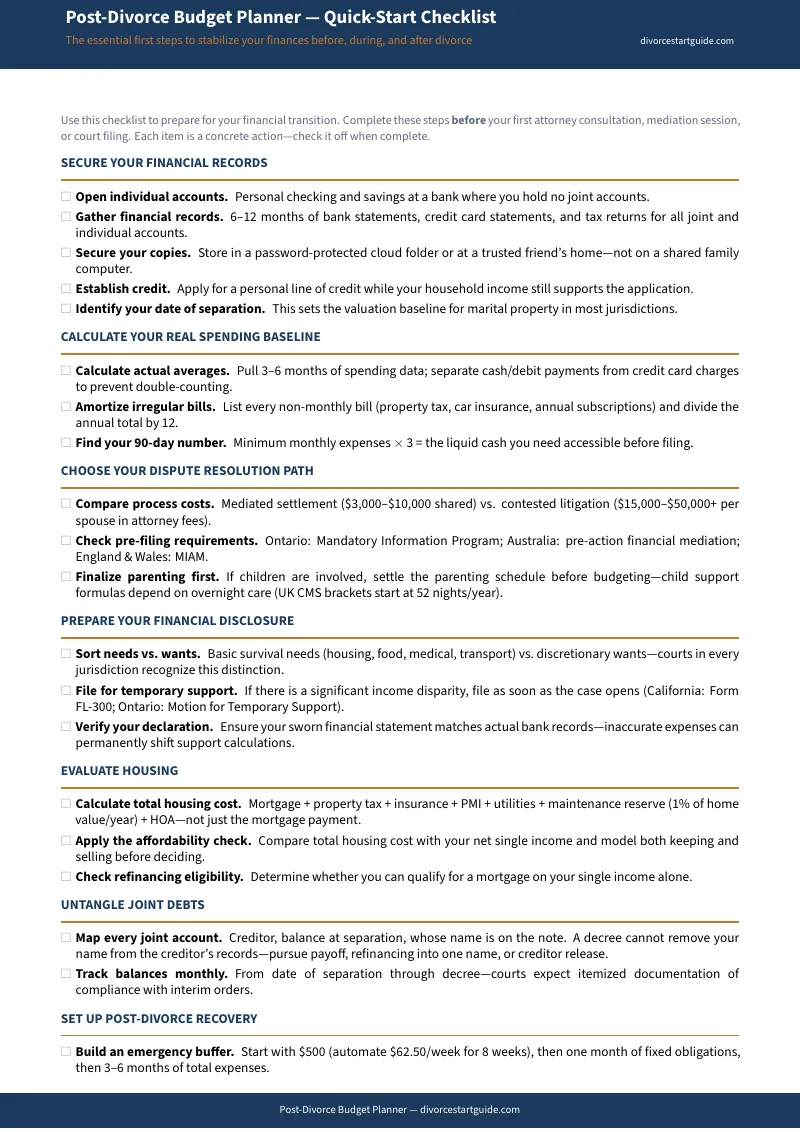
- Quick-start checklist (also available as a free download)
- 13 PDFs total, delivered instantly after purchase
Your Money, Protected
If the toolkit does not help you build a clearer picture of your post-divorce finances, email us and we will make it right. No hoops, no hassle.
You have already made the harder decision. This is the part where you take control of what comes next.
Get the Post-Divorce Budget Planner →
Also available: download the free Quick-Start Checklist to see the framework before you commit.