
You Know You Need to Split Everything. You Just Don't Know Where to Start.
The house. The retirement accounts. The credit cards. The furniture you bought together six years ago. It all needs to be divided — and the court isn't going to tell you how.
Your county clerk will hand you blank forms. What they won't give you is a system for listing every asset, figuring out what it's worth, deciding what's marital property and what isn't, and organizing it all into a proposal that actually holds up in mediation.
That's the gap this worksheet fills.
The Financial Disentanglement System
The Marital Asset & Debt Division Worksheet is a structured, step-by-step system that turns the overwhelming task of "divide everything we own" into a clear, manageable process. It's not a set of blank forms — it's the instruction manual that prepares you to fill out those forms accurately.
You'll work through each asset category methodically: real estate, bank accounts, retirement plans, vehicles, personal property, and business interests. Then you'll do the same for debts. By the time you're done, you'll have a professional-grade financial profile ready for your attorney, mediator, or kitchen-table negotiation.
What's Inside — 12 Printable PDFs
- Complete Guide — the full 14-chapter system covering property regimes, document gathering, asset valuation, separate property tracing, debt division, home equity analysis, retirement accounts, tax implications, negotiation strategies, and post-decree execution.
- Document Source Tracker — a standalone printable to track every financial record you need to gather, organized by category (real property, financial accounts, retirement, employment, debts, insurance, personal property, and commonly overlooked assets).
- Asset Inventory Worksheet — structured tables for every major asset category, with columns for current value, outstanding debt, net equity, and marital vs. separate classification. Includes the actual cash value depreciation formula for household goods.
- Separate Property Exclusion Log — document and trace assets you claim are not subject to division. Includes a commingling tracing worksheet and risk ratings for each asset.
- Debt Allocation Schedule — separate tracking for secured and unsecured liabilities with a creditor reality check. A divorce decree doesn't change your loan agreement with the bank — this worksheet helps you plan around that.
- Home Equity Buyout Calculator — the full buyout formula, a feasibility check, sell-and-split net proceeds calculator, and deferred sale terms worksheet. Know whether keeping the house makes financial sense before you fight for it.
- Retirement Account Division Roadmap — tax-adjusted valuation worksheet, division mechanism for each account type (IRA, 401(k), pension, military, international), and a QDRO processing checklist.
- Settlement Proposal Comparison — model different division scenarios side by side with running totals and offset strategy notes. Bring this to mediation.
- Post-Divorce Cash Flow Planner — monthly budget worksheet comparing joint vs. post-divorce expenses, income projection, and an affordability test to verify you can sustain the proposed settlement.
- Filing & Disclosure Deadline Calendar — track every court deadline from petition to final hearing, with jurisdiction-specific disclosure deadlines and additional task deadlines (QDRO, refinance, appraisals).
- Post-Decree Execution Checklist — title transfers, account closures, beneficiary updates, name changes on deeds and loans. Every task organized by timeline: 30 days, 60 days, 90 days, 6 months, and ongoing.
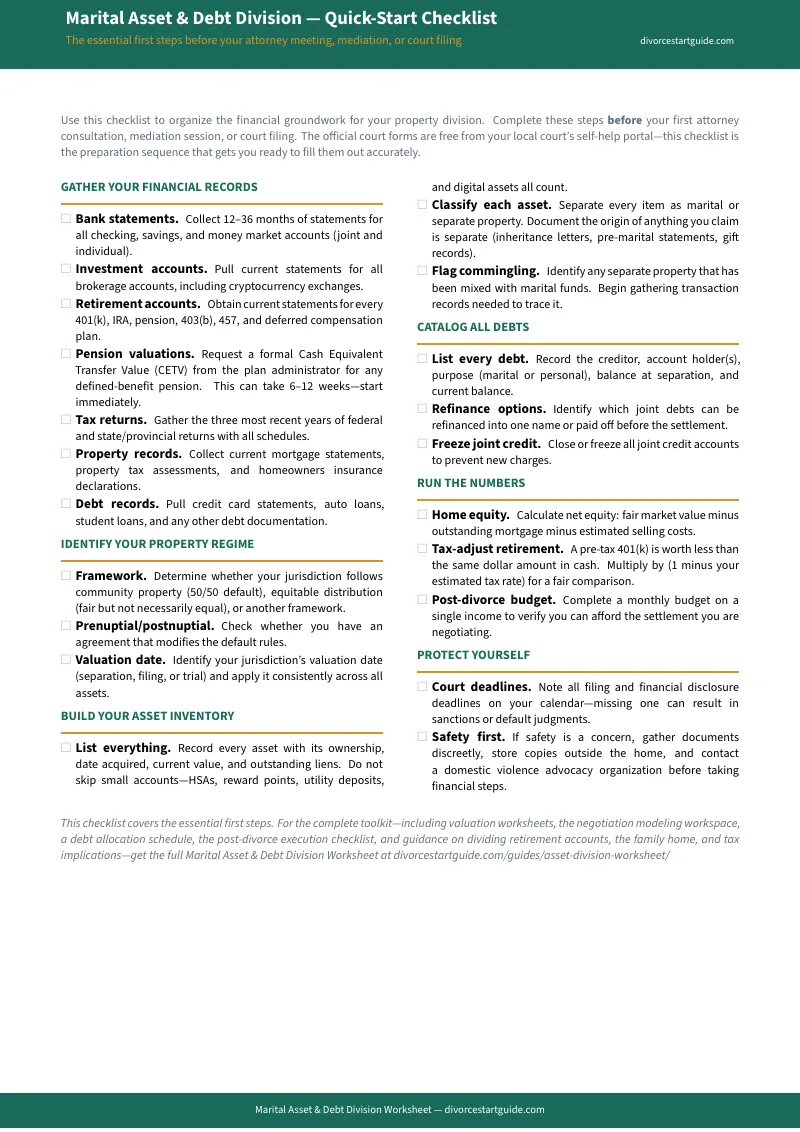
- Quick-Start Checklist — a free 1-page overview of the essential steps across document gathering, asset inventory, debt mapping, and classification.
Who This Is For
- Pre-filing planners who want to understand their full financial picture privately before starting the legal process
- Mediation-bound couples who need organized financial data to make their sessions productive (mediators charge $200–$400/hour — arriving unprepared is expensive)
- DIY filers handling an amicable, uncontested divorce who need a structured framework both spouses can work from
- Anyone with an attorney who wants to reduce billable hours by arriving with pre-organized figures instead of a shoebox of bank statements
Why Not Just Use Free Tools?
Free court forms are designed for administrative filing — they tell the court what you decided, not how to decide it. They don't explain how to value a pension, trace commingled property, or calculate whether keeping the family home is financially viable after refinancing.
A blank Excel spreadsheet won't prompt you to check whether your state uses the date of separation or date of filing as the valuation cutoff. It won't warn you that unvested stock options need different treatment than vested shares. And it definitely won't walk you through QDRO requirements before your ex's employer sends the paperwork back rejected.
This worksheet fills the space between "blank form" and "$7,000 retainer" — giving you the process navigation that free tools skip entirely.
100% Satisfaction Guarantee
If the worksheet doesn't help you organize your financial picture for property division, email us for a full refund. No questions, no time limit.
— Less Than Five Minutes of Attorney Time
At typical attorney rates of $270–$550/hour, you spend more in five minutes of billable time than the entire cost of this worksheet. The average couple spends $7,000–$15,000 on divorce attorneys — much of it on the administrative work of organizing financial data that this worksheet handles upfront.
Get your financial picture organized before your first professional consultation. Download the free checklist to start, or get the complete worksheet system today.