The Registry Filing Ledger for BC Desk Order Divorces
You know you need a divorce. You know the BC Supreme Court offers a desk order process where a judge signs the paperwork without anyone stepping into a courtroom. What you don't know is the exact sequence of forms, fees, deadlines, and registry visits that gets you from separated to legally divorced — without your application being rejected and sent back.
That gap between "I know the desk order exists" and "I have a signed divorce order in my hand" is where most self-represented filers get stuck. Registry clerks in British Columbia apply rigid, formalistic rules to every document they receive. A date written in the wrong format. An affidavit that wasn't sworn before a commissioner. A filing fee paid at the wrong stage. Any one of these sends your entire package back to you — along with weeks or months of delay.
The British Columbia Divorce Filing Process Guide is a sequential filing ledger that maps the entire desk order workflow from first document to final order. It doesn't sell you blank court forms — those are free from the registry. It shows you the path through the registry: which forms to file in what order, which fees to pay at which stage, how to serve your spouse correctly, and how to present your documents so a clerk passes them to the judge's desk on the first attempt.
What's Inside the Filing Ledger
- All three desk order pathways in one reference — sole, joint, and simple applications mapped side-by-side with their forms, fees, service rules, and eligibility requirements so you pick the right route before you pay anything
- The separation agreement filing strategy — how filing your agreement first with a Requisition (Form F17) can reduce your total court fees from approximately CA$290 to approximately CA$120, saving more than the cost of this guide
- A chronological filing sequence — not a list of forms, but the exact order and timing for filing each document, paying each fee, and waiting for each clearance, so nothing arrives at the registry out of sequence
- Service rules and proof-of-service worksheets — when personal service is mandatory, who can serve papers on your behalf, how to complete the Affidavit of Personal Service (Form F15), and when substitutional service is available
- The Ottawa clearance check decoded — what the Central Registry of Divorce Proceedings actually does, how long it takes, and why your final application stalls if you forget the Registration form at the initial filing stage
- Child support compliance structure — how to present income disclosure and Section 7 extraordinary expenses within Form F37 so your figures satisfy the Federal Child Support Guidelines and pass judicial review
- Draft Final Order proofreading system — a checklist matching the exact formatting and phrasing requirements registry clerks look for when reviewing Form F52 and the Certificate of Pleadings (Form F36)
- Post-order administrative steps — the 31-day appeal window, obtaining your Certificate of Divorce (Form F56), dividing provincial pensions with Forms P1–P4, and submitting a CPP credit split to Service Canada
- Fee waiver application guide — eligibility criteria and the process for completing Form F85 if court costs are a financial barrier
Who This Is For
This guide is built for people filing a desk order divorce in British Columbia — either entirely on their own or preparing their documents before hiring a lawyer for a limited, flat-rate review.
You'll get the most value if:
- You've passed the one-year separation mark and want to file the paperwork yourself
- You and your spouse agree on the terms and want a joint application without paying CA$499–CA$899 for a document assembly service
- You need a sole application because your spouse is uncooperative or unreachable
- You have children and need your child support figures to survive judicial scrutiny
- You want to understand the complete fee structure and timeline before committing to any pathway
Why Not Just Use the Free Resources?
British Columbia has some of the best free legal information in the country. Legal Aid BC, Clicklaw, and the BC Supreme Court website all publish accurate procedural guides. This guide is not competing with them — it's doing something different.
Free resources tell you what the forms are. They don't give you a filing ledger that tracks when to file each one, how to sequence the fees to save money, or what the registry clerk is checking when they open your package. The information is scattered across multiple websites, written for different audiences, and organized by legal topic rather than chronological filing order.
The BC Online Divorce Assistant handles joint applications with English-language marriage certificates. If you're filing a sole application, have a foreign-language marriage certificate, or need to address child support or property division, the online tool does not cover your situation.
This guide picks up where the free resources leave off — it organizes the publicly available information into a sequential workflow with tracking worksheets, deadline calculators, and diagnostic checklists so you can present a complete, correctly sequenced file on your first registry visit.
The Unbundled Legal Services Advantage
You don't have to choose between a multi-thousand-dollar lawyer retainer and going it entirely alone. Many BC family lawyers now offer "unbundled" or pay-as-you-go services — you do the administrative preparation yourself and hire a lawyer solely for a flat-rate document review before filing.
This guide serves as your administrative preparation tool. When your documents are organized, your timelines calculated, and your child support figures properly structured, a lawyer's review takes minutes of checking rather than hours of organizing. That's the difference between a CA$200 flat-rate review and a CA$2,000 full-service retainer.
Satisfaction Guarantee
If the guide doesn't give you a clear, actionable filing sequence for your BC desk order divorce, email us and we'll make it right. No fine print.
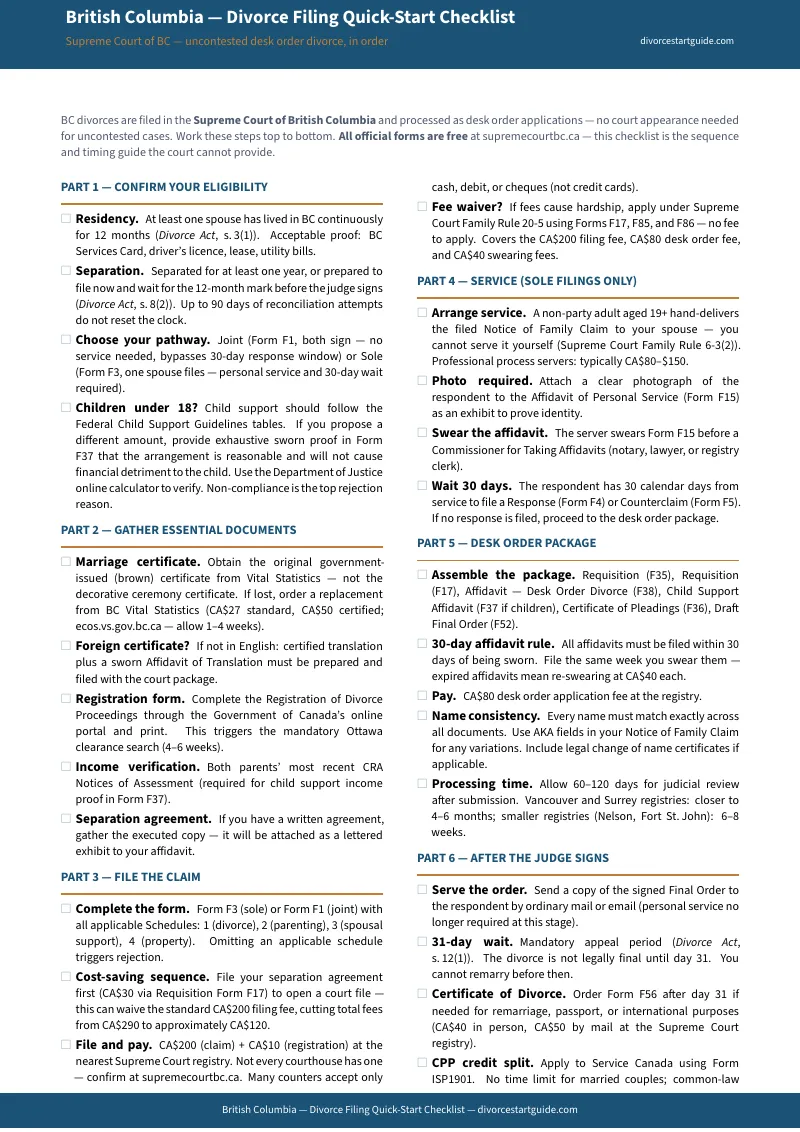
The free checklist gives you the starting line. The full guide gives you the map from filing day to signed divorce order.
Get the full guide —