Wisconsin Court Forms Are Free. Knowing What to Do With Them Is the Hard Part.
You can download every form you need from wicourts.gov right now — the Joint Petition, the Confidential Addendum, the Financial Disclosure Statement, all of it. What you won't find on that site is a process manual. The clerk can't tell you which filing path is right for your situation. The forms don't explain the 90-day service deadline that gets your case dismissed if you miss it. And the state's online forms assistant doesn't save your progress — one timeout and you start over from scratch.
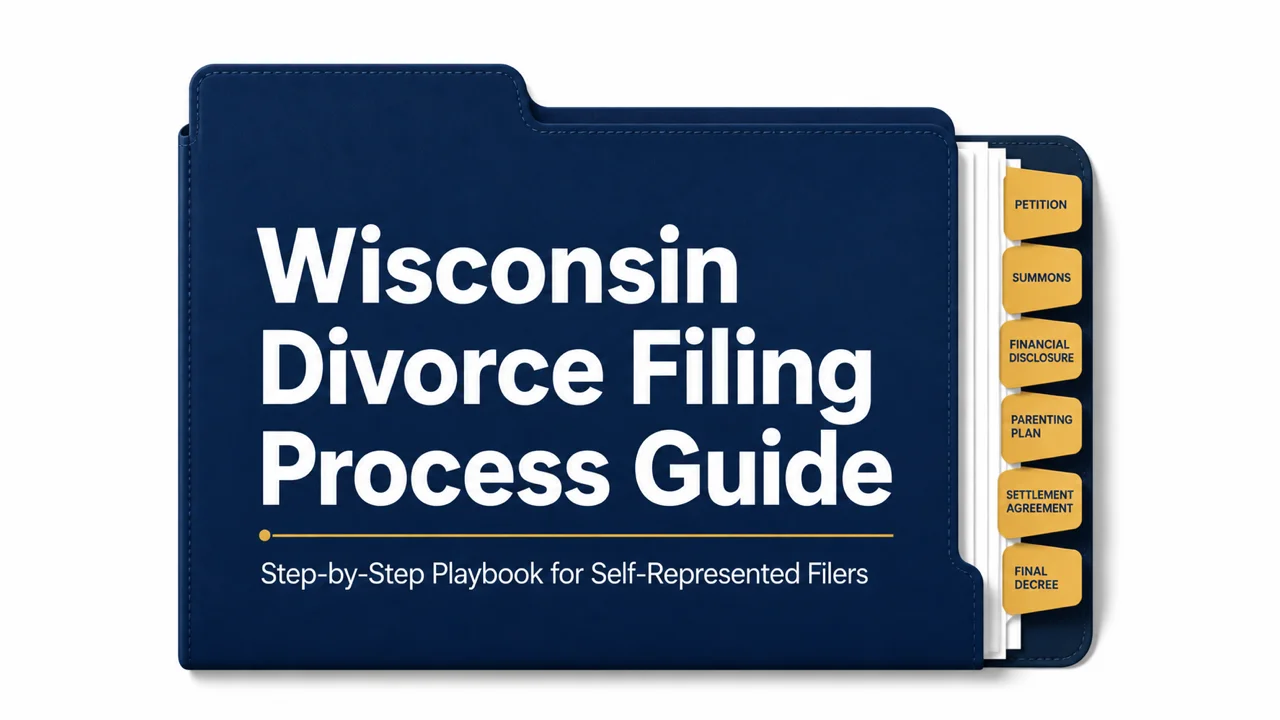
The Wisconsin Divorce Filing Process Guide is the operational layer that sits between the free court forms and a finished divorce. It maps the entire sequence — from confirming your residency qualifies, through the mandatory 120-day waiting period, to walking out of the final hearing with a signed judgment — so you know what to file, when to file it, and what trips up every second pro se filer who walks into a Wisconsin courthouse without a roadmap.
What's Inside the Guide and Toolkit
- Filing pathway decision tree — Joint Petition vs. solo Petition, the criteria for each, and how your choice changes the service requirements, the 120-day clock start date, and the overall timeline
- Service Method Decision Worksheet — a fillable worksheet comparing the four legal service methods (Admission of Service, sheriff's deputy, private process server, and service by publication) with costs, the 90-day completion deadline, and space to lock in your own dates and proof-of-service filing
- Financial Disclosure Preparation Worksheet — organizes every category of Form FA-4139V (income, assets, debts, expenses) with a document-gathering checklist for bank statements, tax returns, retirement accounts, and real estate records, so you meet the 90-day exchange window
- Premarital Asset Tracing Worksheet — a structured sheet for documenting premarital assets, gifts, and inheritances and proving they stayed separate, so you can claim the exemption from Wisconsin's presumption of equal division when you draft your Marital Settlement Agreement
- Physical Placement Schedule Planner — a weekly placement grid and overnight counter with the 25% overnight threshold calculation that determines shared-placement child support, plus county-specific parenting seminar guidance
- Default pathway checklist — what happens when your spouse doesn't respond within 20 days, how to file a motion for default, and what the judge still reviews before approving your terms
- Courtroom Final Hearing Checklist — the day-of document list, courtroom etiquette, the questions judges ask to confirm the marriage is irretrievably broken, and the six-month remarriage restriction you need to know about before you leave
- Document Execution Tracker — a log for every post-judgment task (quitclaim deeds, QDROs, name changes, beneficiary updates) so nothing falls through after the judgment is signed
- Fee waiver walkthrough — Form CV-410A from start to finish, including what fees the waiver covers, what it doesn't cover (newspaper publication fees for service by publication), and the filing sequence so approval comes before any fees are due
Who This Is For
- Joint filers who agree on the terms but need a map through the 120-day waiting period, the financial disclosure exchange, and the settlement agreement paperwork
- Solo petitioners who are filing because their spouse won't cooperate — the guide covers formal service methods, the default pathway, and what happens at a contested temporary hearing
- Parents navigating custody who need to build a placement schedule, complete the parenting seminar, and understand how overnight percentages translate into child support obligations
- Budget-conscious filers who want to handle the process themselves and either save on legal fees entirely or prepare their case in advance to reduce the billable hours if they consult a lawyer later
Why Not Just Use the Free Court Forms?
The forms tell you what to fill in. They don't tell you when to file each one, in what order, or what the clerk checks before accepting your packet. Wisconsin's filing process has specific procedural traps — the 90-day service window that results in automatic dismissal, the financial disclosure exchange that both parties must complete before the settlement agreement means anything, county-level parenting seminar requirements that vary from one courthouse to the next. The court system's interactive online assistant covers form completion but doesn't save progress between sessions, doesn't address county-specific requirements, and cannot help you organize the financial documents that make or break your settlement.
Online document preparation services charge hundreds of dollars to fill in the same free forms, often with generic multi-state questionnaires that miss Wisconsin-specific rules like the community property presumption and the six-month remarriage ban. This guide costs a fraction of those services and focuses on the part they skip: the procedural knowledge that keeps your case moving forward without rejections, missed deadlines, or expensive delays.
100% Satisfaction Guarantee
If the guide doesn't give you a clear, actionable roadmap for your Wisconsin divorce filing, email us and we'll refund your purchase — no questions, no hassle.
Get Started
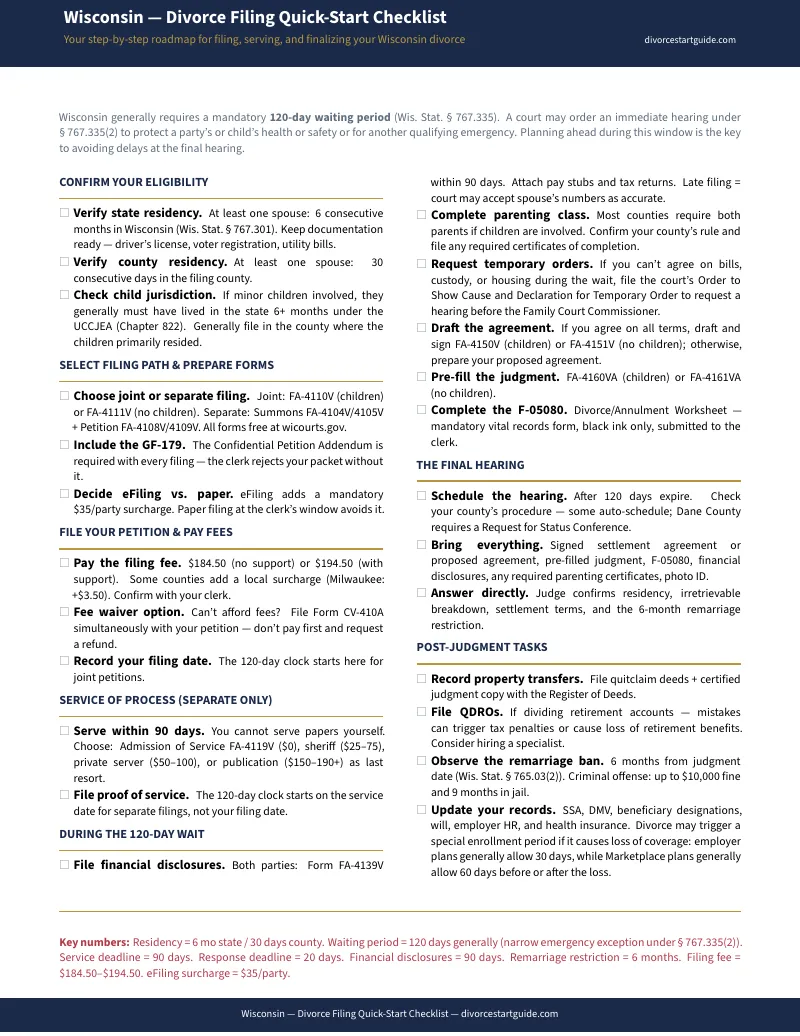
Download the free Quick-Start Checklist to see the 24-item overview of Wisconsin's divorce filing steps, or get the full guide for to unlock the complete step-by-step playbook, worksheets, and hearing preparation materials.