
Wisconsin's court forms are free. They don't tell you how to fill them out.
You've found Form FA-4147V — Wisconsin's official Proposed Parenting Plan that becomes a binding court order the moment a judge signs it. And you've discovered the problem: the form has blank fields for your placement schedule, your legal custody arrangement, your holiday rotation, your summer plan, your exchange logistics, and your overnight count. But it doesn't tell you how to structure a schedule where every overnight now determines whether you fall above or below the 92-overnight threshold that controls child support under DCF 150. It doesn't tell you how to prepare for mandatory mediation — or what happens if you miss the 10-day deadline to submit your plan to the mediator. And it doesn't explain whether a 2-2-3 rotation or an alternating-week schedule fits your child's age, your work pattern, and your co-parent's living arrangement.
Meanwhile, a contested custody case in Wisconsin costs $3,000 to $20,000 in attorney fees. Two or three of those billable hours go to your lawyer asking questions you could have answered yourself — if someone had told you what the questions were and how to think through the answers before you walked in.
You don't need someone to write your parenting plan for you. You need to understand what Wisconsin's Circuit Court expects before you sit down to draft it.
The Parenting Plan Navigation System
This is a complete, step-by-step guide to building a parenting plan in Wisconsin — designed for the specific statutes, court forms, and procedural rules that make this state different from every other. It is not legal representation and it does not file your papers. It is the planning and structuring intelligence that the blank FA-4147V leaves out.
At its core is the Parenting Plan Navigation System — a structured method that walks you from "I need a custody arrangement but I don't know what the court expects" to a comprehensive, child-focused agreement that meets the best-interests standard under Wisconsin Statute § 767.41(5)(am). It handles the part everyone gets wrong: understanding that Wisconsin separates "legal custody" (major decisions) from "physical placement" (where the child lives) and does not use the word "visitation" at all — so you don't signal to the judge that you haven't read the statute. Calculating how your proposed schedule translates into overnights under DCF 150, where crossing the 92-overnight threshold shifts your child support obligation by hundreds of dollars per month. Preparing for mandatory mediation with organized, child-focused arguments and a completed FA-4147V in hand. And building modification-proof plan language for holidays, relocation, and communication protocols — because under § 767.451, your initial order is effectively locked in for two years unless you can prove physical or emotional harm.
What's inside — the 14-chapter guide, standalone worksheets, and the free checklist
- Wisconsin's Custody Framework Decoded — a plain-English walkthrough of the three things that confuse every parent: legal custody (joint, sole, and the divided/impasse allocation hybrid), physical placement categories and their overnight thresholds, and why having joint legal custody does not mean having equal physical placement time. Because using the wrong vocabulary in your filings signals to the court that you have not done your homework.
- Court Filing Roadmap — step-by-step from confirming residency through filing, service, temporary orders, and the 120-day mandatory waiting period. Covers every required form (FA-4104V, FA-4108V, GF-179, and the joint petition alternative), filing fees, fee waiver eligibility under CV-410A, and the 90-day service deadline. Both married and unmarried parent paths covered.
- The Family Court Timeline — a chronological map of every stage: temporary orders before the Family Court Commissioner, the de novo challenge window (20 calendar days in most counties, shortened in Waukesha/Washington/Kenosha/Racine), mandatory parent education under § 767.401, mediation, Guardian ad Litem appointment, and the final hearing. Because missing one deadline can waive your right to contest the other parent's plan entirely.
- 16 Best-Interest Factors Explained — the statutory factors under § 767.41(5)(am) that determine every custody and placement decision, translated into what judges actually look for: cooperation history, parental involvement, adjustment to home and school, domestic abuse, substance dependency, and the child's own wishes. Each factor includes practical guidance on what to document and how to address it in your parenting plan.
- FA-4147V Section-by-Section Walkthrough — a dedicated chapter that maps every section of the official Proposed Parenting Plan form to the decisions you need to make. Legal custody designation, physical placement schedule on a biweekly grid, holiday rotation with specific times and locations, summer arrangements, transportation and exchanges, healthcare and education, communication rules, and dispute resolution. Because "we'll split time 50/50" is not what the form asks for.
- Six Parenting-Time Schedule Models — age-appropriate placement patterns from toddlers through teenagers: alternating weeks, 2-2-3 rotation, 2-2-5-5, 3-4-4-3, alternating weekends with midweek contact, and long-distance/summer-heavy arrangements. Each model includes overnight counts, transition guidance, and the age range it works best for. Because a schedule that works for a three-year-old fails a fourteen-year-old.
- DCF 150 Child Support Workbook — a practical guide to calculating child support under Wisconsin's guidelines. The flat percentage standard for primary placement (17% for one child, 25% for two, 29% for three). The shared-placement formula for parents with 92+ overnights each, including the 1.5× multiplier and dual-income offset. The equivalent care credit for third-shift workers and non-standard schedules. Variable expense allocation for healthcare, childcare, and extracurriculars. Two fully worked examples so you can see the math.
- Guardian ad Litem Preparation — what a GAL does, how they're appointed, what they cost ($1,000–$3,000+ retainer per parent), how to prepare for their investigation, and strategic guidance on reaching agreement at mediation to avoid the appointment entirely. Because understanding who the court sends into your home changes how you prepare.
- Post-Judgment Modification Guide — the two-year statutory truce under § 767.451 and its narrow physical-or-emotional-harm exception, the after-two-year substantial-change-of-circumstances standard, the 100-mile relocation rule under § 767.481, and the required forms for each modification path. Because life changes, and you need to know what it takes to update your order.
- Enforcement Tools — what to do when the other parent violates the placement order. Placement enforcement motions under § 767.471, the 30-day mandatory hearing, make-up time remedies, attorney fee recovery, and the contempt-of-court path. Including what not to do — withholding child support or denying placement yourself creates a separate violation.
- Safety Protections — domestic violence provisions under § 767.41(2)(d) that create a rebuttable presumption against joint legal custody, emergency temporary orders, supervised placement, the substance abuse evaluation pathway, and restraining order procedures. Because high-conflict cases require the most precise preparation.
- Printable Planning Worksheets — the Parenting Plan Decision Worksheet, Schedule Comparison Worksheet, Holiday and Break Rotation Planner, Child Support Calculation Worksheet, Agency Communication Log, and Placement Violation Log. Print them, fill them out, and bring them to mediation or your attorney consultation.
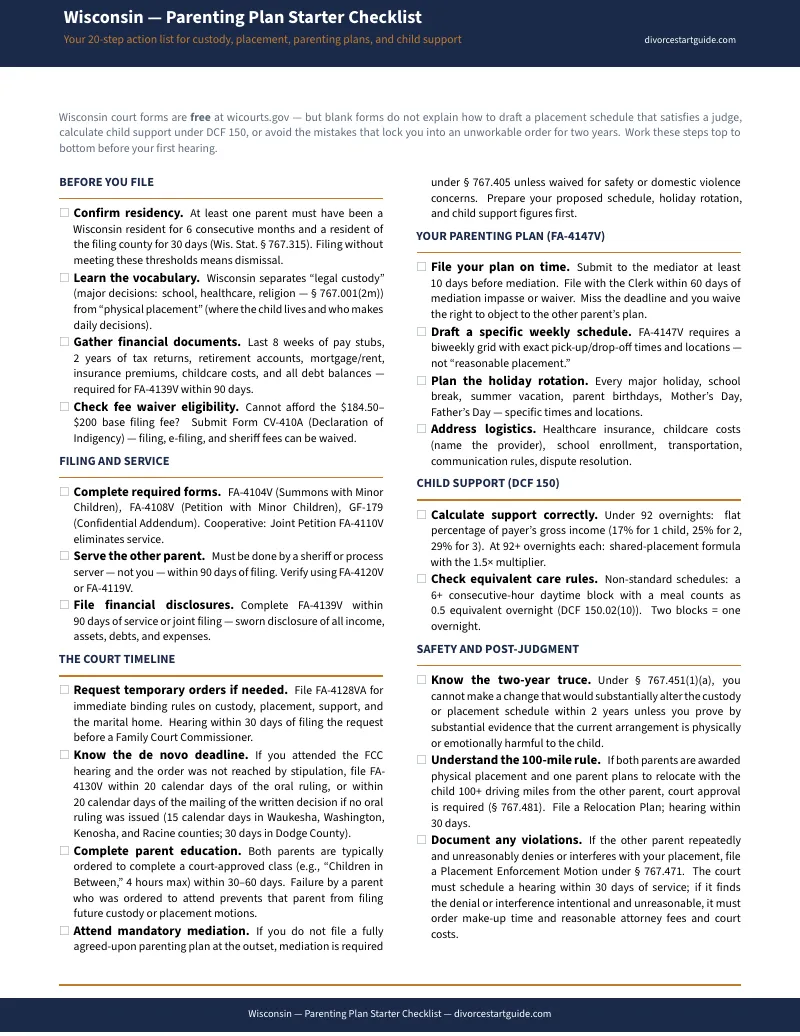
- Parenting Plan Starter Checklist — the free lead magnet. A standalone 20-step checklist covering everything your parenting plan must address before you file or walk into mediation. Start here to see exactly what the full guide covers in depth.
Who this is for
The parent who just learned that Wisconsin does not use "visitation" — it uses "physical placement" — and needs to understand what that means for their court forms and their proposed schedule. The self-represented filer preparing FA-4147V who needs a parenting plan that won't get sent back for missing required sections. The parent heading into court-ordered mediation who wants to arrive with a draft schedule, organized overnight counts, and child-focused arguments — so the mediator's session reflects their preparation, not their panic. The unmarried parent who needs to establish paternity and legal custody and can't find instructions that aren't written for divorce. The parent calculating child support who needs to understand the 92-overnight cliff under DCF 150 and how a single overnight shifts the formula. And the parent with an existing order that no longer fits because the children are older, schedules changed, or one parent needs to relocate.
Why not just use the free resources?
Because free resources give you forms, not decisions. The Wisconsin Court System's self-help center provides the blank FA-4147V and basic filing instructions. But it cannot tell you how to structure an alternating holiday schedule that accounts for winter break, spring break, and three-day weekends. It does not explain how the 92-overnight threshold changes your child support calculation. It does not prepare you for what happens in a mandatory mediation session. It provides the blank form. This guide provides the strategic preparation you complete before you fill it out.
The co-parenting apps — OurFamilyWizard at $110–$300 per year per parent, Custody X Change at $72–$288 per year — are built for ongoing communication logging and schedule tracking after you already have an agreement. They require both parents to pay, both parents to participate, and they don't address Wisconsin's specific terminology, FA-4147V requirements, or DCF 150 calculations. They are useful tools once you have a plan. This guide helps you write the plan.
An honest guarantee
Work through the Parenting Plan Navigation System. If the guide doesn't make your parenting plan clearer, better organized, and more court-ready than any free government form or generic national kit could — email us at any time for a full refund. The risk of trying it is a fraction of one mediation session. The risk of filing an incomplete FA-4147V is a judge rejecting your plan, a mediator filling in the gaps for you, or a child support calculation based on numbers you didn't understand.
For — less than fifteen minutes of attorney time — you get the FA-4147V walkthrough, the DCF 150 child support formula explained, six schedule models, the mediation preparation guide, and the step-by-step filing roadmap that the blank court forms leave out.
Stop guessing what the court expects. Get the guide, build your parenting plan, and walk into your next step — mediation, a lawyer's office, or the courthouse filing window — with the work already done.