You Have the Forms. You Don't Have the Filing Sequence.
West Virginia gives you free divorce forms on the Supreme Court of Appeals website. What it doesn't give you is the order to file them, what to attach, how to get your spouse served when they won't cooperate, what to do when the 40-day Rule 13 disclosure deadline hits, or how to stand up in Family Court and present testimony without an attorney.
The West Virginia Divorce Filing Process Guide is a court-process navigation system — built for self-represented filers who need the mechanical sequence of steps from petition to final decree, not a stack of blank PDFs and a "good luck."
The Problem With "Free Forms"
The West Virginia judiciary website provides free, legally accurate forms. But by statute and court rule, staff at both the Circuit Clerk's Office and the Family Court are prohibited from giving legal advice or helping you fill out paperwork. They can't tell you what's missing, why your filing was rejected, or what step comes next.
That leaves you with forms but no filing sequence. You know what to submit — you don't know when, in what order, what supporting documents to attach, or which procedural mistakes will stall your case for months.
This guide fills that gap.
What's Inside — The Complete Filing Sequence
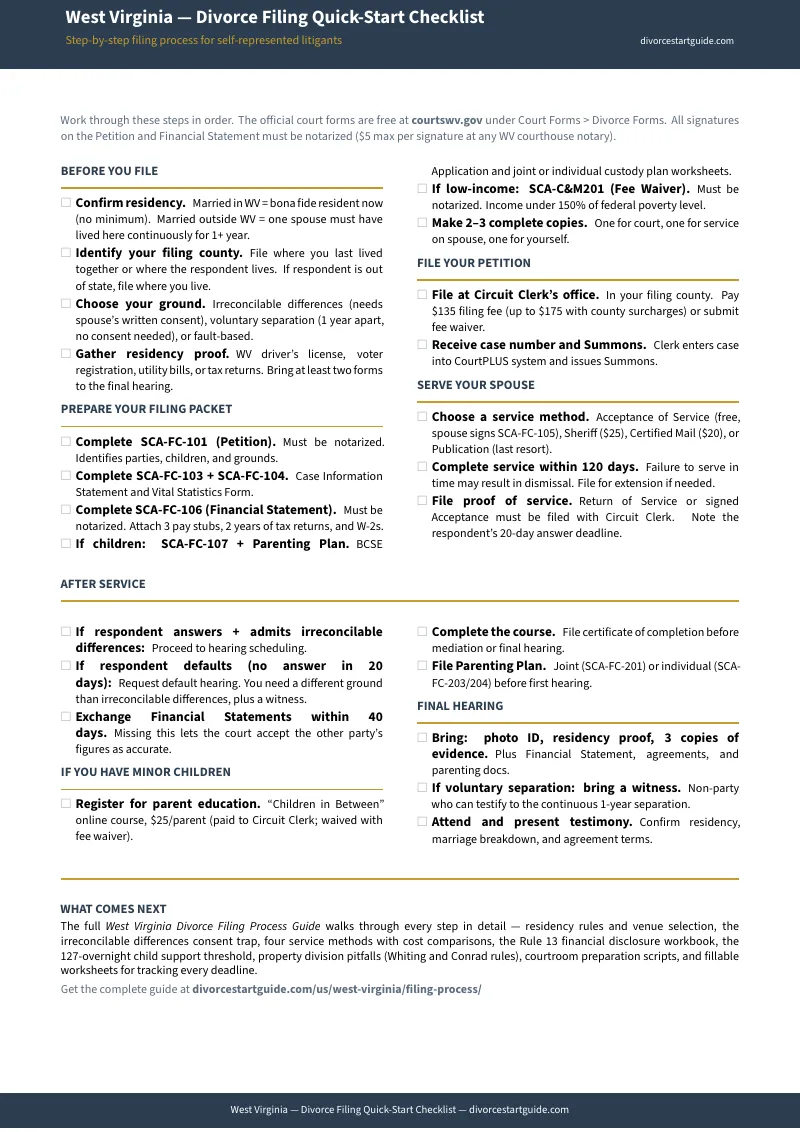
Your download includes 10 files: the 54-page main guide, the quick-start checklist, and 8 standalone printable worksheets you can take to the courthouse, tape to your wall, or hand to your witness.
Four-Pathway Decision Tree
Uncontested, contested, default, and separation-based — with the specific criteria that determine which track applies to your situation. Includes a standalone printable decision tree so you can identify your pathway before assembling your forms.
Residency & Venue Worksheet
West Virginia's residency rules have a hidden distinction that catches out-of-state marriages: if you married in West Virginia, either spouse can file immediately. If you married elsewhere, you need one year of continuous residency. The standalone worksheet walks you through eligibility, venue selection, and a residency proof checklist — complete it before visiting the clerk.
Forms Assembly Checklist
Every form organized in filing order: Petition for Divorce (SCA-FC-101), Civil Case Information Statement (SCA-FC-103), Vital Statistics Form (SCA-FC-104), Financial Statement (SCA-FC-106), and the supporting documents the clerk expects to see attached. Print the standalone checklist and check off each item as you prepare your packet.
Service of Process Tracker
Sheriff service, certified mail, and Order of Publication — with the exact costs, affidavit requirements, and the 120-day completion deadline that can get your entire case dismissed if you miss it. The standalone tracker gives you space to record dates and deadlines as each service milestone passes.
Rule 13 Financial Disclosure Worksheet
Within 40 days of your spouse being served, both sides must file a mandatory Financial Statement with two years of tax returns, pay stubs, and asset documentation. The standalone worksheet helps you inventory marital assets, marital debts, and separate property before completing the official form.
Fee Schedule & Waiver Reference
Every court cost from filing fee through appellate docketing — plus the income thresholds for a full fee waiver. Print the standalone reference card so you know exactly what to bring to the clerk's window.
Hearing Preparation Checklist
What to bring to court, what the judge will ask, and witness requirements by ground. Print the standalone checklist and review it the night before your hearing — it covers courtroom basics, testimony preparation, and what happens after the judge signs the final decree.
Milestone Timeline Tracker
Every deadline from filing day through final decree — the 20-day response window, the 40-day financial disclosure deadline, the parent education completion, and the court's six-month resolution target under Trial Court Rule 16.06. Post the standalone tracker where you can see it daily.
Who This Guide Is Built For
- Self-representing filers who want to handle their own divorce without paying $2,000–$5,000 in attorney retainer fees or $200–$350 per hour for a family lawyer
- Couples filing uncontested who agree on everything but need the exact sequence of forms, signatures, and filings to get through Family Court without delay
- Default petitioners whose spouse won't cooperate, has left the state, or can't be located — and who need to navigate the service and default pathway correctly before the 120-day deadline expires
- Parents with minor children who need to understand the mandatory parent education requirement, parenting plan expectations, and how West Virginia's allocation of custodial responsibility differs from simple "custody" language
- Middle-income filers who don't qualify for Legal Aid but can't justify spending thousands on an attorney for a straightforward dissolution
Why Not Just Use the Free Court Website?
You should absolutely use the free forms from the West Virginia Supreme Court of Appeals website — this guide is designed to work alongside them.
But consider what the free forms don't provide:
- No filing sequence — forms are listed individually, not in the order you actually need them
- No assembly instructions — you get the blank Financial Statement, but nothing explains what supporting documents to attach or how to organize them for the clerk
- No service-of-process guidance — the rules for sheriff service vs. certified mail vs. publication are scattered across different statutes and court rules
- No pathway guidance — uncontested, contested, and default cases have different procedural steps, but the forms don't tell you which path you're on or what that means for your timeline
- No hearing preparation — nothing explains what testimony to prepare, whether you need a witness, or what the judge actually asks at a final hearing
The official forms give you the blanks to fill in. This guide gives you the chronological assembly instructions, the supporting-document checklists, and the courthouse preparation that turns those blanks into a completed case — filed correctly the first time.
Satisfaction Guarantee
If the guide doesn't give you a clearer understanding of your filing path within 24 hours of download, email us for a full refund. No forms to fill out, no hoops.
— Less Than One Hour of a Paralegal's Time
West Virginia family attorneys charge $200–$350 per hour. A full retainer runs $2,000–$5,000. This guide gives you the complete filing sequence, financial disclosure toolkit, and hearing preparation for a fraction of what you'd spend on a single consultation — and you can reference it every time you hit a procedural question.
The free checklist gives you the quick-start overview of the filing steps. When you're ready for the full forms assembly instructions, Rule 13 financial disclosure toolkit, and hearing preparation guide — the complete guide is here.