
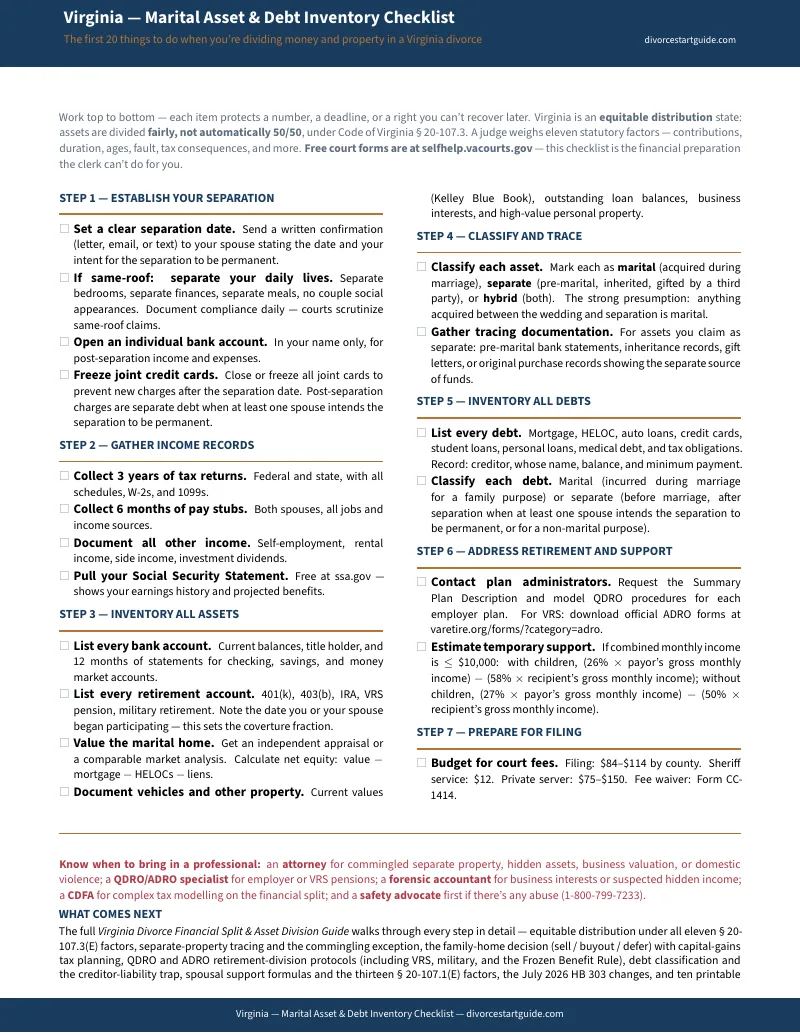
Your finances are about to be divided by a system most people don't understand until it's too late
Virginia doesn't split everything 50/50. Under equitable distribution, a judge evaluates eleven statutory factors and divides your marital estate based on what's fair — and "fair" can look very different depending on who walks into the courtroom better prepared.
The problem is that most separating couples don't know where to start. They don't know which assets are marital and which are separate. They don't know that an inheritance deposited into a joint account may have been permanently transmuted into marital property. They don't know that a divorce decree alone cannot split a 401(k) — that requires a separate Qualified Domestic Relations Order, drafted to the plan administrator's specifications, approved by a judge, and filed months before the final hearing.
And since July 1, 2026, when Virginia's HB 303 took effect, the strategic landscape shifted again. Either spouse can now file for a court-recognized legal separation on day one — without proving fault — unlocking immediate access to temporary support orders, mortgage payment rulings, and formal asset discovery. The old approach of quietly waiting out a twelve-month separation period while hoping everything stays stable is no longer the only path.
The Equitable Distribution Roadmap — a structured system for organizing, classifying, and dividing your finances
This guide is not a bundle of blank legal forms. Virginia's court system provides basic civil forms for free, but it provides no templates, instructions, or worksheets for drafting a Property Settlement Agreement — the signed contract that is a strict statutory requirement for the accelerated six-month no-fault filing path.
The Equitable Distribution Roadmap gives you the structured process that sits between "we need to separate" and "here's our signed agreement." It walks you through the exact sequence of financial decisions, in the exact order Virginia law requires them, using worksheets and calculation tools designed specifically for this state's rules.
What's inside
- Asset classification worksheets — organize every account, deed, and policy into marital, separate, or hybrid categories using the definitions under § 20-107.3, with tracing sheets to document separate-property claims before they get lost
- Separate property tracing method — step-by-step instructions for proving that a pre-marital down payment, inheritance, or gift hasn't been transmuted through commingling, including the documentation checklist courts actually look for
- Home equity and buyout calculator — work through all three paths for the marital residence (sell, buyout, or deferred sale), including how to calculate hybrid equity when separate funds paid part of the mortgage
- Retirement and pension division roadmap — coverture fraction calculator for defined-benefit pensions, QDRO timeline for employer plans, IRA transfer-incident-to-divorce procedures, VRS ADRO requirements, and military retirement division rules under the USFSPA, with the 50% statutory cap explained
- Debt division and credit protection plan — worksheet for classifying and assigning every joint liability, with a creditor notification strategy because third-party creditors are not bound by your divorce agreement
- Spousal support estimator — temporary support calculation using Virginia's presumptive guideline formula (for combined incomes up to $10,000/month), plus a factor-by-factor analysis framework for permanent support under § 20-107.1(E)
- Same-roof separation compliance tracker — daily log template and conduct checklist for couples who must remain in the same home during the waiting period, documenting the separate routines courts require to recognize the separation date
- PSA negotiation framework — structured term-sheet format covering property division, debt allocation, support terms, and real property transfers, designed so you can negotiate with your spouse or hand a completed draft to an attorney for a flat-rate review
- Court filing reference — the complete sequence from Circuit Court Clerk filings to the VS-4 report, with the specific forms and coversheet requirements for Virginia no-fault proceedings
Who this guide is built for
- Couples using the six-month fast-track — no minor children, cooperative relationship, and you need to draft a PSA that holds up under judicial review
- Pre-lawyer planners — you intend to hire an attorney or mediator, but you want to walk in with an organized financial binder instead of paying $200–$650 per hour for someone to sort through your paperwork
- Same-roof separators — you can't afford to maintain two households right now, and you need to document every aspect of your separation to avoid accidentally resetting the statutory clock
- Pension and retirement dividers — you have a 401(k), VRS pension, FERS benefits, or military retirement, and you need to understand the QDRO/ADRO process before signing any agreement
Why not just Google it?
You absolutely can find individual pieces of this information scattered across Virginia law firm blogs, court self-help portals, and legal aid sites. The problem is sequence and completeness. A blog post about QDROs won't tell you that you need to request the plan administrator's model QDRO procedures before your attorney drafts the order. A free checklist won't walk you through tracing a commingled inheritance back to its separate source. And no single resource will connect the dots between your asset classification, your support calculation, your debt allocation, and the specific PSA terms that emerge from all three.
This guide replaces forty hours of scattered research with one structured system. It puts the worksheets, calculations, and decision sequences in the order you actually need them — starting from day one of separation and ending when you file your completed PSA with the Circuit Court Clerk.
A fraction of the cost — and the risk
A full-scope divorce attorney in Virginia charges $200 to $650 per hour, with retainers starting at $1,500 for an uncontested case. Online document preparation services charge $299 or more for standard form filling. This guide costs — a one-time purchase that gives you the same financial organization framework professionals use, so you can arrive at mediation or your first legal consultation with the work already done.
For straightforward separations, it may be the only resource you need. For complex cases, it saves you thousands in billable hours by ensuring your attorney spends their time on legal strategy, not financial organization.