Vermont Puts Every Asset You Own on the Table. Not Just What You Built Together.
Most states draw a line between marital property and separate property. Vermont does not. Under the all-property doctrine, the family court can divide anything either spouse owns — premarital savings, family inheritances, personal gifts, retirement accounts you started decades before the wedding. Holding sole title means nothing.
That changes the entire negotiation. You cannot simply point to a deed or a bank statement and say "this is mine." Every asset becomes a bargaining chip, every inherited dollar a potential concession, and every financial affidavit a document that can cost you or protect you depending on how you fill it in.
The court gives you Forms 813A and 813B. Blank fields. Notary required. No instructions on which numbers matter, how to calculate the marital share of your pension, or whether waiving the 90-day nisi period will cost you health insurance coverage the week after you sign.
The All-Property Settlement System
This is not a book of Vermont family law definitions. It is a step-by-step financial workbook built specifically for the all-property doctrine — where the standard "marital vs. separate" framework other states use does not apply.
You start by mapping every asset and debt you and your spouse own, regardless of when it was acquired. Then you work through the 12 statutory factors courts use to determine what is fair, the specific calculations for your home equity, the coverture fraction for your retirement accounts, and the maintenance guidelines that set the likely range for spousal support.
By the time you finish, you have a complete financial picture — classified, calculated, and organized in the exact structure Vermont courts expect. Whether you are filing uncontested, preparing for mediation, or trying to save thousands in attorney hours, this guide turns the confusion into a numbered process.
What Is Inside — 15 Chapters + 6 Printable Worksheets
The complete guide covers every stage of a Vermont financial split, from initial freeze to post-decree transfers, plus 6 standalone worksheets you can print for attorney meetings, mediation sessions, or kitchen-table negotiations:
- All-Property Classification Worksheet — map every asset and debt through the all-property framework. Track acquisition source, commingling history, and the statutory factors that determine how courts treat premarital and inherited property in Vermont.
- Home Equity Buyout Calculator — step-by-step worksheet for the three scenarios: one spouse buys out the other, both sell and split equity, or the court orders deferred co-ownership. Factors in mortgage balance, appraisal value, separate-property contributions, and closing costs.
- Retirement and Pension Division Planner — covers 401(k)s, IRAs, and Vermont state pensions (VSERS, VMERS, VSTRS). Includes the coverture fraction worksheet, the QDRO vs. DRO process for each plan type, and the tax-free transfer rules that prevent the 10% early withdrawal penalty.
- Debt Allocation Worksheet — classify debts by type and timing, model which spouse the court is likely to assign them to, and plan the payoff sequence that protects your credit. Includes the critical warning: a divorce decree assigning a joint debt to your ex does not release you from the creditor contract.
- Spousal Maintenance Estimator — the two-part threshold test under 15 V.S.A. Section 752, the post-2019 Spousal Support Guidelines (percentage of income difference by marriage length), and a worksheet to estimate your likely range before negotiating.
- Form 813A/813B Preparation Guide — a section-by-section walkthrough of both mandatory financial affidavits, with a document checklist and the valuation rules the court expects (current market value, not replacement cost).
Plus Full Chapters On
- The Nisi Period — why this 90-day window is a tax and health insurance decision, not just a waiting period. Covers the December 31 filing-status threshold, COBRA timing, and when waiving nisi costs you money.
- Business Ownership and Complex Assets — the three valuation methodologies (income, market, asset-based), when to hire a forensic accountant, and where self-help ends and professional help begins.
- Tax Issues in a Property Split — IRC Section 1041 transfers, cost basis traps (a $100,000 savings account and a $100,000 stock portfolio are not worth the same thing after taxes), and filing-status strategy.
- Post-Decree Transfers — every quitclaim deed, beneficiary update, account closure, and title transfer you need to complete after the divorce is final, with deadlines.
Who This Guide Is For
- Self-represented filers completing Vermont divorce forms without an attorney — you need the actual math behind the all-property doctrine, not a pamphlet explaining what "equitable distribution" means
- Mediation participants who want to arrive with organized, pre-calculated numbers so sessions focus on decisions, not data gathering
- People hiring attorneys who want to save thousands in billable hours by showing up with a complete financial inventory structured to match Forms 813A and 813B
- Anyone splitting a Vermont home, retirement account, or pension who needs the specific calculations and DRO/QDRO processes the court requires
Why Not Just Use the Free Court Forms?
The Vermont Judiciary website provides Forms 813A, 813B, and the Final Stipulation for free. They are blank. They do not show you how to calculate the coverture fraction for your VSERS pension, estimate a home buyout that accounts for your premarital down payment, or determine whether waiving the nisi period will trigger immediate loss of your spouse's employer health plan.
The forms tell you what to report. This guide shows you how to calculate what to report — and how to negotiate the split once you know your numbers.
National platforms like LegalZoom generate standardized documents but provide zero guidance on Vermont's all-property doctrine, the 12 statutory factors, or state-specific pension division rules. A $299 document-preparation service gives you filled-in forms. This guide gives you the understanding to know whether those forms protect your interests.
Satisfaction Guarantee
If the guide does not help you organize and calculate your Vermont divorce financial split, email us and we will make it right. No fine print.
— Less Than One Hour of a Vermont Divorce Attorney's Time
Vermont divorce attorneys average $250 to $320 per hour. Most self-represented filers spend 15 to 40 hours organizing their financial disclosures from scratch. This guide compresses that work into a structured process with pre-built worksheets, the exact formulas courts use, and a clear sequence for every step from initial freeze through post-decree transfers.
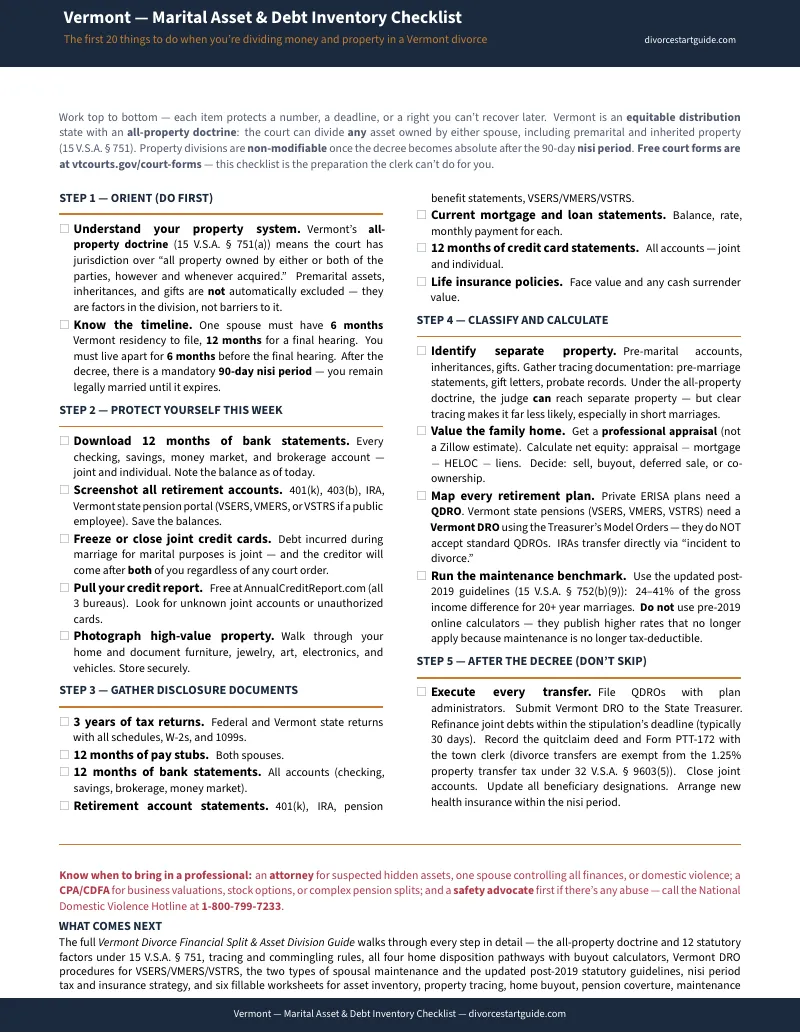
Download the free checklist to start your asset and debt inventory tonight. When you are ready for the full calculation system, the complete guide is here.