You Have Access to MyPaperwork. You Don't Have the Filing Sequence.
Utah gives you a modern document assembly system — MyPaperwork — that generates your divorce forms through an interview-style questionnaire. What it doesn't give you is which decisions to make before you start that interview, how the 30-day waiting period interacts with service deadlines, what happens when your spouse doesn't respond within 21 days, or how to organize the financial records you'll need for Rule 26.1 disclosures when the 14-day clock starts ticking.
The Utah Divorce Filing Process Guide is a court-process navigation system — built specifically for self-represented filers who need the operational sequence, not a pile of generated forms and a court clerk who's legally prohibited from telling you what to do with them.
The Problem With "Free Forms"
Utah's Self-Help Center and court staff do their job well: free forms, basic procedural direction, and a digital document generator that handles the drafting. But court staff are legally prohibited from giving you strategic advice — they can't tell you whether to pursue the uncontested or default path, how to handle the Rule 26.1 financial disclosure deadline, or what to do when your spouse refuses to cooperate.
That leaves you with the right forms but no roadmap. You know what to submit — you don't know in what order, by which deadline, or how to organize the financial and parenting decisions that trip up most self-represented filers.
This guide fills that gap.
What's Inside
MyPaperwork Navigation Cheat Sheet
MyPaperwork replaced the legacy OCAP system in July 2025 and generates your court forms through an interview-style questionnaire. The cheat sheet covers what information to gather before you log in, how to handle the system's 7-day download expiration (your documents are deleted if you don't save them within a week), and tips for navigating the system's hard-coded limitations — including the cap of six children and the document compilation delays that can run from fifteen minutes to an hour.
Residency and Venue Worksheet
Utah's 90-day county residency rule and the separate 6-month UCCJEA requirement for child custody jurisdiction operate on different timelines. File in the wrong county or before you've met the residency threshold, and your case gets dismissed on jurisdictional grounds. The worksheet confirms eligibility before you pay the $350 filing fee.
Service of Process Guide
You can't serve the papers yourself — Utah law prohibits it. The guide covers every legal method: Acceptance of Service (Form 1022FA) for cooperative spouses, sheriff's deputy or private process server for formal service, and the alternative service route when your spouse can't be located. It maps the 21-day response deadline for in-state service, the 30-day deadline for out-of-state service, and the 120-day window for completing service after filing.
Response Path Decision Tree
What happens after service depends entirely on how your spouse responds. The guide maps three distinct paths — uncontested (stipulation and joint decree), default (no response within 21 days), and contested (Answer filed, triggering discovery and mediation) — with separate checklists and timelines for each. You'll know exactly which forms to file and which deadlines apply on your specific path.
Financial Disclosure Workbook
If your spouse files an Answer, you have exactly 14 days to exchange mandatory financial disclosures under Rule 26.1 — including 12 months of paystubs, 2 years of tax returns, bank statements, and loan applications. Missing this deadline can trigger sanctions or adverse presumptions about hidden assets. The workbook organizes every required document before the clock starts, so you're not scrambling through filing cabinets under a two-week deadline.
30-Day Waiting Period Tracker
Utah's mandatory cooling-off period begins the day your petition is filed. It can be waived in extraordinary circumstances — documented domestic violence, severe financial hardship — but judges rarely grant it. The tracker maps when your clock starts, what productive steps to complete during the wait, and when you can file for your final decree.
Pre-Filing Decision Worksheets
Before you launch MyPaperwork, you need answers to the questions it will ask: Who gets primary custody? What's the parent-time schedule? How do you divide the house, the retirement accounts, the credit card debt? The worksheets help you negotiate these decisions offline with your spouse — in structured, organized sections — so you're not making binding entries into the court's system under pressure. Includes the 2026 H.B. 463 childcare expense requirements for child support calculations.
Parenting Class Deadline Planner
Parents of minor children must complete two courses — Divorce Orientation and Divorce Education — before a decree can be entered. The petitioner has 60 days from filing; the respondent has 30 days from service. Combined cost is $65 per parent, and both fees are waivable. The planner includes registration links, deadline calendars, and fee waiver instructions.
Fee Directory and Fee Waiver Guide
The full cost breakdown: $350 filing fee, $60 MyPaperwork fee, service costs, $130 counterpetition fee (if applicable), $65 parenting class fees, and mediation costs ($150–$300/hr). The guide includes income thresholds and qualifying programs for full fee waivers — because every one of these fees is waivable if you meet the criteria.
Decree Finalization Roadmap
A printable checklist of the gates that must be met before you submit Findings of Fact and the Decree of Divorce — 30-day wait, proof of service, parenting certificates, stipulation or default package — plus the post-decree errands (certified copies, name change, beneficiaries, refinance, creditor notice, QDRO).
Who This Guide Is Built For
- Self-representing filers who want to handle their own divorce without paying $4,000–$11,000 in attorney fees or $500–$1,500 for a Licensed Paralegal Practitioner
- Couples who agree on everything but need the exact sequence of forms, signatures, and deadlines to get through the process without tripping the response window or missing a disclosure requirement
- Sole petitioners whose spouse won't cooperate, won't respond, or can't be found — and who need to navigate the service, default, and hearing requirements correctly
- Parents with minor children who need to handle the 6-month UCCJEA residency rule, the mandatory parenting classes, and the parenting plan requirements — on top of the standard filing mechanics
- Filers on a tight budget who qualify for fee waivers and need to understand the income thresholds, application process, and which fees are waivable
Why Not Just Use MyPaperwork?
You should absolutely use MyPaperwork — this guide is designed to work alongside it.
But consider what MyPaperwork doesn't provide:
- No filing sequence — the system generates forms but doesn't explain the order to file them in or how the deadlines connect
- No deadline tracking — the 14-day Rule 26.1 disclosure requirement, the 21-day response window, and the parenting class deadlines aren't explained in the context of your specific case timeline
- No decision prep — MyPaperwork asks for your final terms on custody, property, and support, but nothing helps you reach those decisions before you start entering binding answers
- No default pathway support — if your spouse doesn't respond, the system assumes cooperation and leaves you to figure out the Motion for Default Judgment on your own
- No financial organization — the Rule 26.1 disclosures require assembling months of records across multiple categories, but nothing walks you through what to gather or how to organize it
MyPaperwork generates the documents. This guide gives you the roadmap for assembling them into a completed case — filed correctly the first time.
Satisfaction Guarantee
If the guide doesn't give you a clearer understanding of your filing path within 24 hours of download, email us for a full refund. No forms to fill out, no hoops.
— Less Than One Hour of an Attorney's Time
Utah family law attorneys charge $300 per hour on average. Licensed Paralegal Practitioners run $500–$1,500 for document preparation. National DIY document platforms charge $199–$499 and generate proprietary forms that may not align with Utah's MyPaperwork system. This guide gives you the complete filing sequence, financial disclosure workbook, and deadline trackers for a fraction of what you'd spend on a single consultation — and you can reference it every time you hit a procedural question.
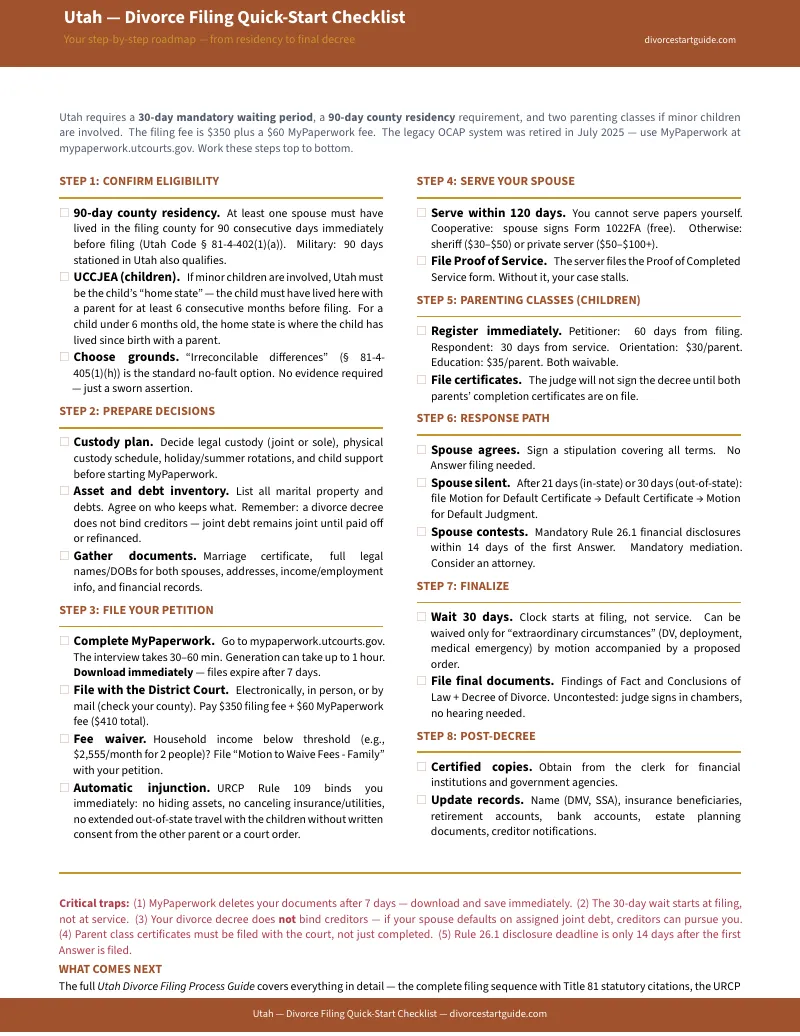
The free checklist gives you the quick-start overview. When you're ready for the full filing instructions, financial disclosure workbook, parenting class planner, and pre-filing decision worksheets — the complete guide is here.