
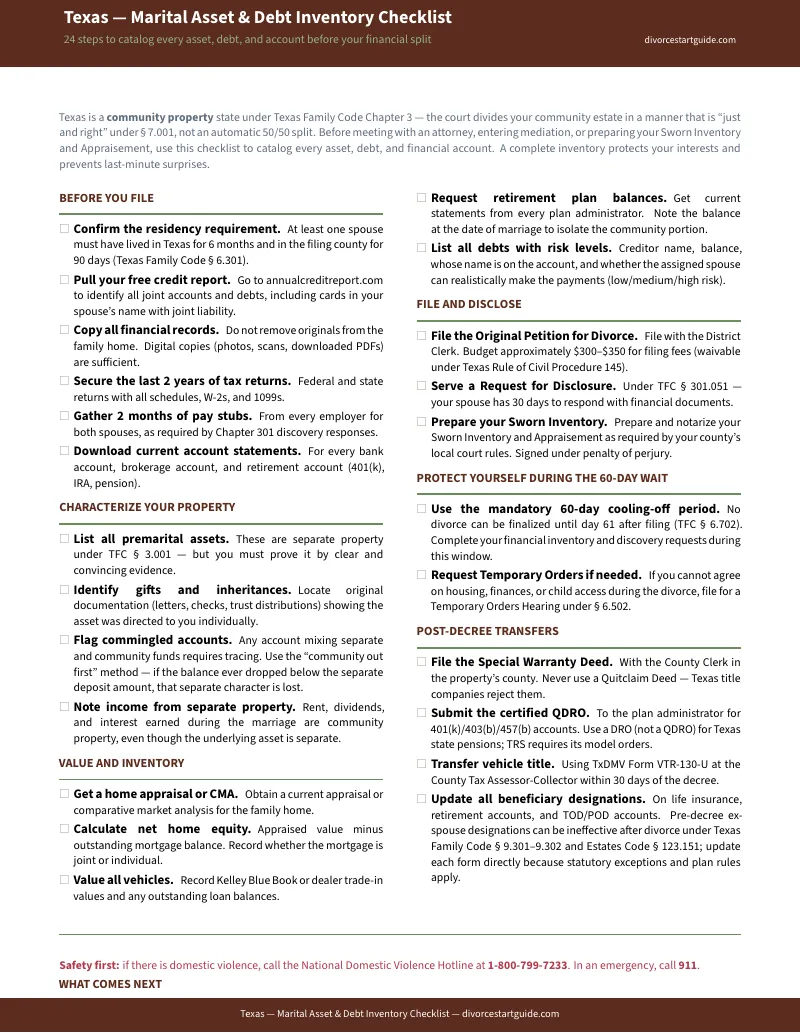
You know the marriage is ending. You don't know what you're going to walk away with.
Texas calls itself a community property state, but that label hides a critical detail: the court does not split your estate down the middle. Under Texas Family Code § 7.001, a judge divides everything in a manner that is "just and right" — weighing your earning capacity against your spouse's, considering who has primary custody, factoring in health, age, and even fault. The same pile of assets can result in a 50/50 split, a 60/40 split, or worse, depending on how well you present your case.
Free court forms on TexasLawHelp.org give you the paperwork to file. They do not show you how to classify a commingled bank account, calculate the community portion of a pension, or model what happens to your monthly budget if you keep the house but give up the 401(k). That is the gap where people lose thousands — not from legal fees, but from signing a decree they did not fully understand.
The Community Property Blueprint: A Complete Financial Division System for Texas Divorces
This is not a stack of blank forms. The Community Property Blueprint is a step-by-step process navigation system — a detailed guide plus printable worksheets designed to walk you through every financial decision in a Texas divorce, from your first asset inventory to the final post-decree transfer.
You work through the chapters in order. Each one covers a specific stage of the process, references the exact worksheet to use, and tells you what evidence to attach. By the time you finish, you have an organized, court-ready financial inventory — whether you are representing yourself, preparing for mediation, or trying to cut your attorney's billable hours in half.
What's Inside the Toolkit
- Marital vs. Separate Property Tracing Log — the legal test for separate property requires clear and convincing evidence. This worksheet walks you through documenting every premarital asset, gift, and inheritance, including how to trace commingled funds using the "community out first" method so you do not accidentally surrender a separate property claim.
- The "Just and Right" Factor Checklist — Texas courts weigh earning capacity, health, custody, fault, and the size of each spouse's separate estate. This checklist helps you identify which factors apply to your situation, so you know whether a 50/50 split is actually fair or whether the law supports asking for more.
- Home Equity and Buyout Calculator — keeping the house is not always the smart move. This worksheet models three scenarios (sell and split proceeds, one spouse buys out the other, refinance into one name) so you can compare the real cost of each option, including the mortgage qualification reality check most people skip.
- Retirement Account Division Walkthrough — step-by-step instructions for dividing 401(k), 403(b), 457, IRA, and defined benefit pension accounts. Covers the coverture fraction formula for calculating the community portion of a pension, the complete QDRO process from drafting through plan administrator approval, and the rollover rules that prevent unnecessary tax hits.
- Comprehensive Liabilities and Creditor Tracker — lists every joint and individual debt, calculates total liability, and explains the critical gap between what the decree orders and what creditors can actually do. Includes the post-separation account closure protocol to prevent your ex from running up joint credit cards after filing.
- Spousal Maintenance Eligibility Guide — Texas has some of the strictest alimony rules in the country. The guide covers the eligibility gates (10-year marriage, disability, domestic violence), the statutory duration caps (5/7/10 years by marriage length), and the income cap, so you know before mediation whether maintenance is even on the table.
- Post-Decree Asset Transfer Tracker — after the judge signs the Final Decree, the real administrative work begins. This tracker lists every transfer instrument, filing office, and deadline: Special Warranty Deeds for real property, QDROs and DROs for retirement accounts, TxDMV Form VTR-130-U for vehicle titles, and beneficiary designation updates for life insurance and TOD/POD accounts.
Who This Is For
- Amicable couples dividing a real estate and retirement portfolio — you agree on the divorce, but you need a neutral framework to work through the numbers without paying a mediator to sit in the room for every calculation
- The lower-earning spouse — you suspect you are entitled to more than half, but you do not know which factors to cite or how to build that argument before mediation
- Self-represented litigants — you are filing pro se and need to prepare a Sworn Inventory and Appraisement that meets your county's local court rules without guessing at format or content
- Anyone hiring an attorney — walking into a consultation with organized financials, classified assets, and a clear picture of the estate saves real money in billable hours
Why Free Resources Won't Get You There
TexasLawHelp.org provides court-approved petition forms, waiver of service templates, and decree worksheets — everything you need to complete the paperwork. What it does not provide is the financial analysis layer: classifying assets as community or separate, calculating the net equity in the family home, determining the community share of a pension, or modeling what happens to your post-divorce budget under different settlement scenarios.
LegalZoom and 3StepDivorce generate documents from questionnaires — fast and convenient for simple cases. But their templates are built for uncontested divorces with minimal assets. If you have a home, retirement accounts, commingled funds, or debts that need allocating, generic questionnaires do not show you the trade-offs. You end up signing a decree without knowing whether keeping the house was worth giving up the 401(k).
The Community Property Blueprint fills the space between free forms and a $5,000 retainer. It is not legal advice, and it is not a document generator. It is the preparation layer — the step you complete before you file, mediate, or meet with counsel so that the numbers on the final decree actually reflect a fair split.
Satisfaction Guarantee
If the toolkit does not give you a clearer picture of your financial situation, email [email protected] at any time and we will refund the full purchase — no questions, no hoops.
Start Organizing Your Financial Split
Download the free Marital Asset & Debt Inventory Checklist to see the approach. When you are ready for the full system — the detailed guide, every worksheet, and the post-decree transfer tracker — get the complete Community Property Blueprint for less than thirty minutes of an attorney's time.