
Your Parenting Plan Has to Satisfy a Texas Judge — Not Just Sound Fair to You and Your Ex
Texas does not use the word "custody." The state uses "conservatorship," "possession," and "access" — and if you confuse the terms on your legal documents, the clerk sends them back. If you agree to Joint Managing Conservatorship thinking it means 50/50 parenting time, you will be wrong — one parent still gets the exclusive right to designate the child's primary residence. And the specific possession schedule you choose (Standard, Expanded, or custom) determines your child support calculation under the $11,700 monthly cap.
TexasLawHelp.org provides excellent free court forms. But those forms do not explain how to construct a step-up schedule for a toddler under three, how to calculate your child support when you have children in multiple households, how to negotiate geographic restrictions when your ex wants to move counties, or how to prepare a mediation strategy that protects your parenting time while keeping the case out of trial.
The Texas Child Custody & Parenting Plan Guide is a Custody Process Roadmap — a step-by-step preparation tool that walks you through Texas's entire conservatorship, possession, and child support framework using the actual statutes. It does not generate court forms or give legal advice. It teaches you the sequence, the requirements, and the strategy so you can draft a parenting plan that mediators expect to see and that a judge will sign.
What's Inside the Guide
- Texas Conservatorship Framework — The three types of conservators (Joint Managing, Sole Managing, Possessory), what decision-making authority each one holds, baseline rights every parent retains under Sections 153.073–153.074, and when courts rebut the JMC presumption under the family violence standard of Section 153.004
- Best-Interest Factor Worksheets — All eight Holley v. Adams factors translated into questions you can answer about your own situation, so you understand how a judge evaluates your case before mediation — with specific evidence documentation strategies for each factor
- Four Possession Schedule Templates — The Expanded SPO (within 50 miles, roughly 45% parenting time from school dismissal Friday to school Monday), the Standard SPO (51–100 miles), the Long-Distance schedule (over 100 miles with 42 days of summer possession), and custom equal 50/50 variations (alternating weeks, 2-2-5-5, 5-2-2-5) — each mapped to annual overnight counts
- Under-Three Step-Up Schedule Builder — Age-appropriate schedule templates designed for infants and toddlers who do not qualify for the Standard Possession Order, with three developmental stages: birth to 12 months, 12–24 months, and 24–36 months — each gradually increasing overnights and weekend duration
- Child Support Calculation Worksheet — Step-by-step instructions for calculating net resources under the September 2025 guidelines, applying the guideline percentages (20% for one child through 40% for five or more), the $11,700 monthly cap, multiple-family adjustment tables, and medical/dental support allocation
- Parenting Plan Drafting Checklist — A 50+ item checklist covering conservatorship rights distribution, possession schedules, holiday rotations (Thanksgiving, Christmas, spring break, summer, birthdays), exchange logistics, right of first refusal, electronic communication rules, co-parenting app protocols, travel expense allocation, and dispute resolution procedures
- Mediation Preparation Workbook — A structured worksheet for organizing your positions into "Must-Haves," "Negotiables," and "Giveaways" before you enter mandatory mediation — plus an explanation of why a Mediated Settlement Agreement is binding and irrevocable, and what happens if mediation fails
- Geographic Restrictions & Relocation — How county-and-contiguous-county restrictions work, the automatic-lift provision when the non-primary parent moves away, the modification process for career-driven relocations, and the evidence standard courts require to change the boundary
- 60-Day Action Plan — A week-by-week calendar that maps out exactly how to use the mandatory 60-day waiting period to gather income documents, compile caregiving evidence, calculate child support, draft your parenting plan, and organize your mediation strategy
- Modification & Enforcement — The material-and-substantial-change standard for modifying existing orders, the three-year automatic review threshold, emergency temporary order procedures, and contempt remedies when the other parent violates the plan
Who This Guide Is For
- Parents filing for divorce in Texas who need to work out conservatorship, possession schedules, and child support
- Unmarried parents establishing custody through a SAPCR (Suit Affecting the Parent-Child Relationship) after paternity is established
- Parents preparing for mandatory mediation who want to arrive with a written, structured proposal rather than improvising
- Parents of children under three who need a developmentally appropriate step-up schedule instead of the Standard Possession Order
- Parents considering relocation who need to understand geographic restrictions before making plans
- Anyone planning to hire an attorney but wanting to reduce billable hours by organizing schedules, support calculations, and plan clauses beforehand
Why Not Just Use Free Court Forms?
TexasLawHelp.org and the Texas Access forms portal provide free, official court documents — and we recommend using them. This guide does not replace those resources. It is a preparation workbook that helps you understand Texas's terminology, organize your goals, and draft your terms before you sit down with those official templates.
Free forms ask what you want. They do not explain the difference between Joint Managing Conservatorship and equal parenting time, how to calculate child support when you have children in multiple households, why certain parenting plan clauses get rejected by judges, or how to structure a negotiation strategy for mandatory mediation. National DIY portals like 3 Step Divorce charge $299 for generic document assembly that treats custody as a secondary checkbox. Co-parenting apps like Custody X Change and OurFamilyWizard cost $72 to $300 per year per parent — and they handle daily logistics, not initial case preparation and plan drafting.
This guide bridges the gap between blank court forms and an attorney who charges $300 to $500 per hour. It is the preparation work — organized, sequenced, and specific to Texas family law — that saves you from rejected paperwork, weak mediation agreements, or thousands in legal fees spent on basic administration.
What You Get
Your purchase includes 9 PDFs: the complete guide (17 chapters covering the full Texas custody process from conservatorship basics through enforcement, plus appendices with key contacts and rights quick-reference), a parenting plan starter checklist, and 7 standalone printable worksheets you can fill in, bring to mediation, or hand to your attorney:
- Holley v. Adams Best-Interest Worksheet — Self-assessment using the 9 factors judges evaluate
- Possession Schedule Reference — ESPO, SPO, Long-Distance, and Under-Three schedules at a glance
- Child Support Calculation Worksheet — Step-by-step calculation under the $11,700 cap
- Mediation Preparation Worksheet — Organize Must-Haves, Negotiables, and Giveaways
- Parenting Plan Drafting Checklist — 50+ items covering every statutory requirement
- 60-Day Action Plan — Week-by-week preparation calendar for the mandatory waiting period
- Holiday Rotation Planner — Even/odd year rotation for Texas holidays, breaks, and summer
Satisfaction Guarantee: If the guide does not help you feel more prepared and organized for your custody process, email us and we will make it right.
— Less Than One Hour of Attorney Time
A single family law consultation in Texas runs $300 to $500 per hour. This guide gives you the preparation framework to organize your case, understand the statutory requirements, and draft enforceable parenting plan terms before that consultation — or handle the process yourself with confidence.
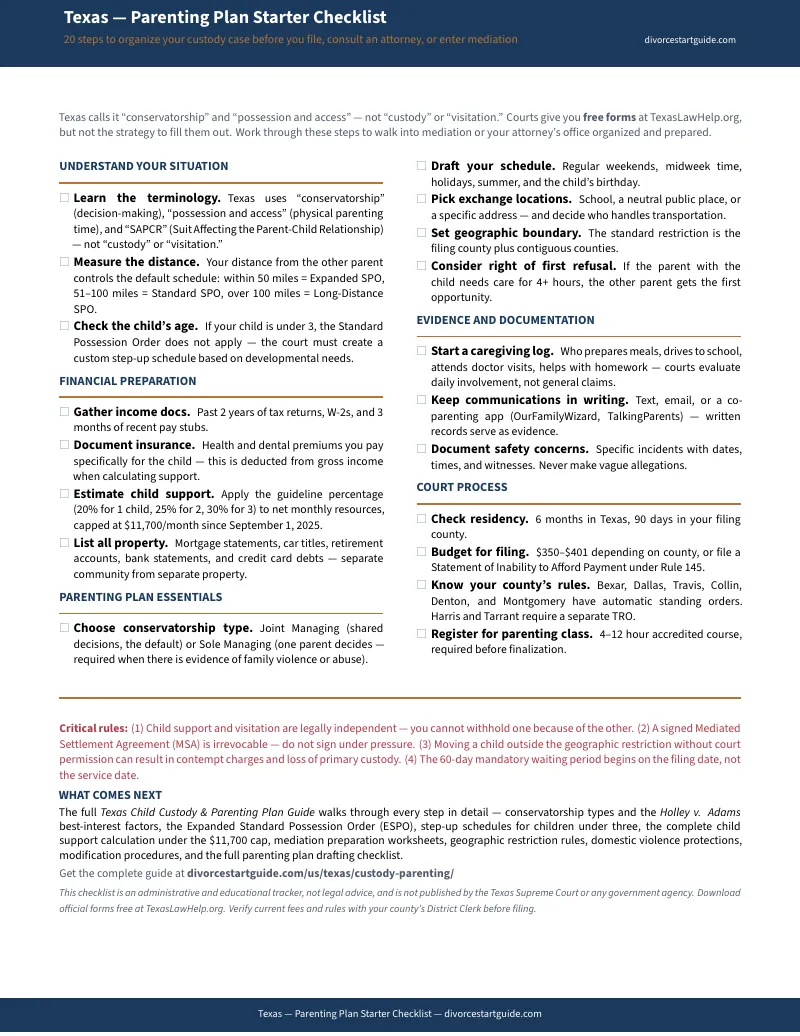
The free checklist gives you a quick-start overview of Texas's custody process and 20 key preparation steps. The full guide gives you the complete roadmap — conservatorship framework, possession schedule templates, child support worksheets, mediation prep, and the Texas-specific legal details you need to get it right.