You Have the Forms. You Don't Have the Sequence.
South Dakota's Unified Judicial System gives you every divorce form for free. What it doesn't give you is a map. Which form comes first? What happens when your spouse ignores the Admission of Service? How do you count the 60-day waiting period when it starts from service, not filing? And what exactly does the Automatic Temporary Restraining Order mean for your bank accounts, your insurance, and your kids?
The forms are raw ingredients. The Court-Clerk Companion System is the recipe — a step-by-step administrative workflow that tells you what to file, in what order, and what to do when the process hits a wall.
What's Inside
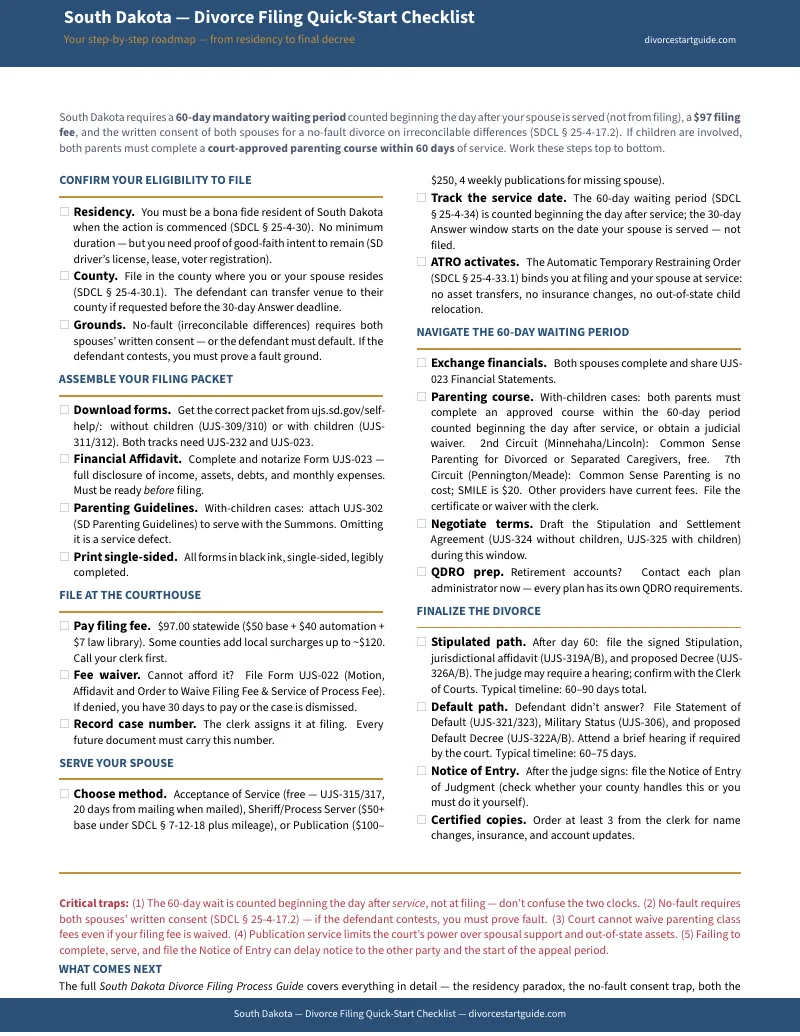
- The Complete Filing Sequence — Every UJS form mapped in chronological order, from the Civil Case Information Statement (UJS-232) through the final Judgment and Decree. No more guessing which form triggers the next step.
- Three Service Methods Decoded — Voluntary admission, sheriff delivery, and service by publication. For each method: exactly what to file, what it costs, and the deadline that governs it. Includes the 20-day Admission of Service countdown so you know exactly when to escalate to a process server.
- Financial Affidavit Preparation Worksheet — The UJS-023 is the form most likely to cause a clerk rejection. This standalone worksheet walks you through calculating gross monthly income, monthly expenses, and asset values before you touch the official form.
- 60-Day Waiting Period Tracker — A day-by-day tracker showing the mandatory cooling-off period under SDCL § 25-4-34, calculated from the day after service. Includes the parenting class deadline, the 30-day answer window, and the earliest date you can submit final paperwork.
- ATRO Compliance Checklist — The four automatic restrictions that bind both spouses from the moment of filing and service. A reference card with checkboxes so you don't accidentally violate a court order you may not even know exists.
- Property and Debt Inventory Worksheet — Catalog every asset and debt — with estimated values, proposed division, and supporting documentation — before you negotiate terms. South Dakota divides all property, so nothing stays off the table, and both spouses should start from the same factual baseline.
- Default Hearing Roadmap — If your spouse never responds, the default path has its own paperwork sequence and usually requires a brief court appearance. This section lists the exact documents to bring, the questions the judge will ask, and the post-decree steps most filers forget.
- Court Clerk Conversation Guide — Verbatim scripts for calling the Clerk of Courts for the first time. How to request file-stamped copies. How to submit Form UJS-022 if you need the filing fee waived. Clerks cannot give legal advice, but they do have procedures — these scripts help you navigate them.
Plus five more print-ready tools: the Filing Packet Assembly Checklist, Service of Process Tracker, Finalization Packet Assembly Checklist, Post-Decree Action Checklist, and Case Tracking Log — every worksheet referenced in the guide is included as its own printable PDF.
Who This Is For
This guide is built for self-represented filers in South Dakota — people who are capable of doing their own paperwork but need a clear sequence instead of a pile of blank forms. It covers both the without-children and with-children filing paths, the stipulated (agreed) and default tracks, and every county-specific wrinkle that trips up pro se litigants.
If you're dealing with contested property worth over $100,000, complex business assets, or a custody battle with abuse allegations, this guide will help you organize your filing — but those situations typically need an attorney. The guide includes clear thresholds for when self-representation is safe and when it's not.
Why Not Just Use the Free Forms?
The UJS self-help portal provides forms and checklists. The Guide & File tool even generates some documents for you. Here's what neither tool does:
- Explain that the Financial Affidavit (UJS-023) must be completed and notarized before filing the Summons and Complaint
- Warn you that certified mail is not valid service unless the defendant returns a signed Admission within 20 days
- Tell you that the 60-day waiting period starts the day after service, not the day you file
- Clarify that South Dakota's no-fault ground requires both spouses to consent in writing — or the defendant to be in default
- Walk you through the post-decree steps (Notice of Entry of Judgment, name change filing, QDRO for retirement accounts) that the checklists don't cover
National form generators like 3 Step Divorce charge $299 for automated templates that may not match South Dakota's county-level rules. Full-service attorneys in Sioux Falls run $250 to $400 per hour, with retainers starting around $2,000 to $5,000 for an uncontested case. This guide sits in between — South Dakota–specific process navigation at a fraction of either cost.
Satisfaction Guarantee
If the guide doesn't help you navigate your South Dakota divorce filing with more confidence and clarity, email us for a full refund. No time limit, no questions.
Start Filing With Confidence
Download the free Quick-Start Checklist to see the filing steps at a glance — or get the full South Dakota Divorce Filing Process Guide for and work through every form, every deadline, and every service method with a clear sequence in front of you.