The Court Divides Assets by "Fairness." Without a Number, You're Guessing What That Means.
South Carolina doesn't split marital property 50/50. Under S.C. Code § 20-3-620, the family court weighs 15 statutory factors — income, earning capacity, homemaker contributions, marriage duration, tax consequences, dissipation of assets — and arrives at whatever split the judge considers equitable. There is no formula. There is no calculator on the court's website. There is a judge, a set of competing declarations, and whoever presents the cleaner financial picture wins.
Before you even reach that hearing, South Carolina requires 365 consecutive days of physical separation in entirely separate residences. During that year, every financial decision you make — who pays the mortgage, who keeps contributing to the joint credit card, who withdraws from the retirement account — sets precedents the court treats as intentional. Six months of covering the mortgage alone doesn't earn you extra equity; it can be classified as a voluntary contribution to the marital estate. Meanwhile, debt your spouse runs up on a joint card during separation can still be assigned to you if you didn't freeze the account.
Free court forms exist. The county self-help packets from Spartanburg, Anderson, and Pickens are free to download. They're also useless unless you and your spouse have already reached a complete, signed agreement on every asset, every debt, and every support obligation. The forms are empty shells — legal containers with no negotiation guidance, no calculation tools, and no explanation of how the 15 factors actually affect your outcome.
Online document services charge $137–$499 to fill in those same forms for you. A family law attorney requires a $2,500–$10,000 retainer at $200–$450 per hour. Neither one hands you the financial analysis tools to figure out what a fair split actually looks like before you sit down at the table.
The South Carolina Divorce Financial Split & Asset Division Guide is the Equitable Division Workbook that fills that gap. It doesn't sell you forms. It gives you the worksheets, tracing tools, and calculation methods to build a documented, mathematically sound settlement proposal — the one thing you need before the free court forms become usable.
The Equitable Division Workbook — What's Inside
Equitable Apportionment Under the 15-Factor Framework
The court doesn't guess at fairness — it scores your case against 15 codified factors. The guide walks through each one: homemaker contributions, earning capacities, physical and emotional health, marital misconduct, tax consequences, retirement needs, and the custody arrangement's impact on housing. You'll understand which factors favor your position and which ones need documentation before you can credibly invoke them.
Marital vs. Separate Property Classification
Everything acquired during the marriage and owned at the date of filing is presumed marital — regardless of whose name is on the title. The only way to protect premarital assets, inheritances, or gifts is to prove they were never commingled with marital funds. The guide includes tracing worksheets that walk you through reconstructing the paper trail from bank statements, inheritance records, and gift documentation. It also covers the transmutation trap: the specific actions (depositing inheritance into a joint account, adding a spouse to a premarital deed) that permanently convert separate property into marital property.
Family Home Division Calculator
The marital home is usually the largest asset and the most emotional decision. The guide walks through every option: one spouse buys out the other's equity, both agree to sell and split proceeds, or a deferred sale keeps the custodial parent in the home until the youngest child reaches a set age. Each option includes the net equity calculation, the refinancing requirements, and the tax consequences — including the $250,000/$500,000 capital gains exclusion and what happens to it when one spouse moves out before the sale.
Retirement and Pension Division
The marital portion of every 401(k), 403(b), IRA, and pension accumulated during the marriage is subject to division. ERISA-covered employer plans require a Qualified Domestic Relations Order (QDRO) for tax-free transfer — the guide maps the four-step QDRO sequence from drafting through plan administrator approval to judicial signature. For South Carolina public employees, PEBA pensions follow their own Domestic Relations Order procedures. Military retirement is governed by the Uniformed Services Former Spouses' Protection Act. The guide covers the coverture fraction formula, the present-value offset method, and when each approach makes financial sense.
Debt Allocation and the Creditor Catch
Debts incurred during the marriage are divided under the same 15-factor framework as assets — but here's what the court doesn't emphasize: a divorce decree assigning a joint debt to one spouse does not release the other from the original creditor contract. The credit card company can still pursue you. The guide includes strategies for freezing joint accounts pre-filing, negotiating payoff sequences, and structuring indemnity clauses that give you legal recourse if your ex defaults on their assigned debt.
Spousal Support Modeling — Five Alimony Forms
South Carolina recognizes periodic, lump-sum, rehabilitative, reimbursement, and separate maintenance alimony. The guide explains how the court weighs each form against the duration of marriage, earning disparities, and marital standard of living. It covers the absolute statutory bar: under § 20-3-130(A), pre-agreement adultery permanently eliminates any right to alimony. And it maps the termination triggers — remarriage, death, and the 90-day cohabitation rule — so you can model what your support obligation or entitlement actually looks like over time.
SCCA 430 Financial Declaration Walkthrough
Rule 20 of the South Carolina Rules of Family Court requires both parties to file a notarized Financial Declaration within 45 days of service — or at the first temporary hearing, whichever comes first. Errors on this form damage your credibility with the judge and can trigger sanctions. The guide breaks down every section of the SCCA 430 with calculation worksheets for gross monthly income, assets, liabilities, and monthly expenses, so your numbers are accurate and internally consistent before the form is notarized.
Pre-Mediation Settlement Proposal Builder
South Carolina mandates alternative dispute resolution before a contested trial can be scheduled. Mediators charge $175–$400 per hour. Walking in without a structured proposal means you're paying the mediator to organize your finances — at their billing rate. The guide includes worksheets for drafting a comprehensive settlement proposal that covers every asset, every debt, the home disposition, support terms, and tax consequences, giving you and the mediator a concrete starting document instead of an open-ended conversation.
Who This Is For
- You own a home, retirement accounts, or significant debt together — you need calculation tools to figure out what a fair split looks like under South Carolina's 15-factor framework, not just blank court forms
- You want to reach an uncontested settlement without spending $10,000–$30,000 on a contested trial — you need a documented, mathematically sound proposal to present in mediation or private negotiation
- You're in the 365-day separation year and need to understand how your financial decisions during separation affect the final division — before those decisions become irreversible precedents
- You're filing the SCCA 430 Financial Declaration and need a structured walkthrough that ensures your numbers are accurate and your supporting documents are organized
- You're working with an attorney and want to arrive at your first consultation with a complete financial inventory, classified asset list, and drafted settlement proposal — so your attorney's billable hours go to strategy and advocacy, not data entry
Why Not the Free Court Forms?
Use the free forms — they're public property. But free forms don't negotiate a settlement. The county SRL packets are designed for couples who have already agreed on everything: every asset, every debt, every support term, signed and notarized. They include zero calculation tools, zero guidance on the 15 statutory factors, and zero worksheets for tracing separate property or modeling buyout scenarios.
Online document services like DivorceWriter ($137) and 3StepDivorce ($299) fill in those same free PDFs through a guided questionnaire — but they don't help you figure out what numbers to put in the blanks. They don't cover retirement division, business valuation, or the creditor catch on joint debt. Divorce.com charges up to $1,999 for a mediation-bundled package that still won't hand you a South Carolina-specific equitable distribution calculator.
This guide fills the gap between the free blank forms and the $2,500–$10,000 attorney retainer. It gives you the analysis tools those services skip.
Satisfaction Guarantee, No Time Limit
If the guide doesn't give you a clearer understanding of how South Carolina divides marital assets and debts, and a workable settlement proposal to bring to mediation or your attorney, email us at any time for a full refund. No conditions, no forms.
Get Started Today
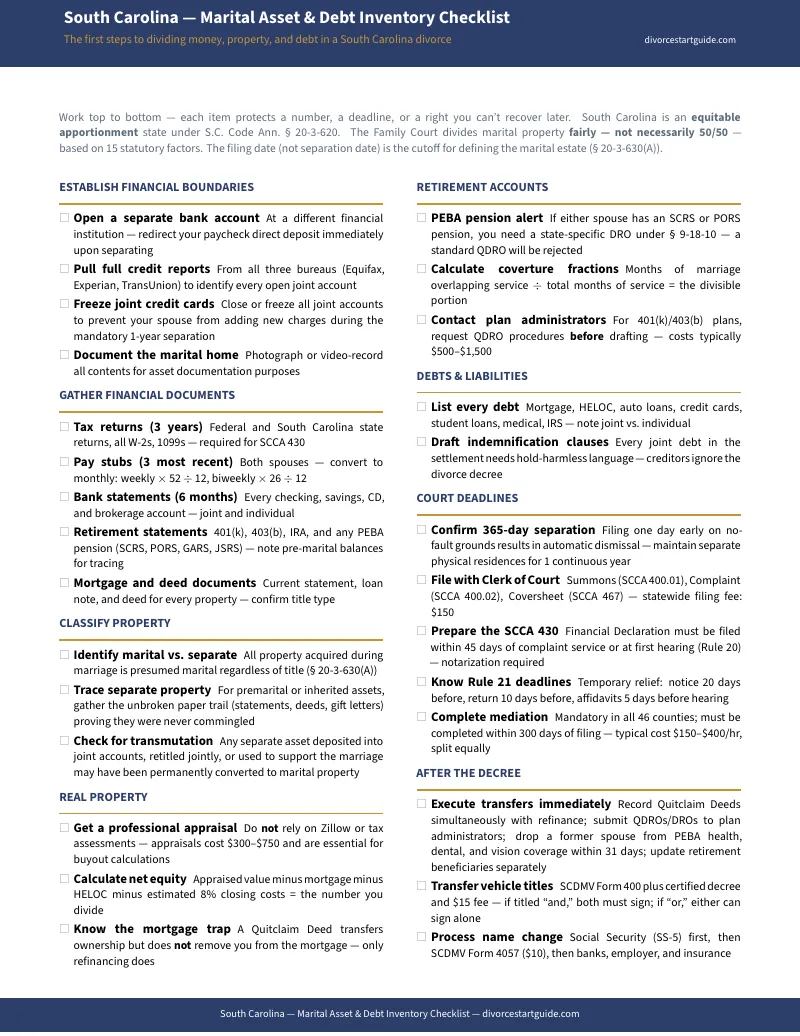
Download the free South Carolina Marital Asset & Debt Inventory Checklist — a one-page checklist covering the documents, account statements, and property records you need to gather before any financial negotiation. When you're ready for the full workbook — tracing worksheets, equity calculators, SCCA 430 walkthrough, and the pre-mediation settlement builder — the complete guide is .