
The SC Custody Roadmap — Because Blank Court Forms Don't Tell You What to Write
South Carolina makes you live apart for 365 consecutive days before you can even file a no-fault divorce. One night under the same roof resets the clock. File on day 364 and the court dismisses your case entirely. And while that year runs, your children's custody, your support arrangement, and who stays in the house are all unresolved — unless you do something about it.
Here's what most parents miss: the arrangement you live under during that waiting year tends to become the permanent one. Agree to "temporary" every-other-weekend visits while you find housing, and twelve months later a judge calls it the established routine. Sign a vague parenting plan that says "reasonable visitation as agreed," and you're one disagreement away from a contempt motion. Get served with a Motion for Temporary Relief, and South Carolina's amended Rule 21 gives you as little as ten days to file your response — for a hearing that lasts 15 or 30 minutes, with no live witnesses, decided entirely from affidavits capped at 10 or 20 pages.
The family court clerk has the forms. LawHelp.org/SC has them for free. But by law, court staff cannot tell you how to fill them in, what clauses to include, or how the schedule you pick shifts your child support calculation by hundreds of dollars a month. That gap — between a free blank form and a $200–$500-an-hour attorney — is where South Carolina parents get stuck.
The South Carolina Child Custody & Parenting Plan Guide is a complete SC Custody Roadmap: the exact sequence from the day you separate through the temporary hearing, mandatory mediation, and the final parenting plan — with clause-by-clause drafting blueprints for SCCA Form 466, the Rule 21 affidavit playbook, and the child support math that turns your schedule into a financial decision. Written for South Carolina law, not adapted from a national template.
What You Get
The Guide (9 Chapters)
The One-Year Separation Reality — the 365-day rule, the corroborating witness requirement, residency rules, and the Action for Separate Support and Maintenance: the legal vehicle that gets you enforceable temporary custody, visitation, child support, and possession of the marital home while the year runs.
Custody Basics, Translated — legal custody (decision-making on education, healthcare, religion, extracurriculars) vs. physical custody (where the child lives), why joint custody is not a 50/50 split, and the radically different defaults for married parents (joint natural guardianship under § 63-5-30) versus unwed parents, where the mother holds sole custody until the father establishes paternity in court.
The 17 Best-Interests Factors — a line-by-line walkthrough of S.C. Code § 63-15-240(B): what judges actually weigh, the two factors you control starting today, the status-quo trap, and how to build a caregiving record (school pickups, doctor appointments, bedtime routines) that survives cross-examination.
Drafting Your Parenting Plan (SCCA Form 466) — what the court expects the plan to cover, age-appropriate weekly schedules, holiday rotations, exchange logistics, and the clauses worth adding beyond the basics: right of first refusal, tie-breaking votes for joint legal custody, and communication protocols (including co-parenting app mandates) that neutralize a high-conflict ex.
The Rule 21 Temporary Hearing Playbook — the amended October 2025 timeline (hearing in 21–45 days, return due 10 days out, affidavits exchanged 5 days out), the strict 10/20-page affidavit limits, how to spend your limited pages for maximum weight, and when emergency ex-parte orders apply. This hearing sets the temporary order that usually becomes the final one — it's the most important court date of your case.
Child Support and the 110-Overnight Threshold — the January 2024 DSS guidelines, Worksheet A vs. B vs. C, the 1.5× shared-custody multiplier, and the graduated obligation formula for 110–127 overnights. You'll see exactly why 109 overnights and 110 overnights can mean very different monthly numbers — before you agree to a schedule.
Mediation, Parent Education, and the GAL — South Carolina mandates ADR for nearly all contested custody cases. Learn how the confidential mediation session works, what proposals and fallback positions to prepare, how to avoid signing a weak binding agreement under pressure, what court-mandated parenting classes to expect, and what a Guardian ad Litem actually does with your child.
Special Situations — domestic violence and safety conditions, relocation inside and outside South Carolina, modifying an existing order (the "substantial, material, permanent change of circumstances" bar), and the unwed father's path to establishing paternity and court-ordered rights.
The Full Process, Step by Step — the pre-filing checklist (establish separate residences, gather 12 months of financial records for SCCA Form 430, document caregiving history, draft Form 466), county-level variations to verify locally, key official resources, and honest guidance on when you need more than a guide.
The Printable Worksheets
Eight fillable worksheets turn the guide into documents you can hand a mediator, a judge, or your attorney:
- Parenting Plan Drafting Worksheet (SCCA 466) — weekly schedule grid, decision-making table, exchange logistics, and the clauses worth adding
- Rule 21 Temporary Hearing Planner — the date-math countdown (10-day return, 5-day exchange) and an affidavit page-budget table
- Overnight Counter & Child Support Worksheet — count your schedule's annual overnights and run the graduated 110–127 formula yourself
- Custody Schedule Comparison Worksheet — score three candidate schedules side by side before you propose one
- Holiday & School-Break Rotation Planner — the alternating-year rotation, summer blocks, and school-closure days
- Mediation Preparation Worksheet — opening proposal, realistic fallback, and walk-away limit for every issue
- Caregiving Documentation Log — the dated daily record that feeds your best-interests case and your affidavits
- Custody Case Cost Tracker — typical SC costs by stage with budget-vs-actual columns
The Free Starter Checklist
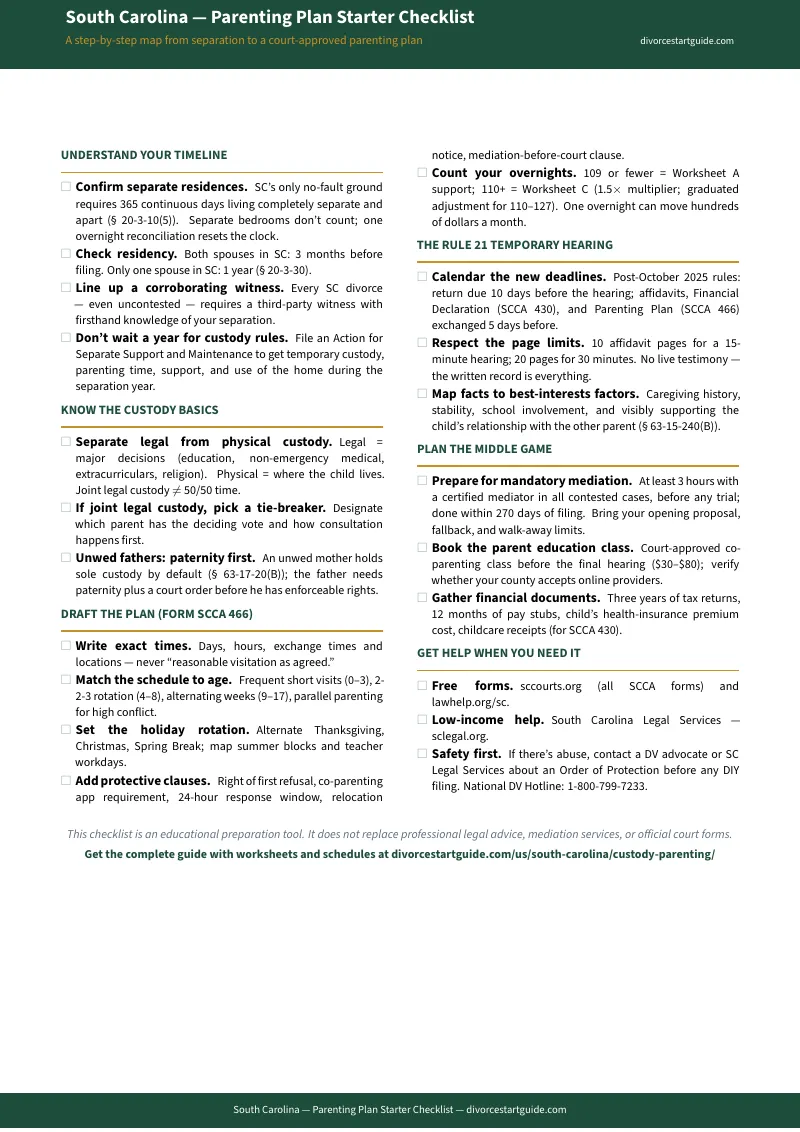
Not ready for the full guide? Download the South Carolina Parenting Plan Starter Checklist — a one-page overview of SC custody basics, the key court forms, and a quick-start checklist for your parenting plan. Free, instant download, no credit card.
Who This Is For
- Parents in the separation year — you're living apart, the clock is running, and you need enforceable custody and support arrangements now, not after the divorce. The guide shows you how the separate maintenance action works.
- Parents facing a Rule 21 temporary hearing — you've been served (or you're filing) and you have days, not weeks, to assemble a proposed parenting plan and compliant affidavits. The guide gives you the timeline math and the page-limit strategy.
- Self-represented parents (pro se) — you downloaded the free court forms and found blank containers with zero instructions. The guide supplies the sequencing, the plain-language definitions, and the drafting language the packets leave out.
- Parents preparing for mandatory mediation — walk in with an opening proposal, realistic fallbacks, and defined walk-away limits instead of improvising under pressure.
- Parents modifying an existing order — relocation, a child entering adolescence, or a documented change in the other parent's fitness. The guide explains the high modification threshold and how to draft a revised plan a judge will approve.
- Parents working with an attorney — arrive at your first consultation with a drafted schedule and organized financials, so your attorney's hours go to strategy instead of basics.
Why Not Free Resources?
South Carolina's official self-help portals (LawHelp.org/SC, the Judicial Department forms library) give you the real court forms for free — but they're legally barred from telling you what to write in them, and they say nothing about Rule 21 page limits or the 110-overnight support threshold. The SC Bar sells an excellent model parenting plan for $80, but it's written for practicing attorneys, dense with case citations. National document services (LegalZoom, 3 Step Divorce at $299) treat divorce as one linear transaction and ignore South Carolina's separate maintenance action and affidavit-only temporary hearings entirely. Custody X Change builds nice calendars on a subscription but won't walk you through a Charleston or Greenville filing. OurFamilyWizard runs $150–$300 per parent per year and starts after your order exists.
This guide fills the gap: SC-specific law, the Rule 21 playbook, Form 466 drafting blueprints, and the support-threshold math in one printable document — without the $2,500–$5,000 retainer.
Money-Back Guarantee, No Time Limit
If the guide doesn't give you a clearer understanding of South Carolina's custody process and a workable parenting plan, email [email protected] at any time for a full refund. No questions, no forms, no waiting period.
— Less Than Ten Minutes of Attorney Time
A South Carolina family law attorney charges $200–$500 an hour, retainers run $2,500–$5,000, and a contested custody case averages $12,600 — often far more. This guide costs less than the first ten minutes of a consultation and covers the procedural groundwork most of those billable hours are spent explaining.
Download includes the full 9-chapter guide, all 8 printable worksheets, and the quick-start checklist as printable PDFs. Instant access. Use them at the kitchen table, in mediation prep, or at your attorney's office.