The court gives you blank forms. This guide gives you the financial blueprint behind them.
Rhode Island's Family Court Self-Help Center will hand you Form DR-6 — a nine-page financial affidavit — and tell you to fill it out under penalty of perjury. What the clerks cannot do, by law, is explain how to calculate the numbers, how to classify your assets, or how to sequence the rest of the process. That gap between "here are the forms" and "here's how to actually do this" is where most people either freeze or overpay an attorney for hours of document organization they could have done themselves.
The Rhode Island Divorce Financial Split Guide is a complete DR-6 Navigation System — a structured, step-by-step workbook that walks you through every financial decision in a Rhode Island divorce, from the automatic restraining order on day one through the final nisi deadline months later. It is not a packet of blank forms. It is the financial logic layer that connects your bank statements, pension records, and property deeds to the court's twelve-factor equitable distribution framework.
What makes this different from free resources and generic online tools
Free court forms give you empty boxes. Generic divorce platforms give you national templates that ignore Rhode Island's specific rules — the 4.3× weekly-to-monthly income multiplier for the DR-6, the Sullivan passive appreciation standard for separate property, the distinction between ERISA-governed QDROs and ERSRI pension orders, the two-document nisi finalization sequence that trips up even experienced filers. This guide was built around those rules. Every worksheet, every calculation template, every checklist item maps directly to what Rhode Island Family Court actually requires.
What's inside the DR-6 Navigation System
The Automatic Restraining Order Compliance Log — The moment your divorce complaint is filed, R.I. Gen. Laws § 15-5-14.1 freezes marital assets. You cannot close joint credit cards, make unusual withdrawals, change life insurance beneficiaries, or transfer property. Print the log: check ordinary vs. prohibited activity, then record every non-ordinary transaction so you can keep paying normal bills without accidentally triggering a contempt proceeding.
The Form DR-6 Line-by-Line Workbook — Nine pages of mandatory financial disclosure, deconstructed into a category-by-category preparation workflow. Income converted using the court's strict 4.3× weekly multiplier. Assets organized by type — real estate, banking, retirement, vehicles, personal property. Debts catalogued with account numbers, balances, and whose name is on the obligation. Health insurance premiums, childcare costs, and utilities itemized in the format the court expects. Compile your numbers here first, then transfer them to the official form with confidence.
The Marital vs. Separate Property Inventory — Under Rhode Island equitable distribution, the classification of each asset drives the outcome. The worksheet walks each item through: acquisition date, source of funds, commingling history, and the Sullivan test for passive versus active appreciation. Premarital assets, inheritances, and personal gifts start as separate property — but the tracing page shows you exactly where the line blurs and how to document your claim.
The Equitable Distribution Scenario Modeler — Rhode Island does not guarantee a 50/50 split. The judge weighs twelve statutory factors under R.I. Gen. Laws § 15-5-16.1. The worksheet lets you model 50/50, 55/45, and 60/40 scenarios across your entire asset pool, so you walk into mediation or your attorney meeting with concrete proposals instead of vague hopes.
The Home Equity Buyout Calculator — Three resolution paths: buyout, sale, or deferred sale. The calculator covers current market value, outstanding mortgage balance, net equity, each spouse's share under different split scenarios, the 40% carrying-cost screen for a deferred sale, and the refinancing checklist to fully separate the obligation. It includes the critical trap most people miss: a divorce decree assigning the mortgage does not release the other spouse from creditor liability. Refinancing is required.
The Retirement Account Division Tracker — Private 401(k) and 403(b) plans require a QDRO. IRAs are divided by transfer incident to divorce. But ERSRI state pensions and municipal retirement plans require specialized domestic relations orders — standard QDRO templates are routinely rejected by state administrators. One row per plan tracks draft, pre-approval, court signature, and transfer, plus the coverture fraction and the 60-to-90-day QDRO timeline, including military retirement under USFSPA.
The Debt Allocation and Indemnification Ledger — Debts are divided equitably alongside assets. But the divorce decree does not override your creditor contracts. Joint credit card debt assigned to your spouse can still hit your credit report if they default. The ledger helps you inventory every joint and individual obligation, mark whether the marital settlement includes indemnification, plan a closure timeline for joint accounts, and build a credit-protection strategy.
The Alimony Need vs. Ability to Pay worksheet — Rhode Island has no statutory formula for alimony. Courts apply a need-plus-ability-to-pay test with broad judicial discretion. The worksheet structures your monthly budget around the factors judges actually consider: income disparity, length of marriage, earning capacity, health, age, and contributions to the other spouse's career. The informal local guideline — roughly one year of support for every three years of marriage — gives you a starting framework, but the worksheet helps you model specific scenarios.
The Nisi Period and Final Judgment Deadline Tracker — After the nominal hearing, you are not yet divorced. Under R.I. Gen. Laws § 15-5-23 you file the Decision Pending Entry of Final Judgment within 30 days of the hearing — that filing starts the 90-day nisi period (20 days if the ground is three years' separation). After nisi ends, file the Request for Entry of Final Judgment within 180 days. Miss that window and you need a motion to enter out of time. The tracker is a fill-in date sheet for each of those deadlines.
The Post-Decree Transfer Checklist — After the divorce is final, you still need to execute the property transfers: deed transfers, vehicle title changes, retirement account divisions, beneficiary updates, and account closures. The checklist sequences every post-decree action so nothing falls through the cracks.
Who this is for
You are preparing to file or have just been served, and you need to organize your finances before anything else. The automatic restraining order limits what you can do from day one. The DR-6 deadline is coming. The guide gives you a structured system to get your financial house in order — fast.
You earn too much for free legal aid but cannot justify a $2,500 retainer for document organization. Rhode Island Legal Services has income limits. The Family Court Self-Help Center cannot advise you. At $200 to $415 per hour, paying an attorney to sort through your bank statements is the most expensive way to organize paper. This guide lets you do that work yourself and save your attorney hours for strategy.
You are negotiating in mediation and need concrete proposals, not wishes. Rhode Island courts regularly order mediation before trial. Private mediators charge $200 to $500 per hour. Walk in with scenarios already calculated and you spend less time (and money) at the table.
Who this is NOT for
If your spouse has hired an attorney and you have not, if you suspect hidden assets or undisclosed business income, if your case involves complex business valuations, or if there is any history of domestic violence or financial coercion — you need a licensed Rhode Island family-law attorney, not a worksheet. This guide is a financial-organization and process-navigation tool. It does not provide legal advice and does not represent you in court.
Satisfaction guarantee
If the guide does not help you organize your Rhode Island divorce finances more clearly, email us and we will make it right. No hoops, no time limits.
Start organizing your finances today
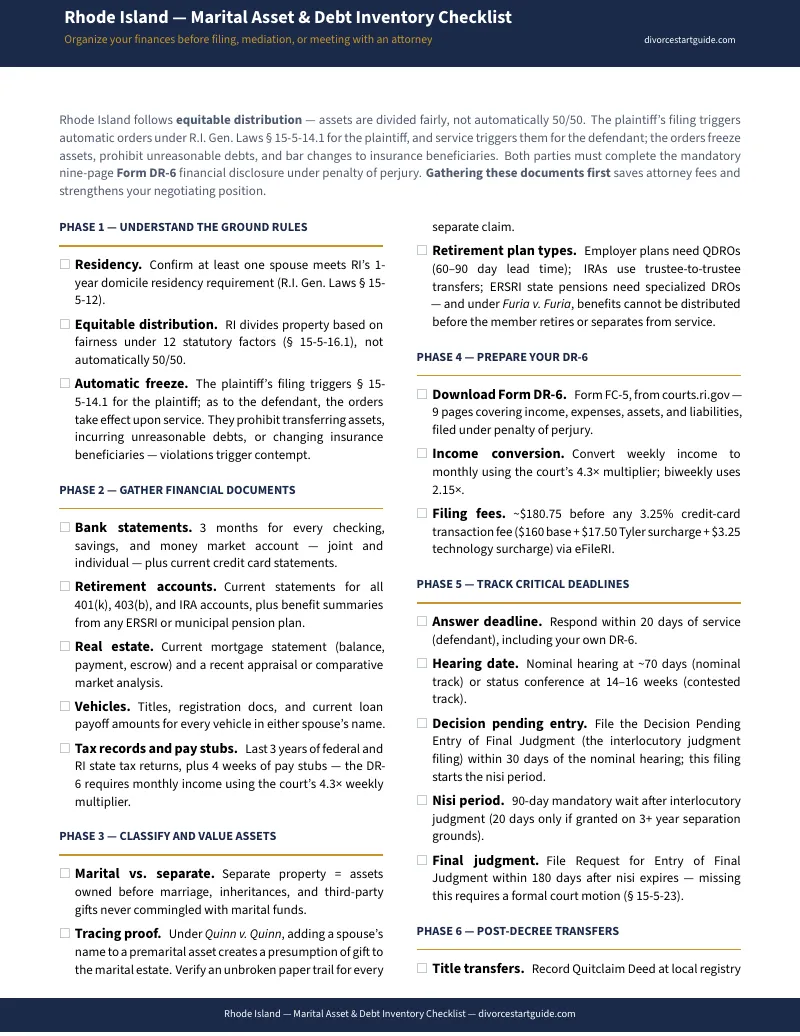
Download the free Rhode Island Marital Asset & Debt Inventory Checklist to see the quality of the material. When you are ready for the complete DR-6 Navigation System — with the line-by-line workbook, the scenario modeler, the retirement tracker, the nisi tracker, and every worksheet — get the full guide for .