You Have the Blank Forms. You Don't Have the Filing Sequence.
Rhode Island gives you free divorce forms through the Judiciary website and the eFileRI portal. What it doesn't give you is which forms to file first, how to fill out the DR-6 financial disclosure without triggering a rejection, what your corroborating witness needs to say at the nominal hearing, or what paperwork you still owe the court after the judge grants the divorce.
The Rhode Island Divorce Filing Process Guide is a court-process navigation system — built for self-represented filers who need the operational sequence, not a stack of blank PDFs and a courthouse visit they're not ready for.
The Problem With "Free Forms"
Rhode Island's Family Court Self-Help Center, virtual clerk help desk, and court navigators do their job: free, accurate forms and general procedural direction. But court staff are legally prohibited from giving you filing advice or helping you fill out forms. They can accept your paperwork. They cannot tell you whether it's correct, in what order to file it, or what happens next.
That leaves you with the right forms but no roadmap. You know what to submit — you don't know in what order, by which deadline, or how to handle the financial disclosures, service requirements, and post-hearing steps that trip up most pro se filers.
The Nisi Navigator System inside this guide fills that gap — it maps every step from your initial filing through the 90-day nisi waiting period to the Final Judgment, with deadline tracking at each stage so nothing falls through the cracks.
What's Inside
Residency and Grounds Decision Tree
Rhode Island requires one year of domiciled residency before filing. Military service members have different rules. Filing in the wrong county gets your case dismissed. The decision tree confirms your eligibility and venue before you pay the filing fee, and covers the two no-fault grounds — irreconcilable differences and three-year separation — so you choose the right one for your situation.
DR-6 Financial Disclosure Walkthrough
The Statement of Assets, Liabilities, Income, and Expenses is the form that stops most pro se filers cold. One missed asset, one math error, and the judge can reject your filing — forcing you to refile, pay another round of e-filing fees, and wait months for a rescheduled hearing. The walkthrough breaks the DR-6 into sections with plain-language instructions for each field, so your disclosure is accepted on the first attempt.
Service of Process Roadmap
Rhode Island law bars you from serving divorce papers yourself. You need to arrange service through a county sheriff or licensed private constable, file the return of service to prove proper notification, and handle it all within 120 days of filing. If your spouse can't be found, you'll need a motion for alternative service — by certified mail or newspaper publication. The roadmap covers every method with the specific costs and deadlines for each.
Nominal Hearing Preparation Checklist
Rhode Island requires at least one in-person court appearance. You cannot finalize a divorce entirely online or by mail. If both spouses attend, the judge typically waives extra witnesses. If only you attend, you need two live witnesses — or one witness plus an ex parte affidavit of residency from the clerk. Show up without the right corroboration and the judge postpones your case, potentially by months. The printable checklist covers what to bring, what you'll testify to, witness names, and Providence County's mandatory co-parenting video requirement.
Default Divorce Process Guide
When a spouse won't respond or can't be found, you need the default track. The guide walks through filing a motion for default, proving proper service, and meeting the stricter two-witness requirement at the default hearing — step by step, so you don't discover these requirements the morning of your court date.
The Two-Step Finalization Tracker
Most pro se filers think the divorce is final on hearing day. It isn't. After the judge grants the divorce, you must file a Decision Pending Entry of Final Judgment within 30 days, wait out the mandatory 90-day nisi period, then file the Final Judgment within 270 days. Miss any of these deadlines and you're still legally married. The tracker maps every milestone from hearing day through legal finality.
Equitable Distribution and Settlement Worksheets
Rhode Island uses equitable distribution, not 50/50 splitting. The worksheets help you categorize assets as marital or separate, understand the factors the court considers (length of marriage, conduct, health, economic circumstances), and organize your settlement terms — property, debts, alimony, and child-related matters — before you negotiate or walk into court.
Cost Summary and Timeline Planning Worksheet
The base filing fee is $160, plus e-filing processing charges that bring the standard e-filing total to $180.75 (about $187 if you pay by card). Service costs run $30–$100 depending on the method. If your income qualifies, you can apply for a fee waiver through a Motion to Proceed In Forma Pauperis. The worksheet totals your expected costs and maps your entire timeline — from initial filing through the nisi period to Final Judgment.
What You Get
Your purchase includes 12 PDFs — the full guide, the quick-start checklist, and 10 standalone worksheets you print and fill in:
- guide.pdf — 13-chapter Rhode Island Divorce Filing Process Guide
- checklist.pdf — Quick-start filing checklist
- residency-grounds-decision-tree.pdf — Confirm eligibility, grounds, and venue before you pay the filing fee
- filing-packet-checklist.pdf — Every document the clerk needs on opening day
- dr6-financial-disclosure-worksheet.pdf — Income conversion, assets, debts, and the double-counting check
- service-of-process-roadmap.pdf — Landscape attempt log and the 120-day service deadline
- nominal-hearing-prep-checklist.pdf — What to bring, witness names, and testimony notes
- default-divorce-checklist.pdf — Motion steps and the stricter default-hearing witness rule
- two-step-finalization-tracker.pdf — DPEFJ, nisi, and Final Judgment dates
- equitable-distribution-worksheets.pdf — Marital vs. separate inventory and § 15-5-16.1 factors
- timeline-planning-worksheet.pdf — Cost estimate plus every deadline from filing through Final Judgment
- marital-settlement-agreement-checklist.pdf — Property, alimony, and child terms the judge will look for
Who This Guide Is Built For
- Self-representing filers who want to handle their own divorce without paying $10,000+ in attorney fees or $137+ for a generic document-preparation service that doesn't cover Rhode Island's specific rules
- Couples who agree on everything but need the exact sequence of forms, deadlines, and post-hearing filings to get through the nominal track without a procedural error that costs them months
- Filers with an uncooperative spouse who won't respond, won't sign, or can't be found — and who need to navigate the default track, alternative service, and the stricter witness requirements
- Parents with minor children who need to handle co-parenting course requirements, child support calculations, and the parenting plan in addition to the divorce filing itself
- People who plan to hire a lawyer eventually but want to organize their financial records, understand the process, and minimize billable hours when they walk into that first consultation
Why Not Just Use the Free Court Resources?
The Rhode Island Judiciary website and HelpRILaw give you forms, general overviews, and access to a virtual clerk help desk. These are useful starting points. But the virtual clerk answers general questions — they can't review your specific filing for errors, they can't help you fill out the DR-6, and they can't tell you whether your service of process will hold up in court.
Generic document-preparation services like DivorceWriter and 3 Step Divorce generate your paperwork through an online questionnaire. But they rarely explain Rhode Island's nominal hearing witness requirements, the two-step post-hearing finalization process, or Providence County's mandatory co-parenting video.
This guide covers the administrative details that are specific to Rhode Island and that free resources don't address — the parts that cause delays, rejections, and postponements when pro se filers discover them at the wrong moment.
What This Guide Is Not
This is process navigation, not legal advice. It does not include blank court forms — you download those free from the Judiciary website. It does not replace an attorney for contested cases involving domestic violence, hidden assets, or complex custody disputes. It tells you how to navigate the system, not how to litigate in it.
Your Purchase Is Protected
If the guide doesn't deliver the step-by-step clarity you expected, contact us and we'll make it right. Your files are available for immediate download after purchase.
Start With the Free Checklist or Get the Full Guide
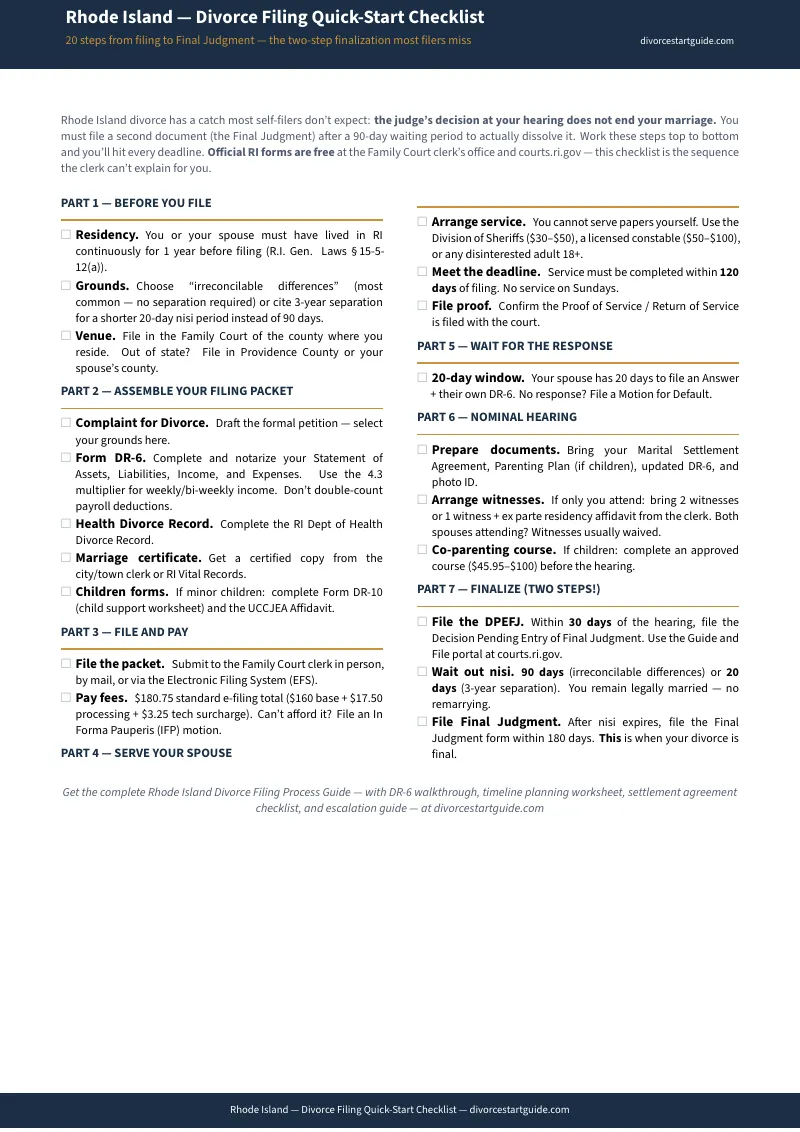
The free Rhode Island Divorce Filing Quick-Start Checklist gives you a one-page overview of the filing steps, residency rules, and waiting period. It's a solid starting point if you want to confirm your eligibility and understand the basic timeline.
The full Rhode Island Divorce Filing Process Guide gives you the complete Nisi Navigator System — 13 chapters of step-by-step instructions, worksheets, checklists, and deadline tracking from initial filing through Final Judgment. For less than a single hour of an attorney's time, you get the roadmap for the entire process.