Pennsylvania Gives You the Forms. Nobody Gives You the Filing Sequence.
The Unified Judicial System of Pennsylvania provides every divorce form for free at pacourts.us. So does PA Safe Law, Adams County, Delaware County, and most of the state's 67 Prothonotary offices. The forms are not the problem.
The problem is that no official source publishes the chronological order of operations. The forms arrive as a pile of PDFs with names like "Divorce Complaint," "Notice to Defend," "Affidavit of Consent," and "Praecipe to Transmit Record" — but nothing tells you which one to file first, what happens after you serve your spouse, when the 90-day waiting period actually starts, or what physical items to bring to the courthouse counter.
Meanwhile, Pennsylvania's 67 counties each set their own filing fees ($285 in some rural counties, $333.73 plus a $21 defendant surcharge in Philadelphia), require different numbers of copies, and operate different offices — some counties call it the Prothonotary, others the Office of Judicial Support. File in the wrong office or bring the wrong fee amount and the clerk sends you home.
National document-preparation services ($299 flat fee or $84/month for 4 months) will fill out those same free forms through a questionnaire. But they don't explain the 30-day service deadline, the difference between the 90-day mutual consent track and the one-year separation track, or what a Praecipe to Transmit the Record is and when to file it. Hello Divorce charges $99 to $4,000 depending on the plan tier. Rocket Lawyer charges $149 to $349 per year in a subscription that keeps billing while your case sits in the 90-day waiting period.
The Courthouse Filing Sequence
This guide is the step-by-step operational sequence the court system doesn't publish. Not forms. Not legal advice. Not a document-prep service. It's the chronological filing blueprint that coordinates Pennsylvania's free official forms into a complete pathway from the initial complaint through the final decree — with every deadline, every filing fee, and every decision point mapped in plain language.
Every chapter is built around Pennsylvania's actual statutes (23 Pa.C.S. Chapter 33) and the Pennsylvania Rules of Civil Procedure (Rule 1920 series), not generic "how to get divorced" content recycled from a national template. The guide covers what makes Pennsylvania different: the dual no-fault tracks (90-day mutual consent vs. one-year separation), the county-by-county filing fee variation, the strict 30-day service window, and the consent affidavit signing rules that trip up even experienced paralegals.
What You Get
The Complete Filing Process Guide
A 15-chapter guide covering the full Pennsylvania divorce filing sequence:
- Eligibility and Venue Navigator — verify the six-month residency requirement under 23 Pa.C.S. Section 3104(b), determine which county's Court of Common Pleas to file in, and choose between the mutual consent and separation pathways based on your specific circumstances
- Pre-Filing Financial Protection — what to document and preserve before you file, so you don't accidentally waive your rights to equitable distribution or alimony by failing to raise them in the initial complaint
- Filing Packet Assembly — the exact documents to prepare, the number of copies your county requires, acceptable payment methods for filing fees, and how to apply for an In Forma Pauperis fee waiver if you can't afford the $285 to $500 filing fee
- Service of Process Guide — three valid methods (personal service, sheriff, certified mail with restricted delivery), the 30-day deadline under Pa.R.Civ.P. 1930.4, how to complete and file the Proof of Service, and what to do when your spouse can't be located
- Dual-Track Finalization Maps — separate chapter-length walkthroughs for the mutual consent track (90-day wait, consent affidavits, Praecipe to Transmit) and the separation track (one-year apart, counter-affidavit notice, 20-day response window, default decree)
- Filing Fee and Cost Worksheet — standalone printable worksheet to calculate your total out-of-pocket costs, including county-specific filing fees, service costs, certified copy fees, and optional extras like QDRO preparation
- Timeline Tracking Calendar — standalone fill-in calendar mapping your critical dates: service deadline, waiting period expiration, affidavit signing windows, and Praecipe filing target
- Common Mistakes Reference — standalone card covering the 12 most frequent errors that stall Pennsylvania divorce filings, from wrong-venue filings to unsigned verifications to missed equitable distribution claims
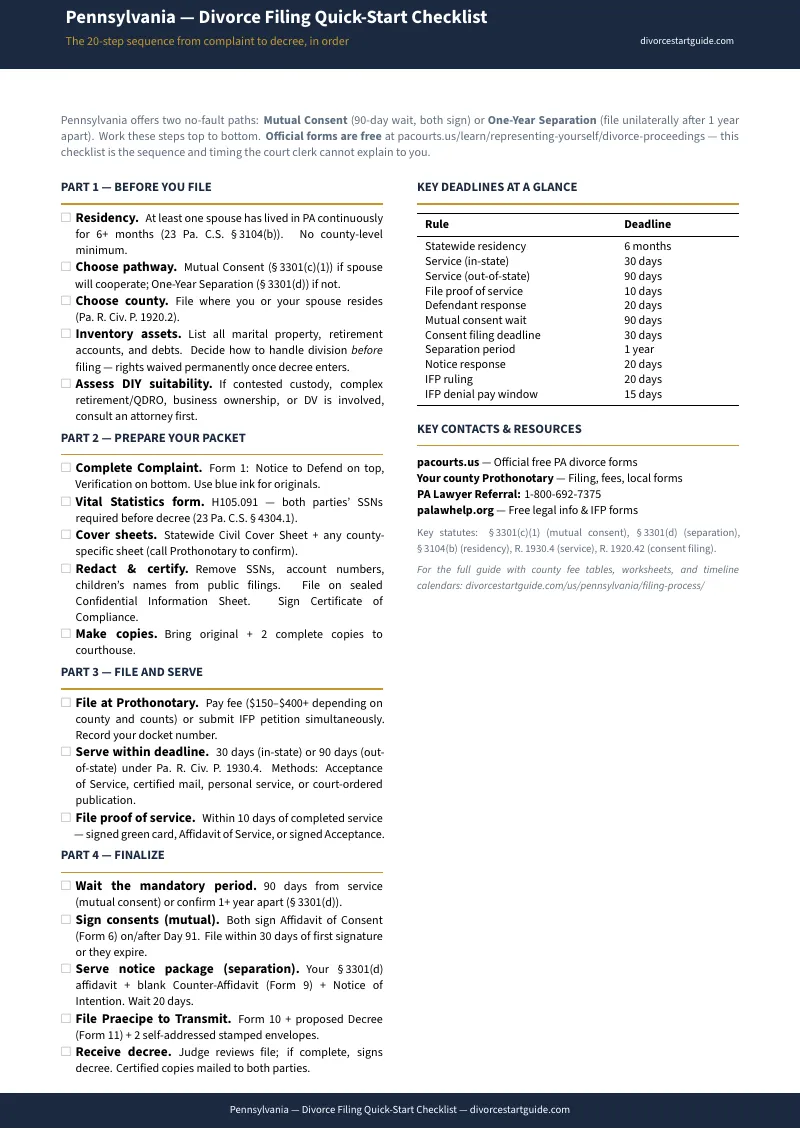
- Document Checklist by Pathway — standalone printable listing every form you need for mutual consent or one-year separation, organized by filing stage — bring it to the Prothonotary
- Service of Process Log — standalone tracker for every service attempt, with method, server name, and proof-filed status
- Quick Reference Sheet — standalone one-page card with all key deadlines, statutes, and contacts at a glance
- Post-Decree Action Guide — what to do after receiving your final divorce decree: certified copies, name change process, retirement account division via QDRO, updating beneficiaries, and modifying support or custody orders
- Professional Referral Checklist — a clear diagnostic for when you can handle the process yourself vs. when you need a family law attorney, mediator, CPA, or QDRO specialist. Includes the Limited Scope Representation option where a lawyer reviews specific documents without a full retainer
Quick-Start Checklist (Free Tier)
A printable one-page process map covering the entire Pennsylvania divorce filing sequence — from verifying residency through receiving the final decree. Includes both no-fault tracks, the service of process rules, and the key deadlines, with checkboxes to track your progress.
Who This Is For
- You and your spouse agree on most or all terms and want to handle the filing without paying a $3,000 to $5,000 attorney retainer
- You've been through mediation and have a settlement agreement drafted, but discovered that the mediator doesn't file the paperwork — you still need to navigate the court process yourself
- You've already tried filing and the Prothonotary returned your papers because of a missing verification, wrong fee, or incorrect number of copies
- Your spouse won't sign and you need to understand the one-year separation track, the counter-affidavit process, and how to proceed to a decree without their cooperation
- You qualify for a fee waiver and need step-by-step instructions for the In Forma Pauperis petition, including the financial disclosure requirements
- You want to understand the full process first before deciding whether to go pro se or hire a family law attorney for limited-scope representation
Why Free Forms and $299 Document Services Don't Solve This
The official Pennsylvania court forms are excellent. They're free, they're legally correct, and any county clerk will accept them. But no official source publishes the sequence. You get 8 to 12 PDF forms with no roadmap explaining which to file first, what to do between filings, or how the timeline works.
PA Safe Law provides structured filing packets, but they're designed exclusively for simple cases with zero property, zero debt, and zero custody counts. If you have a shared car, a modest savings account, or children, those packets don't apply to your situation.
National document-preparation services charge $299 to $1,999 to fill out the same free forms through a questionnaire. They print the papers. They don't explain the 30-day service deadline, the difference between the Prothonotary and the Office of Judicial Support, or what happens when your spouse ignores the counter-affidavit notice. Subscription services bill $39 to $49 per month while your case sits in the mandatory 90-day waiting period — that's $120 to $147 in charges before you can even file your consent affidavits.
This guide costs — less than a single hour of the $275 to $500 hourly rate Pennsylvania family law attorneys charge. One purchase, instant download, no subscription, no recurring fee. You keep it for your entire case.
100% Satisfaction Guarantee
If the guide doesn't give you a clear path through Pennsylvania's divorce filing process, email [email protected] and we'll make it right — no hoops, no time limit.
— Less Than One Hour of Attorney Time
A typical Pennsylvania family law attorney charges $275 to $500 per hour. A full-service retainer runs $3,000 to $5,000 upfront. This guide gives you the complete filing sequence, deadline trackers, and decision tools for a fraction of one billable hour — and you keep it for your entire case.