You Have the Forms. You Don't Have the Filing Sequence.
Oregon gives you free, blank dissolution forms through the Judicial Department's Self-Help Center and Guide & File system. What it doesn't give you is which forms to file first, how the three filing paths actually differ, what documents get exchanged between spouses versus what gets filed with the court, or what happens when mandatory financial disclosures are due in 30 days and you haven't started organizing your records.
The Oregon Divorce Filing Process Guide is a court-process navigation system — built specifically for self-represented filers who need the operational sequence, not a pile of OJD forms and a courthouse appointment they're not prepared for.
The Problem With "Free Forms"
Oregon's family law facilitators do their job well: free, accurate forms and basic procedural direction. But facilitators are legally prohibited from giving you strategic advice — they can't tell you whether to file jointly as co-petitioners or file alone, how to handle a spouse who won't cooperate, or what to do when mandatory ORS 107.089 disclosures are due and you don't know which documents count.
That leaves you with the right forms but no roadmap. You know what to submit — you don't know in what order, by which deadline, or how to avoid the filing-packet errors that get cases rejected by court clerks.
This guide fills that gap.
What's Inside
Three-Path Filing Decision Tree
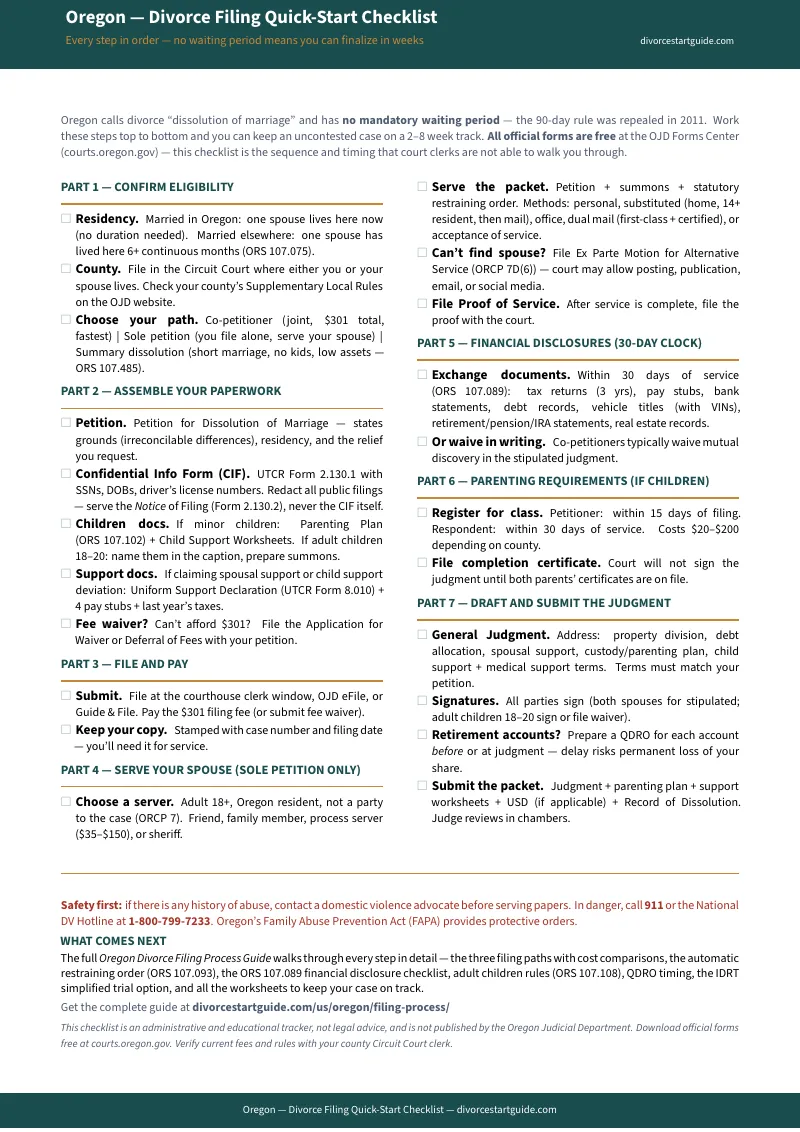
Co-petitioner (joint filing), sole petition, or summary dissolution — with the specific eligibility criteria that determine which track fits your situation. Filing jointly avoids service of process entirely and can finalize in 2–4 weeks. Filing alone gives you control of the timeline but adds ORCP 7 service requirements and a 30-day response window. Summary dissolution works for qualifying short marriages with limited assets. The guide maps all three paths with separate checklists for each.
Two-Track Residency Worksheet
Oregon's residency rule under ORS 107.075 depends on where your marriage was performed. Married in Oregon? One spouse just needs to be a resident — no waiting period. Married elsewhere? At least one spouse must have lived here continuously for six months before filing. The worksheet confirms eligibility before you pay the $301 filing fee, so you don't get your case dismissed on jurisdictional grounds.
ORS 107.089 Financial Disclosure Workbook
Both spouses must exchange tax returns, pay stubs, bank statements, retirement account records, real property documents, vehicle titles, and debt documentation — all within 30 days of service. Miss the deadline and you face court sanctions. The workbook organizes everything before the clock starts, and clarifies the distinction that trips up most pro se filers: supporting documents get exchanged between spouses, not filed with the court.
Service of Process Roadmap
Personal service by a qualified adult, substitute service (leaving documents with a household member aged 14+ and mailing a copy), Acceptance of Service, and the publication route for a missing spouse. Includes the strict ORCP 7D requirements — server must be 18+, an Oregon resident, and not a party to the case — plus the 63-day deadline to file Proof of Service and the 30-day response window that starts the moment your spouse is served.
Fee Waiver and Deferral Guide
The $301 filing fee is significant. Oregon offers both fee waivers (no payment required) and fee deferrals (payment plan). But most filers don't know the critical difference: unpaid deferred fees convert to a judgment after your case ends, with a 28% collection surcharge added on top. The guide covers every eligibility pathway and the paperwork required to apply correctly.
Court Clerk Rejection Audit
The top reasons Oregon court clerks reject filing packets — missing forms, unsigned documents, inconsistent terms between the initial petition and proposed judgment, missing child support worksheets, or incomplete Confidential Information Forms. A pre-submission review checklist catches these errors before they add weeks to your timeline.
Parenting Plan and Child Support Checklists
What's required when minor children are in the case — the mandatory parenting class, the proposed parenting plan, the child support computation worksheets, and the separate process for adult children ages 18–20 who must be named in the case caption and served individually.
IDRT Decision Framework
The Informal Domestic Relations Trial (UTCR 8.120) is a simpler, less expensive alternative to a full courtroom trial — no formal evidence rules, no cross-examination, and decided by a judge based on statements and documents. Both parties must consent in writing. The guide explains how it works, when it makes sense, and how to request one.
Who This Guide Is Built For
- Self-representing filers who want to handle their own dissolution without paying $3,500–$10,000 in attorney retainers or $130–$155 for a document preparation service that just types your information onto free court forms
- Couples filing jointly who agree on everything but need the exact sequence of forms, signatures, and deadlines to finalize in 2–4 weeks instead of 2–4 months
- Sole petitioners whose spouse won't cooperate, won't respond, or can't be found — and who need to navigate service, default, and judgment requirements correctly
- Parents with minor children who need to handle the parenting class requirement, proposed parenting plan, and child support worksheets without missing any mandatory steps
- Filers on a tight budget who qualify for fee waivers and need to understand the income thresholds, application process, and the collection risk of fee deferrals
Why Not Just Use the Free Court Portal?
You should absolutely use the free forms from the Oregon Judicial Department — this guide is designed to work alongside them.
But consider what the state portal doesn't provide:
- No filing sequence — forms are grouped by topic, not arranged in the order you actually need them
- No deadline tracking — the 30-day financial disclosure requirement and the 63-day service deadline aren't explained on most form pages, and missing either triggers serious consequences
- No path comparison — three filing paths exist but nothing walks you through which one applies to your situation, or how choosing the wrong one wastes your filing fee
- No default pathway support — if your spouse doesn't respond, the self-help materials assume both parties are cooperating
- No worksheet prep — the official forms ask for final decisions on property, debts, and parenting, but nothing helps you reach those decisions before you start filling in the blanks
The official forms give you the bricks. This guide gives you the blueprint for assembling them into a completed case — filed correctly the first time.
Satisfaction Guarantee
If the guide doesn't give you a clearer understanding of your filing path within 24 hours of download, email us for a full refund. No forms to fill out, no hoops.
— Less Than One Hour of an Attorney's Time
Oregon family law attorneys charge $250–$400 per hour. Online platforms like Hello Divorce start at $100 and run up to $4,000. Local document preparation services charge $130–$155 just to type your information onto the same free court forms. This guide gives you the complete filing sequence, financial disclosure workbook, service roadmap, and clerk rejection audit for a fraction of what you'd spend on a single consultation — and you can reference it every time you hit a procedural question.
The complete guide comes with 9 standalone printable worksheets — the residency worksheet, filing path decision tree, financial disclosure workbook, service of process roadmap, fee waiver guide, court clerk rejection audit, parenting requirements checklist, deadline timeline tracker, QDRO tracker, and post-judgment checklist. Print the ones you need and keep them on your desk as you move through each phase of the process.
The free checklist gives you the quick-start overview. When you're ready for the full filing instructions, financial disclosure workbook, service roadmap, and printable worksheets — the complete guide is here.